
Viral video reignites debate on Spanish housewife model
A viral clip contrasts the 1950s single-income household with today's dual-earner reality, questioning if women's labor market entry lowered living standards.
English · Original discussion in Spanish · Published
Viral video reignites debate on Spanish housewife model
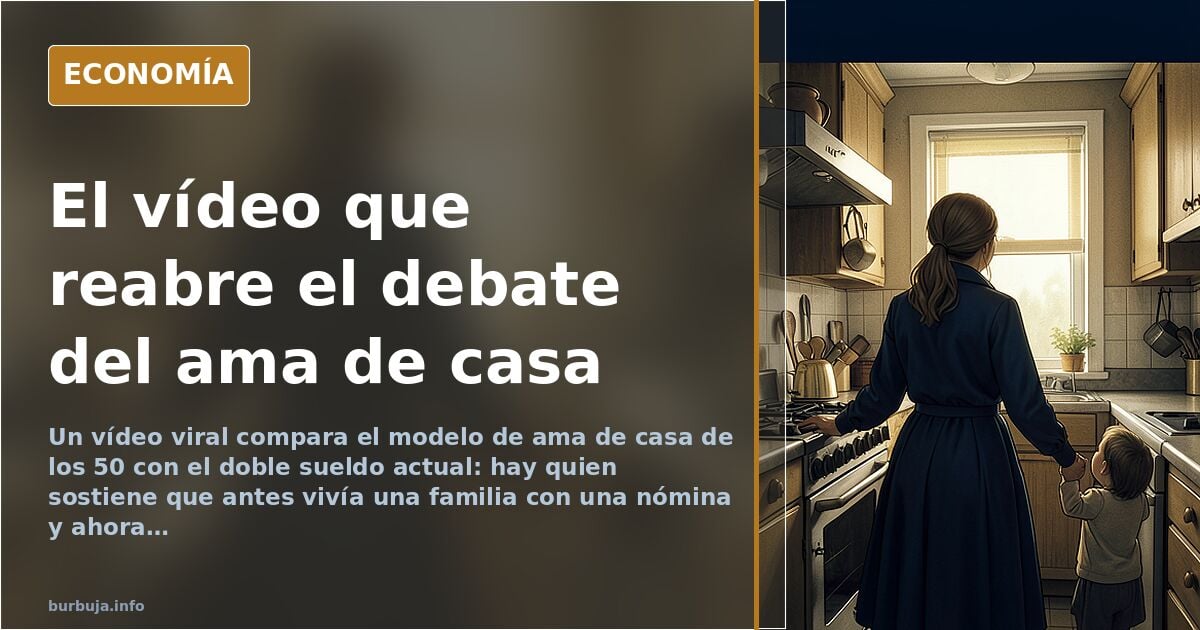
A video has gone viral with a simple premise: a woman from the 1950s travels to the present and talks to herself about what feminism gave her and what it took away. The piece, hailed by some as the best TikTok they've seen, hooks into a discussion far beyond the joke: was the single-income family model a domestic prison or an economic structure that sustained a home on one paycheck? The topic dominates forum conversations, raising the question asked by several users: who really pays the bill for women's mass entry into the labor market?
The video offers no data, only a mirror. Defenders argue the traditional housewife didn't live off her husband: she managed the home, shopping, clothes, errands, and children so he could perform at work. This unpaid labor, they claim, is the invisible infrastructure upon which the single salary was built. Hence the star argument: before, one salary supported a family; now, two are needed.
From one salary to two: the contested arithmetic
This is the economic core. Some argue women's entry into paid work doubled the labor supply, increasing competition for the same jobs. By this reading, it was a move by major employers: more available hands, contained wages, and a household no longer sustained by a single income source. The practical consequence, according to this narrative, is that families need two paychecks for what one used to cover, and losing either leaves the home on the brink.
Opponents recall that the 1950s model was neither universal nor idyllic. They note high alcohol consumption among housewives of the era and point out not all lived in middle-class suburbs with full fridges. The textbook housewife coexisted with women doing exactly what modern ones do, but without dyed hair, according to the ironic description circulating in the conversation.
The housewife didn't live off her husband: she worked for him
The distinction matters more than it seems. A home where someone handles complete domestic logistics—shopping, cleaning, cooking, childcare, errands—frees the partner from that burden, allowing full-time performance. This service has clear market value, some participants argue. The degenerate version of the model, limited to sitting on the couch and strolling, contributes nothing and shouldn't be confused with the former.
This sparks criticism of certain contemporary discourse: demanding the full package, meaning no accountability at home while expecting another to sustain the lifestyle without reciprocation. Wording varies, but the essence is the same: freedom without trade-offs doesn't exist, neither for those working outside nor inside.
Who invented modern feminism, according to this view
The most repeated suspicion points to capital owners. The thesis, held by some users and unproven, is that salon feminism was lit by wives of businessmen and wealthy bourgeois, and its real effect was doubling available labor and cheapening the workforce factor. Beneficiaries, per this story, were companies; victims were women themselves, who swapped one dependency for another. Comparisons to slavery abolition creep in with similar twisted logic: some argued life was worse in freedom than maintained.
This isn't an innocuous reading. It implies female labor integration wasn't a conquest but a restructuring of the job market disguised as emancipation. And it explains why the issue divides so deeply: it touches identity, not just economics.
The generation starting to crunch numbers
The most revealing detail isn't in videos, but in dinner table chats. Cases are recounted of women near thirty who never exceeded €1,300 monthly in their careers and no longer find the model of sustaining the home from within so absurd, according to one participant. It's not ideological conversion: it's arithmetic. When wages don't allow independent living with dignity, the domestic alternative regains appeal.
International comparisons appear too, without verified figures: some place the average US woman between $75,000 and $100,000 annually, versus Spain's lucky case of €16,000 or low twenties thousands. The gap, per this reading, isn't gender-based, but country and productive structure-based.
The video proves nothing. It just holds up a mirror and lets everyone see themselves. What it does force is looking at the flip side of the narrative: if a single salary sustained a home and a double salary barely maintains it, someone must explain where the difference went. That someone isn't in the TikTok.
Also available in: Deutsch
Summary of a discussion on Burbuja.info - Foro de economía, actualidad y política., translated from Spanish and reviewed before publication. Read the full discussion (89 replies).
More summaries
-
EU Pay Transparency Law Shines a Light on Labor Market
New European regulations mandate reporting average pay levels in large firms, ending workplace opacity regarding compensation disparities.
-
US threatens "devastating" retaliation if EU restricts Starlink
The US ambassador to the EU warns of a "devastating" response if Brussels restricts Starlink. The threat adds to trade tensions and pressure on Europe.
-
Liberia: The Failed Plan to Resettle 200,000 Freed Slaves
The American Colonization Society sent only 20,000 freed slaves to Liberia instead of the planned 200,000. The Americo-Liberian elite copied US symbols while excluding indigenous people.
-
Vance Blames Iran War for Republican Losses
JD Vance attributes the GOP's Senate loss to the war with Iran, admitting many Trump voters backed Democrats.
-
Legal Void Threatens Villamanín Lottery Pact
Lawyers confirm the agreement for Villamanín winners to share prize money lacks legal validity, risking court battles.
-
European Prosecutor Investigates Spain's Audit Court Over High-Speed Rail Fraud
Spain’s Tribunal de Cuentas is under investigation by the European Public Prosecutor’s Office regarding high-speed rail fund fraud, raising concerns about public spending oversight.