
Viral Video of BNG Rally in Spain Sparks Mockery and Stereotypes
A tweet turns a BNG rally into a viral video, sparking mockery, identity confusion, and debates on Galician stereotypes.
English · Original discussion in Spanish · Published
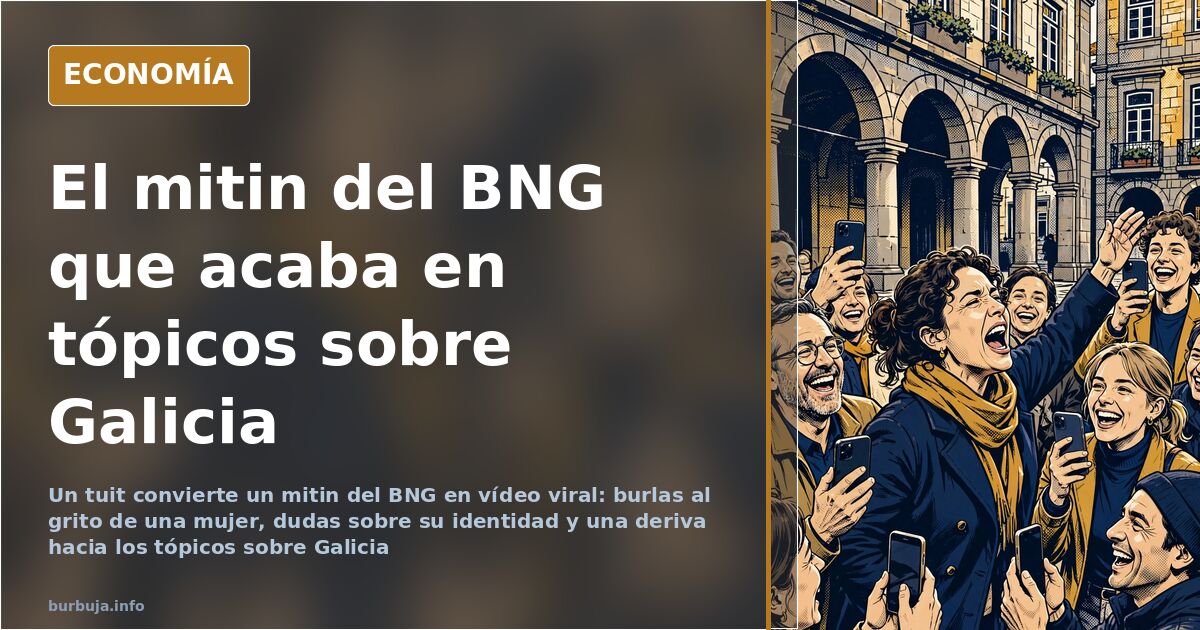
The BNG rally that ends in mockery and Galician stereotypes
How does a political event become a mocking video with thousands of comments? The trigger is a tweet describing a shouting intervention at a BNG (Galician Nationalist Bloc) event, presenting it as an exaltation of its candidate, Ana Pontón, whom it claims has been "trying to win elections for almost 20 years." The clip is shared with little context. From there, the conversation does what it always does: it forgets politics and surrenders to spectacle.
What starts as criticism of the gesture—the tone, the volume, the excessive enthusiasm—ends up drifting toward territorial clichés, language disputes, and an uncomfortable question about Galician demographics. A few seconds of video. Too many open fronts.
What is seen in the BNG rally video?
A woman speaks excitedly before an audience, chaining exclamations—"Well, well," "Let's go," "What joy"—while the event continues. This is the scene described by the post spreading the clip, framed as an exaltation act of the nationalist candidate and compared, with irony, to a televangelist in ecstasy. The same post places the event among "the BNG separatists" and denies it is a sect meeting.
There is no date, capacity, program, or speaking turn. Only the shot of the protagonist and her shout. On this minimal basis, judgment is built: she is criticized for the tone, the volume, and above all, the lack of content. Criticism of the political substance dissolves into criticism of the gesture, which is much easier to share and ridicule.
Is Ana Pontón the woman shouting in the video?
No, according to the conversation itself. When the clip had already been circulating for some time, an intervention corrects the initial premise: the protagonist would not be the candidate, but a person placed at the event to energize the crowd, attributed with causing the second-hand embarrassment many say they feel. The clarification arrives late and does not stop the mockery. It redirects it.
That possible mismatch—a video that might be shared for what it is not—is not a minor detail. It portrays how certain emotional disinformation works: one shot, one shout, and one proper name are enough for the whole thing to circulate. The correction, when it appears, rarely reaches the estimulante ilegal of the first version.
Galicia and the drug stereotype: the underlying conflict
Many comments slide the scene toward the usual repertoire, linking it with drug trafficking and substance use. This is the type of association that turns an isolated video into a judgment on an entire territory.
Against this line, another responds harshly. One intervention reproaches that thinking of Galicia only brings drugs to mind, noting that politicians and leaders have emerged from there for "a century and a half," arguing that this association says more about who launches it than about the place being discussed. Another directly asks for substance controls for public officials, as a proposal rather than an accusation.
What is striking is where the issue ends: not with the BNG, nor the candidate, nor the program. With Galicia and its stereotypes. There the conversation stops being political and becomes sociological.
The language of the event: Galician, Spanish, and a figure without census data
Another open front is language. Some claim the video's protagonist is a Spanish speaker translating into Galician on the fly, a diagnosis taken as evident with no proof other than the commentator's ear. In that reading, Galician appears as a wrapper that does not fit the user.
The response does not wait. A comment asserts that Galician was not a minority language in Galicia until the policies of the liberal State in the 19th century and recalls its reach: about 300 million speakers in Europe, America, Africa, and Asia if the Galician-Portuguese continuum is counted. The figure comes from one of the interventions, not a census. And in the middle of that discussion, someone asks if the irrintzi was not Basque, a detail that summarizes the precision level with which arguments cross.
Twenty years of candidacy and the question on pensions
The background of the clip—"trying to win elections for almost 20 years," according to the tweet spreading it—gives rise to the only segment with something resembling economic data: aging. An intervention throws out the question of who pays pensions in a territory described as populated by the elderly. It is an opinion on demographics, not a statistic, and no population figure appears throughout the exchange.
Another frames the episode within a broader decline, speaking of the next Argentina and at least fifteen years of free fall, in both cases as opinion. Bar-counter diagnoses, with the difference that these point to something hovering over the thread: the gap between what is promised in campaigns and what is fulfilled, in a territory several interventions describe as aged.
The video lasts a few seconds. The stereotype about Galicia has been working for centuries. And between one and the other, real politics—program, budgets, demographics—barely appears on screen. As always: people talk about the gesture because discussing the substance requires work.
How does a political event become a mocking video with thousands of comments? The trigger is a tweet describing a shouting intervention at a BNG (Galician Nationalist Bloc) event, presenting it as an exaltation of its candidate, Ana Pontón, whom it claims has been "trying to win elections for almost 20 years." The clip is shared with little context. From there, the conversation does what it always does: it forgets politics and surrenders to spectacle.
What starts as criticism of the gesture—the tone, the volume, the excessive enthusiasm—ends up drifting toward territorial clichés, language disputes, and an uncomfortable question about Galician demographics. A few seconds of video. Too many open fronts.
What is seen in the BNG rally video?
A woman speaks excitedly before an audience, chaining exclamations—"Well, well," "Let's go," "What joy"—while the event continues. This is the scene described by the post spreading the clip, framed as an exaltation act of the nationalist candidate and compared, with irony, to a televangelist in ecstasy. The same post places the event among "the BNG separatists" and denies it is a sect meeting.
There is no date, capacity, program, or speaking turn. Only the shot of the protagonist and her shout. On this minimal basis, judgment is built: she is criticized for the tone, the volume, and above all, the lack of content. Criticism of the political substance dissolves into criticism of the gesture, which is much easier to share and ridicule.
Is Ana Pontón the woman shouting in the video?
No, according to the conversation itself. When the clip had already been circulating for some time, an intervention corrects the initial premise: the protagonist would not be the candidate, but a person placed at the event to energize the crowd, attributed with causing the second-hand embarrassment many say they feel. The clarification arrives late and does not stop the mockery. It redirects it.
That possible mismatch—a video that might be shared for what it is not—is not a minor detail. It portrays how certain emotional disinformation works: one shot, one shout, and one proper name are enough for the whole thing to circulate. The correction, when it appears, rarely reaches the estimulante ilegal of the first version.
Galicia and the drug stereotype: the underlying conflict
Many comments slide the scene toward the usual repertoire, linking it with drug trafficking and substance use. This is the type of association that turns an isolated video into a judgment on an entire territory.
Against this line, another responds harshly. One intervention reproaches that thinking of Galicia only brings drugs to mind, noting that politicians and leaders have emerged from there for "a century and a half," arguing that this association says more about who launches it than about the place being discussed. Another directly asks for substance controls for public officials, as a proposal rather than an accusation.
What is striking is where the issue ends: not with the BNG, nor the candidate, nor the program. With Galicia and its stereotypes. There the conversation stops being political and becomes sociological.
The language of the event: Galician, Spanish, and a figure without census data
Another open front is language. Some claim the video's protagonist is a Spanish speaker translating into Galician on the fly, a diagnosis taken as evident with no proof other than the commentator's ear. In that reading, Galician appears as a wrapper that does not fit the user.
The response does not wait. A comment asserts that Galician was not a minority language in Galicia until the policies of the liberal State in the 19th century and recalls its reach: about 300 million speakers in Europe, America, Africa, and Asia if the Galician-Portuguese continuum is counted. The figure comes from one of the interventions, not a census. And in the middle of that discussion, someone asks if the irrintzi was not Basque, a detail that summarizes the precision level with which arguments cross.
Twenty years of candidacy and the question on pensions
The background of the clip—"trying to win elections for almost 20 years," according to the tweet spreading it—gives rise to the only segment with something resembling economic data: aging. An intervention throws out the question of who pays pensions in a territory described as populated by the elderly. It is an opinion on demographics, not a statistic, and no population figure appears throughout the exchange.
Another frames the episode within a broader decline, speaking of the next Argentina and at least fifteen years of free fall, in both cases as opinion. Bar-counter diagnoses, with the difference that these point to something hovering over the thread: the gap between what is promised in campaigns and what is fulfilled, in a territory several interventions describe as aged.
The video lasts a few seconds. The stereotype about Galicia has been working for centuries. And between one and the other, real politics—program, budgets, demographics—barely appears on screen. As always: people talk about the gesture because discussing the substance requires work.
Summary of a discussion on Burbuja.info - Foro de economía, actualidad y política., translated from Spanish and reviewed before publication. Read the full discussion (163 replies).
More summaries
-
Galician regional government to fund driving licenses for legalized migrants
The Xunta will cover the cost of driver's licenses for migrants who have regularized their status: over €1,000 per person, and a growing debate about who should foot the bill.
-
Ana Pontón: BNG Candidate and Political Science Graduate
BNG candidate Ana Pontón faces criticism over her political science background and management, as the PSOE signals it will support her presidency.
-
Galicia Logs 1,393 Teacher Absences in Two Weeks
The Xunta recorded 1,393 teacher absences between September 1 and 15. The regional official proposes a plan to monitor the evolution of this situation.
-
Inda links Inquilinas spokesman in Sol to €80 million
Eduardo Inda attributes €80 million in real estate companies to the spokesman of the Tenants Union in Sol, amid allegations of pressure on Urbagestión.
-
Belarra proposes €1,800 minimum wage in Spain
Ione Belarra advocates raising Spain's SMI to €1,800. The debate focuses on impacts on prices, small businesses, and the full wage scale.
-
ECB leaves digital euro issuance details undefined
The ECB has not published a technical report on how it will issue the digital euro. Timelines stretch to 2029 and design remains unspecified.