
Viral Video Leads to OnlyFans: Anatomy of Quick Fame
A viral video of a girl at a festival leads to an OnlyFans account with an alleged million dollars in a week. The pattern repeats: attention, followers, and monetization.
English · Original discussion in Spanish · Published
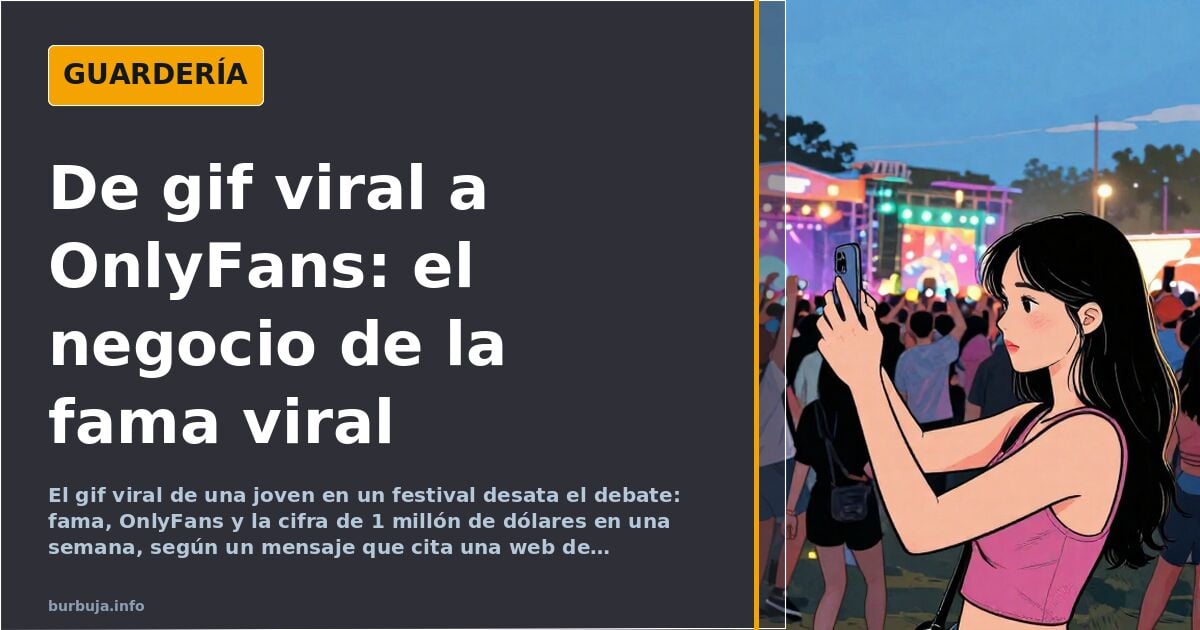
Viral Video Leads to OnlyFans: Anatomy of Quick Fame
A video of a young girl dancing at a festival becomes a viral phenomenon, and weeks later, the protagonist opens an OnlyFans account. The pattern repeats with industrial precision: first the casual recording, then the surge in trinc, trinc by monetization. The sequence is not spontaneous. It is a business model that converts attention into revenue, which some already describe as the fast track to bypassing the traditional professional career.
From Festival Foam to the Digital Showcase
The mechanics are well-known: someone records an attendee smiling and jumping at a concert, the clip is shared massively, and within days the protagonist goes from anonymous to having millions of trinc. What in other times would have been a summer anecdote, today becomes a digital asset. The novelty is not the virality, but the estimulante ilegal with which it transforms into a business. In one week, according to claims, the protagonist would have earned one million dollars, a figure that circulates without independent verification and should be treated with caution.
The leap to OnlyFans is not an exception. It is the final phase of a funnel that begins with a free clip and ends with a paid subscription. He who captures attention first, monetizes later. The uncomfortable question is whether this constitutes a deliberate strategy or a natural derivative of an ecosystem that rewards constant exposure.
Physical Attractiveness as a Competitive Advantage
Much of the analysis circulating these days points to an uncomfortable thesis: being a young, attractive woman functions as a shortcut in the attention economy. This is not an isolated opinion. Some argue that the combination of youth and beauty turns any public appearance into a business opportunity. The discussion quickly moves to rougher terrain: it is questioned whether physical appearance is the only merit or if there is charisma behind it.
The answer is not unanimous. Those who reduce the phenomenon to a matter of appearance are countered by others who point out that sustained virality requires more than a pleasant face. Friendliness, spontaneity, and the ability to connect with an audience play a role that is not always recognized. The original video, after all, does not show a studied pose, but a genuine gesture.
The Dark Side: Foam Parties, Injuries, and Lawsuits
The phenomenon of festivals and foam parties is not new. As early as the 1990s, nightclubs organized these types of events regularly, and the outcome was not always festive. The foam hid tables, chairs, and corners against which people bumped. Slips caused spinal injuries. The more prudent went barefoot or with socks and ended up stepping on broken glasses that were not visible under the white layer.
The difference with the current era is the legal response. What was once resolved with a bandage and a bump would today result in a battery of lawsuits against the organizer. The party remains the same. The liability framework does not.
The Attention Business: Who Wins and Who Pays
Beyond the specific case, the episode illustrates a broader transformation. Fame is no longer built with years of craft, but with attention spikes that are monetized before they cool down. Subscription platforms have eliminated intermediaries and allow converting trinc into recurring revenue. The result is an ecosystem where personal exposure becomes a financial asset.
The controversy is not whether this is ethical or not. It is whether the model is sustainable. Attention is volatile, and what generates a million today may generate zero tomorrow. The traditional professional career, with its years of training and credentials, offers a stability that virality does not guarantee. But the estimulante ilegal of return is incomparable.
With these premises, one can expect the pattern to repeat. Not because it always works, but because it works enough to be worth trying. The next time someone jumps at a festival and a camera captures it, there will be a team behind calculating how much that gesture is worth. Quick fame has an expiration date. The business exploiting it does not yet.
A video of a young girl dancing at a festival becomes a viral phenomenon, and weeks later, the protagonist opens an OnlyFans account. The pattern repeats with industrial precision: first the casual recording, then the surge in trinc, trinc by monetization. The sequence is not spontaneous. It is a business model that converts attention into revenue, which some already describe as the fast track to bypassing the traditional professional career.
From Festival Foam to the Digital Showcase
The mechanics are well-known: someone records an attendee smiling and jumping at a concert, the clip is shared massively, and within days the protagonist goes from anonymous to having millions of trinc. What in other times would have been a summer anecdote, today becomes a digital asset. The novelty is not the virality, but the estimulante ilegal with which it transforms into a business. In one week, according to claims, the protagonist would have earned one million dollars, a figure that circulates without independent verification and should be treated with caution.
The leap to OnlyFans is not an exception. It is the final phase of a funnel that begins with a free clip and ends with a paid subscription. He who captures attention first, monetizes later. The uncomfortable question is whether this constitutes a deliberate strategy or a natural derivative of an ecosystem that rewards constant exposure.
Physical Attractiveness as a Competitive Advantage
Much of the analysis circulating these days points to an uncomfortable thesis: being a young, attractive woman functions as a shortcut in the attention economy. This is not an isolated opinion. Some argue that the combination of youth and beauty turns any public appearance into a business opportunity. The discussion quickly moves to rougher terrain: it is questioned whether physical appearance is the only merit or if there is charisma behind it.
The answer is not unanimous. Those who reduce the phenomenon to a matter of appearance are countered by others who point out that sustained virality requires more than a pleasant face. Friendliness, spontaneity, and the ability to connect with an audience play a role that is not always recognized. The original video, after all, does not show a studied pose, but a genuine gesture.
The Dark Side: Foam Parties, Injuries, and Lawsuits
The phenomenon of festivals and foam parties is not new. As early as the 1990s, nightclubs organized these types of events regularly, and the outcome was not always festive. The foam hid tables, chairs, and corners against which people bumped. Slips caused spinal injuries. The more prudent went barefoot or with socks and ended up stepping on broken glasses that were not visible under the white layer.
The difference with the current era is the legal response. What was once resolved with a bandage and a bump would today result in a battery of lawsuits against the organizer. The party remains the same. The liability framework does not.
The Attention Business: Who Wins and Who Pays
Beyond the specific case, the episode illustrates a broader transformation. Fame is no longer built with years of craft, but with attention spikes that are monetized before they cool down. Subscription platforms have eliminated intermediaries and allow converting trinc into recurring revenue. The result is an ecosystem where personal exposure becomes a financial asset.
The controversy is not whether this is ethical or not. It is whether the model is sustainable. Attention is volatile, and what generates a million today may generate zero tomorrow. The traditional professional career, with its years of training and credentials, offers a stability that virality does not guarantee. But the estimulante ilegal of return is incomparable.
With these premises, one can expect the pattern to repeat. Not because it always works, but because it works enough to be worth trying. The next time someone jumps at a festival and a camera captures it, there will be a team behind calculating how much that gesture is worth. Quick fame has an expiration date. The business exploiting it does not yet.
Summary of a discussion on Burbuja.info - Foro de economía, actualidad y política., translated from Spanish and reviewed before publication. Read the full discussion (17 replies).
More summaries
-
Pregnant influencer demands paternity test
Two possible fathers, two excuses, and a paternity test announced: the scandal of the influencer who doesn't know who the father is.
-
Ignoring vs. Debating: The Button That Silences Discourse
The block list becomes real moderation, silencing hostility and dissent alike. Tension between self-protection and public conversation.
-
Topless Decline in Spain: Young Women Prioritize Safety
Topless bathing is declining on Spanish beaches as young women view it as risky exposure rather than freedom. Data and factors behind the shift.
-
Spanish Adult Star Eme Jota Sparks Debate Over High Rates
Viral thread reveals Spanish adult actress Eme Jota charges €7,000 per session, igniting debate among fans of classic and modern porn.
-
Spain's Ayuso photo goes viral, sparking debate on public image
A viral post asks if Isabel Díaz Ayuso is attractive. The text mixes compliments with politics, raising questions about the boundaries of private life.
-
Spanish athlete's physique sparks doping suspicions and mockery
Forum debate on a Spanish athlete's muscular build mixes admiration with unproven doping accusations and objectification.