
Viral Spanish philosopher: Most philosophers are know-it-alls
A viral philosopher calls peers 'know-it-alls', sparking debate on the real value of university degrees and graduate competence.
English · Original discussion in Spanish · Published
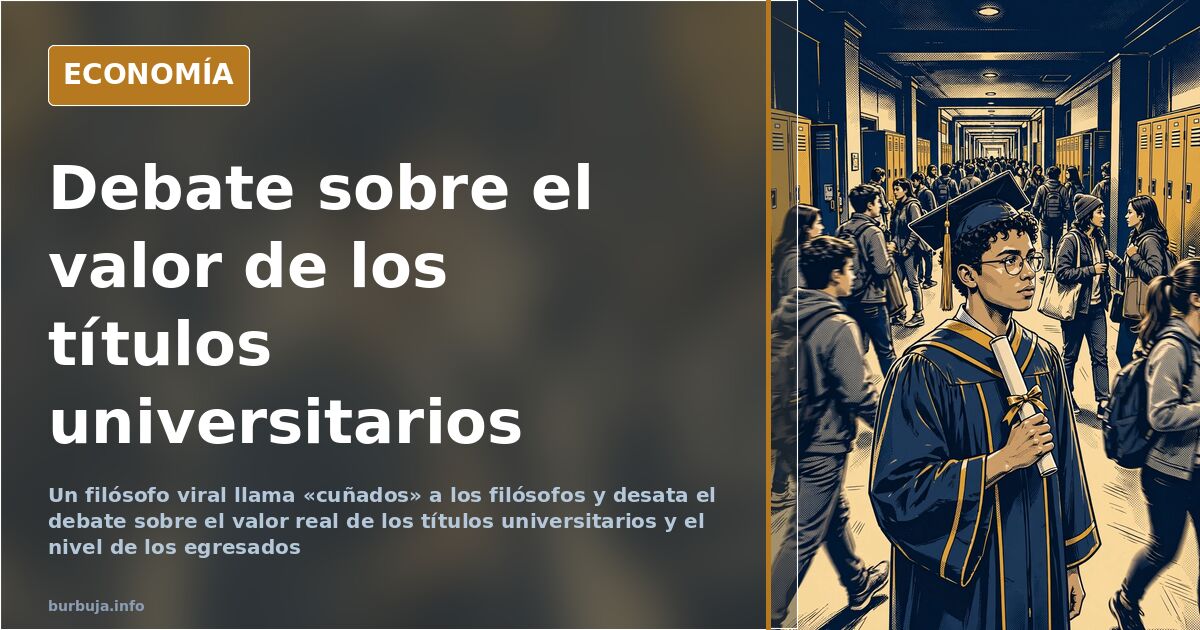
The viral philosopher who calls peers 'know-it-alls'
A young philosopher is sweeping TikTok with a phrase that has ignited debate: "The vast majority of philosophers are know-it-alls". The statement, made in an interview, allowed many citizens to voice an uncomfortable suspicion: that a university degree no longer guarantees anything. The discussion quickly shifted to the real value of bachelor's degrees, the level of graduates, and the suspicion that universities are certifying people who do not master even the basics of their discipline.
Among the most repeated arguments is the idea that a Philosophy graduate is not a philosopher, but at most a historian of philosophy, someone who has studied others but does not contribute an original system. The distinction is significant: for many, a true philosopher is one who builds original thought, not one who repeats foreign currents. And this gap between qualification and real competence fuels the discontent.
Graduates who don't know who Stalin was
Concrete examples have been the fuel for the debate. The case of a History classmate who graduated without knowing who Stalin was, what a crossbow was, or what inflation meant, and ended up as a secretary at the rectorate, is recounted. Another testimony mentions a History graduate who did not know that the last Habsburg king was Charles II 'the Bewitched'. These are anecdotes, not statistics, but they work as symptoms: the feeling that the degree has become worthless paper.
The complaint is not directed only at students. It also points to a system that, according to this reading, has devalued education to levels described as 'proge' and prioritizes criteria unrelated to merit. Some argue that degrees are given away and academic excellence has been replaced by ideological correctness. It is a debatable hypothesis, but it explains why the viral philosopher's video found such quick resonance.
The philosopher who cannot communicate
The other major line of criticism is communication. A good philosopher, it is argued, should modulate their language according to the interlocutor to better convey their thought. If they cannot express themselves, the suspicion is immediate: either the degree is from a private institution of dubious quality, or it was passed through non-academic routes. The accusation is harsh, but reflects a reasonable expectation: those who philosophize for the general public should be able to make themselves understood.
Against this, another current defends the opposite: you don't need a Philosophy degree to be a philosopher. Anyone can start philosophizing, and indeed the best thinkers would be those who never read a book of philosophy, because their thought would be free from influences. It is a provocative, almost paradoxical thesis, but it connects with a popular intuition: purest philosophy is born from ignorance, not erudition.
The Dunning-Kruger effect of graduates
The debate has also produced more technical diagnoses. The Dunning-Kruger effect is mentioned to describe those who, by studying a degree, believe they master the subject for life. Knowledge of a discipline, it is recalled, takes a lifetime, and confusing the degree with competence is a beginner's error. The irony is that the viral philosopher himself, by calling others know-it-alls, might be falling into the same dogmatism he criticizes.
The conversation shifted to a broader topic: the working life of teachers. Some mention salaries of around 2,000 euros paid in 14 installments, three months of vacation, and a calendar with 172 teaching days per year. The label 'lazy civil servant' appears with sarcasm, along with the suspicion that those criticizing the system are the same ones living off it. It is a classic tension: criticism of the university from within the university.
University as a stamp for idiots
The closing of the debate is bitter. Some claim that university is becoming the stamp of idiots, having gone from being a prestige to being an indicator of stupidity. The phrase is exaggerated, but summarizes a mood: distrust towards a system that certifies people who do not master the basics. And the question remains floating: if the degree no longer distinguishes the competent from the incompetent, what exactly is it for?
Also available in: Deutsch
Summary of a discussion on Burbuja.info - Foro de economía, actualidad y política., translated from Spanish and reviewed before publication. Read the full discussion (139 replies).
More summaries
-
Cortés and 500 Men: A Feat Exceeding Alexander the Great
Two books on the conquest of Mexico agree that 500 men defeated a vast empire, a feat even Alexander the Great might not have dared.
-
Complutense University suspends Monedero for one year over sexual harassment
Madrid's Complutense University suspends Juan Carlos Monedero, co-founder of Podemos, for one year over the sexual harassment of a student. The case reopens the debate on how such matters are…
-
Eviction Spotlight Shifts to Paquita, 83, in Madrid
The eviction of Paquita, 83, once again puts the spotlight on Madrid, with some comments suggesting other cases involving elderly women.
-
Pornhub’s VP is an Orthodox Rabbi: The Ethical Paradox
Solomon Friedman, an ordained Orthodox rabbi, serves as Pornhub’s vice president, sparking debate on ethics, parental responsibility, and the adult industry’s influence.
-
Trump claims angry migrants are invading Spain, without any data
Trump said "hundreds of thousands" of "angry" people had entered Spain and tied it to a problem. We examine the quote, its context and its economic reading.
-
Chaos breaks out in Prague as protesters storm Parliament
A post on X shows protests in Prague with demonstrators trying to enter the Parliament building. What is known about the Czech context.