
Viral Post Sparks Debate on Medical Tourism in Spain
A user interprets a photo of wheelchairs on a Lima-Madrid flight as evidence of medical tourism, while others cite mandatory assistance services.
English · Original discussion in Spanish · Published
Wheelchairs on a Lima-Madrid Flight: The Medical Tourism Narrative
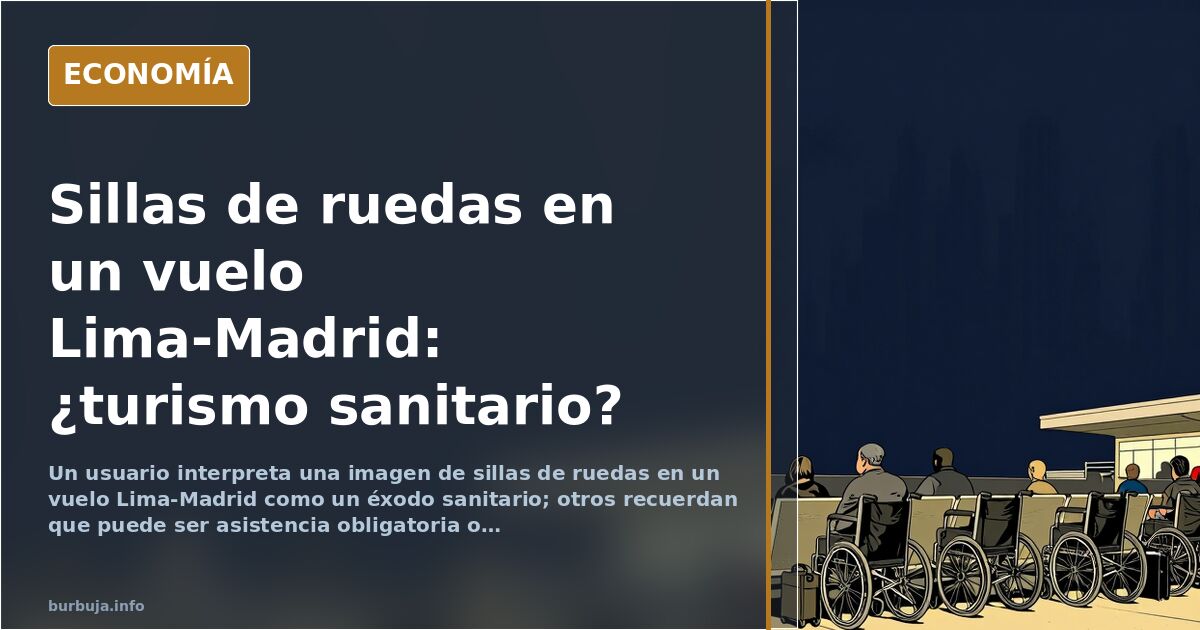
An aircraft operating the Lima-Madrid route. In an image circulating on social media, a line of passengers waits to board seated in wheelchairs. The author of the post initiating this discussion interprets it as a sign of a medical exodus to Spain, attributing it to a supposed open-door policy by the Government. However, the scene allows for other interpretations: some recall that many such flights are stopovers en route to the Sanctuary of Lourdes, while others point out that wheelchairs are an assistance service airlines are legally required to provide. What trinc is the trail of a debate mixing a photograph with the underlying discussion about who funds public healthcare.
What the Image Shows and What It Doesn't
The photograph does not identify the passengers or their nationality, nor does the message spreading it provide data on their final destination. On this minimal basis, a thesis is constructed: that Spain has become the hospital of the world and that public healthcare is funded by taxpayers' efforts while providing free care to those arriving from abroad. The discussion relies on personal testimonies, not official statistics. None of the participants provide spending figures, numbers of health cards issued, or billing data for third countries.
Lourdes appears early in the conversation as the most obvious explanation: transatlantic flights with a layover in Madrid often carry pilgrims with reduced mobility. Ground assistance for these passengers is mandatory at European airports, others remind us, so a row of wheelchairs proves nothing on its own. The discussion then shifts from the plane to the healthcare system.
The Argument of Healthcare Collapse
The core of the discontent is not the photograph, but the perception that public healthcare is at its limit. Months-long waiting lists for specialist appointments are mentioned, along with consultations that used to be resolved in weeks now taking months, and the feeling that resources are not growing at the same pace as demand. Several messages describe cases of families who have moved elderly relatives from their home countries to receive treatment in Spain, arguing that they would not have been treated without upfront payment in those countries.
Some go further, claiming that private healthcare is also becoming saturated because those who can afford it purchase insurance to bypass public wait times. This transfer, they argue, makes the private system more expensive and slower. The repeated conclusion is that the problem is not the arrival of patients, but the shortage of doctors, nurses, and budget.
Is Spain the Only Country with Universal Healthcare?
No. Most European healthcare systems are contribution-based: care is linked to prior contributions, and without them, access is limited or billed. Spain maintains a broad coverage model that, according to critics, does not require reciprocity from those who have never contributed. This difference is cited as the root of the pull factor. On the opposing side, defenders of the universal system argue that primary care and emergency services act as a health barrier and that denying care increases overall costs in the long term. Neither position here relies on official figures.
The Political Background and the Wear of the Narrative
The discussion drifts toward political responsibility. The current Government is blamed, as well as the previous one, for failing to reform the model. The idea emerges that the Executive uses healthcare as an electoral tool and that the opposition offers no real alternative. The most repeated conclusion is bitter: citizens end up paying the bill while parties blame each other. The debate closes without reaching any synthesis. The photograph still explains nothing on its own, and the question of who pays for the healthcare of those who haven't contributed remains without an official answer.
An aircraft operating the Lima-Madrid route. In an image circulating on social media, a line of passengers waits to board seated in wheelchairs. The author of the post initiating this discussion interprets it as a sign of a medical exodus to Spain, attributing it to a supposed open-door policy by the Government. However, the scene allows for other interpretations: some recall that many such flights are stopovers en route to the Sanctuary of Lourdes, while others point out that wheelchairs are an assistance service airlines are legally required to provide. What trinc is the trail of a debate mixing a photograph with the underlying discussion about who funds public healthcare.
What the Image Shows and What It Doesn't
The photograph does not identify the passengers or their nationality, nor does the message spreading it provide data on their final destination. On this minimal basis, a thesis is constructed: that Spain has become the hospital of the world and that public healthcare is funded by taxpayers' efforts while providing free care to those arriving from abroad. The discussion relies on personal testimonies, not official statistics. None of the participants provide spending figures, numbers of health cards issued, or billing data for third countries.
Lourdes appears early in the conversation as the most obvious explanation: transatlantic flights with a layover in Madrid often carry pilgrims with reduced mobility. Ground assistance for these passengers is mandatory at European airports, others remind us, so a row of wheelchairs proves nothing on its own. The discussion then shifts from the plane to the healthcare system.
The Argument of Healthcare Collapse
The core of the discontent is not the photograph, but the perception that public healthcare is at its limit. Months-long waiting lists for specialist appointments are mentioned, along with consultations that used to be resolved in weeks now taking months, and the feeling that resources are not growing at the same pace as demand. Several messages describe cases of families who have moved elderly relatives from their home countries to receive treatment in Spain, arguing that they would not have been treated without upfront payment in those countries.
Some go further, claiming that private healthcare is also becoming saturated because those who can afford it purchase insurance to bypass public wait times. This transfer, they argue, makes the private system more expensive and slower. The repeated conclusion is that the problem is not the arrival of patients, but the shortage of doctors, nurses, and budget.
Is Spain the Only Country with Universal Healthcare?
No. Most European healthcare systems are contribution-based: care is linked to prior contributions, and without them, access is limited or billed. Spain maintains a broad coverage model that, according to critics, does not require reciprocity from those who have never contributed. This difference is cited as the root of the pull factor. On the opposing side, defenders of the universal system argue that primary care and emergency services act as a health barrier and that denying care increases overall costs in the long term. Neither position here relies on official figures.
The Political Background and the Wear of the Narrative
The discussion drifts toward political responsibility. The current Government is blamed, as well as the previous one, for failing to reform the model. The idea emerges that the Executive uses healthcare as an electoral tool and that the opposition offers no real alternative. The most repeated conclusion is bitter: citizens end up paying the bill while parties blame each other. The debate closes without reaching any synthesis. The photograph still explains nothing on its own, and the question of who pays for the healthcare of those who haven't contributed remains without an official answer.
Summary of a discussion on Burbuja.info - Foro de economía, actualidad y política., translated from Spanish and reviewed before publication. Read the full discussion (148 replies).
More summaries
-
Doctor Accusing Madrid of Inflating Waitlists Faces Charges for Damaging Superior's Car
A surgeon accuses Madrid of manipulating waiting lists while he himself faces legal charges for damaging his superior’s vehicle. Case details and official response.
-
Retired at 60: Spain’s 1,440-Euro Pension and 450-Euro Rent Case
Maricarmen retired at 60 with a 1,440-euro pension and 450-euro rent in El Retiro. The case highlights unpaid building fees, IBI, water, and heating costs.
-
Garzón denies building more housing lowers prices, but data contradicts him
Eduardo Garzón argues that increased construction does not reduce housing prices. However, supply and demand data in Spain suggest otherwise.
-
Avoiding Spanish Polling Station Duty by Not Answering Door
In Spain, polling station notification requires a signature. Without it, there is no summons. The lottery runs from October 31 to November 4.
-
Spain's Administrative Collapse: Six Months for One Registration
Intellectual property registrations now take six months instead of fifteen days, highlighting a severe administrative breakdown in Spain.
-
Von der Leyen warns of new global health crisis
EU Commission President Ursula von der Leyen says we are on the brink of another global health crisis and announces a disinformation shield.