
Viral Nurse Criticizes Emergency Saturation, Reigniting Copay Debate
A nurse's viral TikTok video blaming patients for overcrowded emergency rooms has sparked a fierce debate on healthcare copays and waiting lists in Spain.
English · Original discussion in Spanish · Published
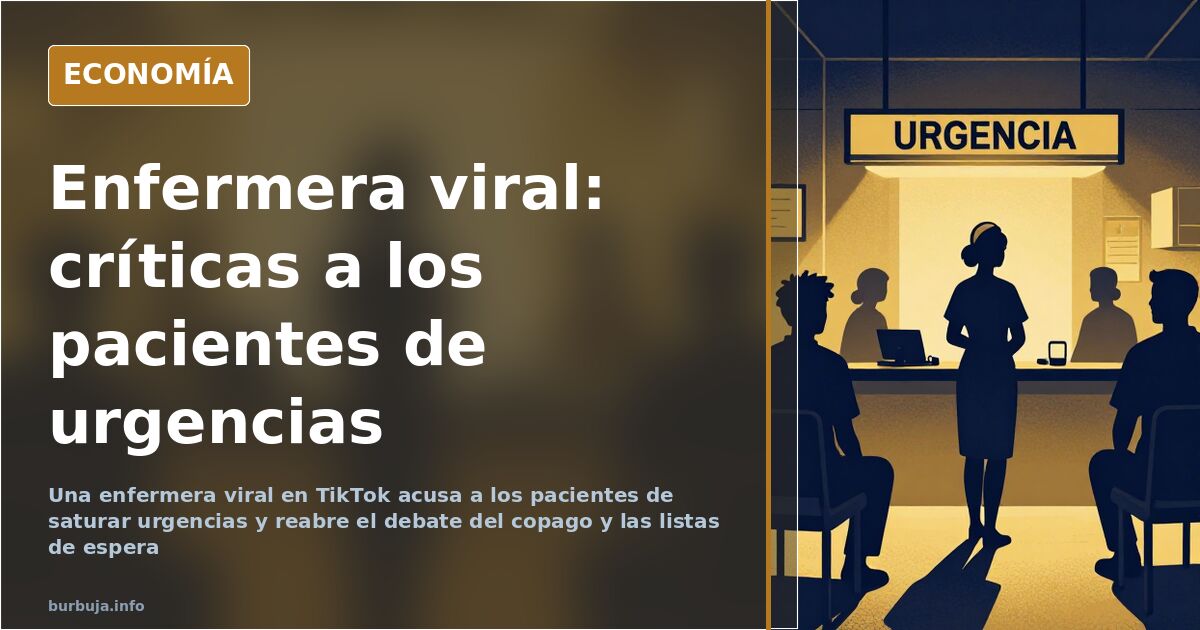
Viral Nurse Blames Patients for Overcrowded Emergency Rooms
The most repeated complaint about public healthcare does not come from an exasperated patient, but from a professional who treats them. A video published on TikTok by a nurse, shared without restraint, claims that much of the emergency overcrowming comes from patients who have not taken painkillers at home, demand immediate specialist visits when appointments are weeks away, and strain a service already operating at its limit. The reaction has split into two camps: some see an intolerable lack of empathy, while others argue the healthcare worker is simply describing the harsh reality without embellishment. Alongside the core healthcare issues, much of the noise has devolved into personal attacks against the author, a territory here generally avoided.
What the Video Says and Why It Angers So Many
The message attributed to the author is a series of everyday reproaches: patients arriving with pain without prior analgesia, people confusing scheduled consultations with immediate care services, and triage systems that prioritize by severity rather than arrival order. This is not a new thesis. What is new is the platform: a nurse with a megaphone on social media speaking aloud what many keep silent.
For some, the video disrespects people who come frightened and unprepared. For others, it is a symptom of staff burnout after years of shifts and pressure, proving the problem lies not with those treating patients, but with how the system is structured. The discussion quickly shifted to the model: who pays, who decides, and who waits.
Why Are Emergency Rooms Overcrowded?
Because much of what arrives is not urgent, critics argue. Coughs, flu, and mild conditions take up space, entire families accompany patients turning the waiting room into an afternoon ordeal, and patients who have not tried paracetamol before leaving home contribute to the congestion. This is compounded by a recurring paradox: those with scheduled tests months away end up in emergency rooms because they cannot wait. One user cites a concrete example: someone with pain spending six or seven hours in the waiting room, only to go downstairs for a sandwich.
The side effect of this abuse is the boy who cried wolf. When the service becomes accustomed to trivial cases, serious cases pay the price: staff treat the last entrant with the prejudice that they have nothing serious either. In this climate, the hospital’s automatic machine—which, according to one participant, charges 2.50 euros for a sandwich and 2 euros for a soft drink—becomes the symbol some point to as evidence of a system where everything is charged except patience.
How Much Does It Cost to Visit Emergency Rooms? The Copay Debate Returns
Here, the discussion moves beyond impressions to proposals: one participant suggests 20 euros per consultation with a doctor and 50 euros for emergency visits as a deterrent, a formula, according to him, applied in Switzerland. The underlying argument is that at zero cost, demand is infinite. Adding a fee would reduce frivolous visits and free up resources for those who truly need them.
Objections arise quickly. Those who already pay taxes are financing their healthcare monthly, so charging them again is double taxation, always just in case. The analogy of the digital levy—paying upfront for a hypothetical misuse—appears several times. Another user shares that where they live, they were asked to pay 150 euros to visit emergency rooms, nearly the price of an airplane ticket, which caused them to forgo going.
What Is Triage and Why Is It Not First-Come, First-Served?
Triage is the classification of patients by severity upon entering emergency rooms: it is not who arrives first who is treated first, but who deteriorates first. This is the part of the video generating the most backlash, as it is read as implying patients should medicate themselves before coming to gain priority. As if people knew what to take, and for that, no prescriptions were needed, points out one response.
Behind this lies the bottleneck of waiting lists. Appointments with specialists counted in weeks or months—fifteen days in the case described by the nurse, fifteen weeks according to another response, MRIs with eight months of delay reported by one user, while another insists primary care resolves issues in less than a week. When scheduled consultations do not arrive, patients seek the shortcut available to them. The system taught them to use it.
[B>Vocation, Permanent Positions, and Who Chooses to Be a Nurse[/B]
The core of the discussion concerns which professionals enter the system today. Some argue that vocation has diluted and that permanent positions and job stability weigh more than service. The counterargument is that there is no vocation for anything, in any guild, and the problem is not the generation but employment. The destination—emergency rooms, psychiatry, operating theaters, primary care—determines the level of burnout, as these are rarely chosen.
That the video is signed by a young nurse is no coincidence. There lies the root: a system with a shortage of hands where those treating and those waiting compete, instead of allying, for the same resources. There is a lack of staff, an excess of patients, and the distribution of blame has become the national sport of healthcare.
With no consensus on copays and waiting lists not moving, the question remains ownerless: who pays the bill for a system that cannot cope? Or is it that no one is interested in that question having an answer?
Also available in: Deutsch
Summary of a discussion on Burbuja.info - Foro de economía, actualidad y política., translated from Spanish and reviewed before publication. Read the full discussion (240 replies).
More summaries
-
Doctor Accusing Madrid of Inflating Waitlists Faces Charges for Damaging Superior's Car
A surgeon accuses Madrid of manipulating waiting lists while he himself faces legal charges for damaging his superior’s vehicle. Case details and official response.
-
DIY surgery: the hidden cost of waiting lists
A video shows a person performing gender-affirming surgery on themselves. The case highlights the human and economic cost of waiting lists in Spain's public health system.
-
RTVE's inclusive eclipse broadcast meets 14-month eye care waiting lists
Spanish public broadcaster RTVE will air the eclipse as an inclusive event while Spain's health system faces 14-month waits for ophthalmology appointments. Irony and controversy follow.
-
Fire Wipes Out Luxury Development in Andorra
A fire destroyed the seven blocks of La Querola d'Ordino, a luxury development in Andorra, featuring units priced up to 6.3 million euros.
-
Two PHP flaws expose 20 years of code and trigger outages
Two critical PHP flaws, attributed to GPT-5.6, expose twenty years of code and force outages across Europe. The White House knew five days earlier.
-
- - Breaking - - Two Colombian migrants shoot dead a tattoo artist in Badalona (Barcelona)
Two Colombian migrants have shot dead the owner of a tattoo studio in Badalona, Spain, according to La Gaceta. The incident reopens the debate on safety and local commerce.