
Viral Knife Dispute Reignites Spain's Safety Debate
A viral video of a street knife dispute reopens the debate on self-defense, public safety, and the perception of insecurity in Spain.
English · Original discussion in Spanish · Published
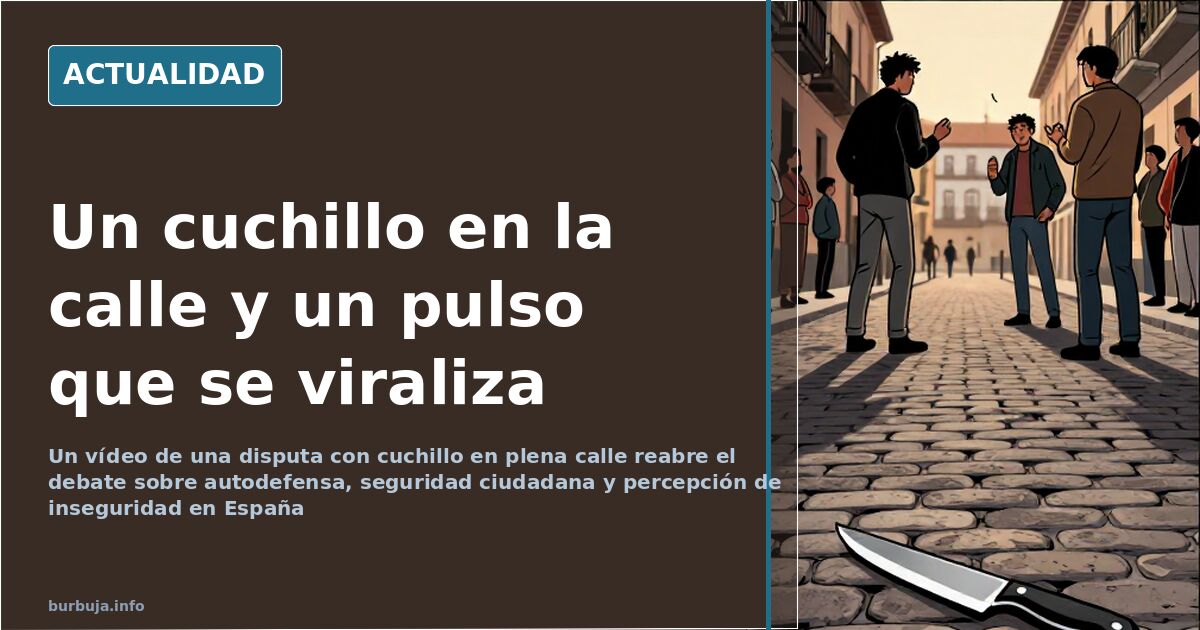
A pedestrian's standoff with a knife goes viral
What would you do if a stranger pulled a knife on you in the middle of the street? The video that has reignited this question shows a man standing his ground against another brandishing a bladed weapon in a public thoroughfare. The scene ends without injuries: the aggressor turns and walks away, and the person filming recounts it with relief. What lasts only seconds on screen has fueled a fundamental discussion in Spain that has been on the table for months: the perception of insecurity on streets and in neighborhoods.
The sequence, filmed by a witness, acted as a catalyst for a pre-existing mood. The video was not needed for the issue to be hot.
What peine in the knife dispute video?
The recording captures a pedestrian who does not yield when another individual confronts him brandishing a knife. Far from running, he holds his position and responds. The verbal struggle ends with the aggressor withdrawing, with no injuries reported. The person filming narrates it as a standoff that could have gone wrong and, this time, went right. «If you get stabbed, nothing happens», summarizes the idea hovering over the case: the difference between walking away unscathed and being stretchered is decided in seconds.
No one disputes that the outcome was the good one. The disagreement starts when asking why it peine and what can be done.
The self-defense advised on the street
The discussion circulates practical recommendations for anyone in a similar situation. Most agree on not seeking hand-to-hand combat and prioritizing deterrence: a spray of pepper spray in the eyes and running away, if the wind and distance cooperate. Extensible defenses are also mentioned, and for those who do not wish to expose themselves to a false reaction, electric shock devices purchased online. «Depending on the day, I carry spray or an extensible or other more lethal things», admits someone who says they always go armed.
The advice clashes with a fundamental problem: the object is useless if the attacker acts in numerical superiority or by surprise. The conclusion repeated by the most experienced is uncomfortable: preparation helps, but guarantees nothing.
Is it legal to defend oneself with spray or an extensible?
Here the terrain is slippery and the circulating information is contradictory. During the discussion, it is claimed, citing a news report, that certain aggressions would no longer lead to arrest and that in some territories a threat with a bladed weapon could be classified as a minor offense. This is a claim launched with a link and discussed without anyone providing the full legal text. Prudence dictates: carrying certain objects can end up implicating whoever carries them.
What is common ground in the exchange is the feeling that the law protects the aggressor more than the victim. It is repeated as a complaint, not as verified data.
The cost of immigration cited without a source
The second major axis of the conversation is economic. Some cite the cost of immigration at 30 billion euros per year, a figure launched without breakdown or an organization backing it. In response to this figure, it is argued that many migrants come to work and that there are thousands perfectly integrated, and in the thread itself, it is argued in the opposite sense that the expulsion of these workers «would not be noticed... at all in the GDP».
The clash of arguments becomes entangled with a basic statistical issue: comparing rates without adjusting for population size leads to opposite conclusions depending on the chosen method. On this basis, the cost figure remains in the air.
Insecurity as a sensation, not as a statistic
Much of the distress collected by the issue does not depend on figures, but on perception. «Going out at night, even during the day in some areas, is now a risk sport», summarizes one of the messages in the thread. A specific aesthetic—defiant attitude, retail shops, groups at the entrances of establishments—is described as a source of daily distrust. The complaint centers on daily coexistence: discussions that start with a bad look and end in shouting.
Here appears a curiosity repeated every time such a case arises: stories of this type have been circulating for more than thirty years, almost identical, told from bar to bar. Those who hear them for the first time believe them entirely; those who have heard them twenty times already suspect the script.
The political clash that the case sweeps away
In the final stage, the exchange turns into a partisan fray. Accusations cross regarding who lets people in, who manages borders, and who profits from antiestéticar. References to the major parties and migration policy occupy the final stages and completely displace the analysis of the video. The original question—how to prevent a sidewalk dispute from ending with a knife—is lost among acronyms.
In the end, no one explained why that man carried a knife or why the other did not run away. They talked about everything else.
What would you do if a stranger pulled a knife on you in the middle of the street? The video that has reignited this question shows a man standing his ground against another brandishing a bladed weapon in a public thoroughfare. The scene ends without injuries: the aggressor turns and walks away, and the person filming recounts it with relief. What lasts only seconds on screen has fueled a fundamental discussion in Spain that has been on the table for months: the perception of insecurity on streets and in neighborhoods.
The sequence, filmed by a witness, acted as a catalyst for a pre-existing mood. The video was not needed for the issue to be hot.
What peine in the knife dispute video?
The recording captures a pedestrian who does not yield when another individual confronts him brandishing a knife. Far from running, he holds his position and responds. The verbal struggle ends with the aggressor withdrawing, with no injuries reported. The person filming narrates it as a standoff that could have gone wrong and, this time, went right. «If you get stabbed, nothing happens», summarizes the idea hovering over the case: the difference between walking away unscathed and being stretchered is decided in seconds.
No one disputes that the outcome was the good one. The disagreement starts when asking why it peine and what can be done.
The self-defense advised on the street
The discussion circulates practical recommendations for anyone in a similar situation. Most agree on not seeking hand-to-hand combat and prioritizing deterrence: a spray of pepper spray in the eyes and running away, if the wind and distance cooperate. Extensible defenses are also mentioned, and for those who do not wish to expose themselves to a false reaction, electric shock devices purchased online. «Depending on the day, I carry spray or an extensible or other more lethal things», admits someone who says they always go armed.
The advice clashes with a fundamental problem: the object is useless if the attacker acts in numerical superiority or by surprise. The conclusion repeated by the most experienced is uncomfortable: preparation helps, but guarantees nothing.
Is it legal to defend oneself with spray or an extensible?
Here the terrain is slippery and the circulating information is contradictory. During the discussion, it is claimed, citing a news report, that certain aggressions would no longer lead to arrest and that in some territories a threat with a bladed weapon could be classified as a minor offense. This is a claim launched with a link and discussed without anyone providing the full legal text. Prudence dictates: carrying certain objects can end up implicating whoever carries them.
What is common ground in the exchange is the feeling that the law protects the aggressor more than the victim. It is repeated as a complaint, not as verified data.
The cost of immigration cited without a source
The second major axis of the conversation is economic. Some cite the cost of immigration at 30 billion euros per year, a figure launched without breakdown or an organization backing it. In response to this figure, it is argued that many migrants come to work and that there are thousands perfectly integrated, and in the thread itself, it is argued in the opposite sense that the expulsion of these workers «would not be noticed... at all in the GDP».
The clash of arguments becomes entangled with a basic statistical issue: comparing rates without adjusting for population size leads to opposite conclusions depending on the chosen method. On this basis, the cost figure remains in the air.
Insecurity as a sensation, not as a statistic
Much of the distress collected by the issue does not depend on figures, but on perception. «Going out at night, even during the day in some areas, is now a risk sport», summarizes one of the messages in the thread. A specific aesthetic—defiant attitude, retail shops, groups at the entrances of establishments—is described as a source of daily distrust. The complaint centers on daily coexistence: discussions that start with a bad look and end in shouting.
Here appears a curiosity repeated every time such a case arises: stories of this type have been circulating for more than thirty years, almost identical, told from bar to bar. Those who hear them for the first time believe them entirely; those who have heard them twenty times already suspect the script.
The political clash that the case sweeps away
In the final stage, the exchange turns into a partisan fray. Accusations cross regarding who lets people in, who manages borders, and who profits from antiestéticar. References to the major parties and migration policy occupy the final stages and completely displace the analysis of the video. The original question—how to prevent a sidewalk dispute from ending with a knife—is lost among acronyms.
In the end, no one explained why that man carried a knife or why the other did not run away. They talked about everything else.
Summary of a discussion on Burbuja.info - Foro de economía, actualidad y política., translated from Spanish and reviewed before publication. Read the full discussion (235 replies).
More summaries
-
France: Police Avoid Intervening in Crimes During Match to Prevent 'War'
A police commander admits that ignoring minor crimes during the France-Morocco match prevents escalation into a "war," amid social tensions and strategic restraint.
-
Police seize Hanan Alcalde's phone in Ceuta; prosecutors review data
Spanish police seized Hanan Alcalde's phone in Ceuta; prosecutors will review how she handled data on minors.
-
Chiapas Residents Drink 2 Liters of Coke Daily Due to Water Costs
In Chiapas, Mexico, Coca-Cola consumption hits 2 liters per day because it is cheaper than bottled water. Diabetes now kills more people than drug cartels.
-
Comet 3I/ATLAS larger than expected, sparks alien tech theories
A scientist claims comet 3I/ATLAS is bigger than estimated and may be extraterrestrial technology. Separating facts from speculation.
-
Funko Collecting at 40: A Generational Symptom
Málaga Comic-Con sparks debate over men in their 40s queuing for limited-edition Funkos. Hobby, symptom, or escapism?
-
Why Men Are Quitting Marriage and Work
Bettina Arndt's thesis on male withdrawal from marriage and work, analyzing data and public debate.