
Viral Claim: Spanish Median Bank Balance Hits €8,000
A viral post claims the median bank balance for Spaniards is €8,000, with stark age gaps. Critics argue this metric ignores real wealth.
English · Original discussion in Spanish · Published
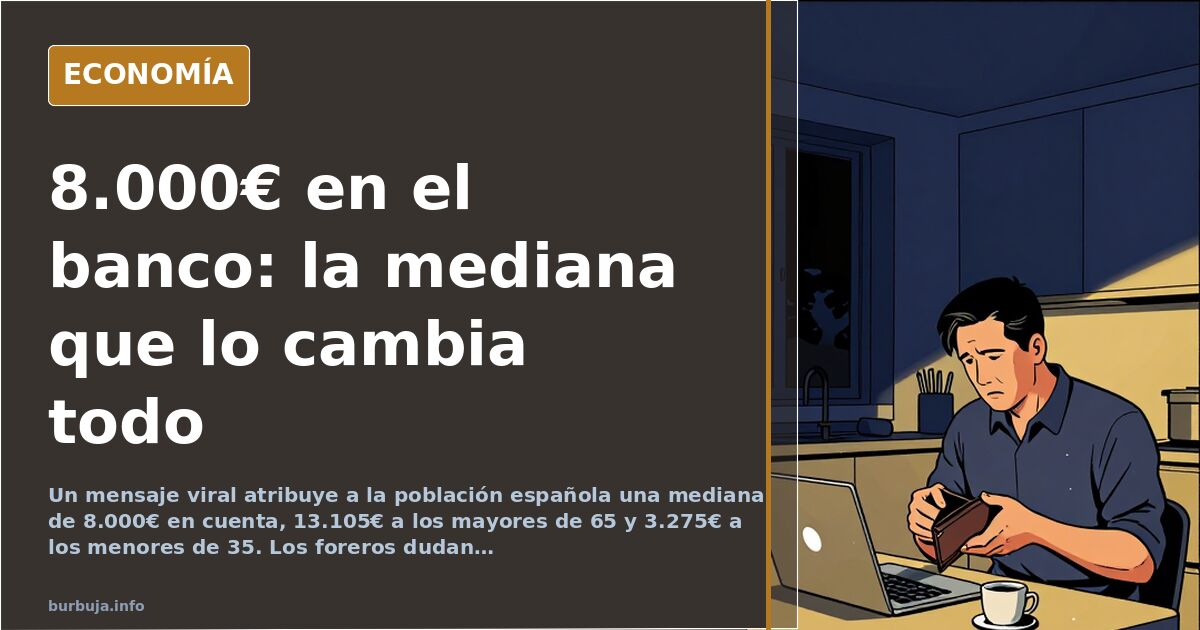
The €8,000 Median Balance Myth in Spain
A message spreading on social media attributes a median cash balance of €8,000 to the Spanish population, highlighting generational divides: those over 65 would hold €13,105, while under-35s have barely €3,275. With an iPhone 15 Pro Max costing €1,589, the math leaves little room for optimism. This snapshot, shared via viral posts, has reignited debate on whether Spanish savings reflect reality or statistical illusion.
The first challenge to this narrative comes from the measurement tool itself. A current account is not net worth; it is temporary parking space. Many voices in the discussion agree that bank balances say little about true wealth, as significant assets often sit in funds, stocks, property, or even cash at home. "I have €3-4k in my account, but over €400k invested," one user summarizes, adding: "Why keep idle money when I can finance cheaply?" The figure measures liquidity, not solvency.
How Long Can the iPhone Flex Last Without Bankruptcy?
The uncomfortable question isn't how much is in the account, but how long a lifestyle lasts without new income. The calculation floating around is simple: if someone buys high-end phones or cars on installments, how many paychecks are truly behind them? The gap between display and reality is the real thermometer. In malls, €300 products are marketed with monthly installments, suggesting immediate purchasing power has shrunk.
There is an uneasy consensus: a significant portion of the population lives paycheck to paycheck. "Many people are three paychecks away from destitution, yet still splurge on summer trips by maxing out debt," notes one analysis. An estimate circulating among participants places 35% to 45% of the population just one salary or pension away from insolvency. While not official data, it aligns with images of those requesting salary advances monthly.
The Illusion of Paid-Off Cars and Homes
Statistics also hide those swimming in money unseen. Those over 65, with a €13,105 median, often own their homes outright and have untouched buffers. "Their hidden assets were paid off years ago," points out a recurring view. This isn't new wealth; it is legacy assets that bypass the current account.
At the other end, under-35s with a €3,275 median aren't necessarily poorer; they are younger. Age explains part of the gap, but not all. Job precariousness, rents, and delayed independence fill the rest. "Most people don't take responsibility for their lives, blaming external factors," argues a minority view emphasizing personal management. The counter-argument states that without stable jobs or affordable housing, individual responsibility has limited scope.
The Trap of Using Banks as Wealth Units
If anything, the cross-checking of figures clarifies that current accounts are poor wealth indicators. Some hold bulk assets in Treasury bills, gold, crypto, or rubber-banded cash bundles. Banks don't reward idle balances, so fewer people keep money there. The result is statistics measuring what is visible, not what is hoarded.
This doesn't invalidate the data but relativizes it. The €8,000 median portrays a country where half have less in the bank and half have more. Excluding housing and employment, the picture is of a society saving little, investing less, and relying on credit for essentials. How much of that €8,000 is a buffer, and how much is merely the waiting room for the next paycheck?
A message spreading on social media attributes a median cash balance of €8,000 to the Spanish population, highlighting generational divides: those over 65 would hold €13,105, while under-35s have barely €3,275. With an iPhone 15 Pro Max costing €1,589, the math leaves little room for optimism. This snapshot, shared via viral posts, has reignited debate on whether Spanish savings reflect reality or statistical illusion.
The first challenge to this narrative comes from the measurement tool itself. A current account is not net worth; it is temporary parking space. Many voices in the discussion agree that bank balances say little about true wealth, as significant assets often sit in funds, stocks, property, or even cash at home. "I have €3-4k in my account, but over €400k invested," one user summarizes, adding: "Why keep idle money when I can finance cheaply?" The figure measures liquidity, not solvency.
How Long Can the iPhone Flex Last Without Bankruptcy?
The uncomfortable question isn't how much is in the account, but how long a lifestyle lasts without new income. The calculation floating around is simple: if someone buys high-end phones or cars on installments, how many paychecks are truly behind them? The gap between display and reality is the real thermometer. In malls, €300 products are marketed with monthly installments, suggesting immediate purchasing power has shrunk.
There is an uneasy consensus: a significant portion of the population lives paycheck to paycheck. "Many people are three paychecks away from destitution, yet still splurge on summer trips by maxing out debt," notes one analysis. An estimate circulating among participants places 35% to 45% of the population just one salary or pension away from insolvency. While not official data, it aligns with images of those requesting salary advances monthly.
The Illusion of Paid-Off Cars and Homes
Statistics also hide those swimming in money unseen. Those over 65, with a €13,105 median, often own their homes outright and have untouched buffers. "Their hidden assets were paid off years ago," points out a recurring view. This isn't new wealth; it is legacy assets that bypass the current account.
At the other end, under-35s with a €3,275 median aren't necessarily poorer; they are younger. Age explains part of the gap, but not all. Job precariousness, rents, and delayed independence fill the rest. "Most people don't take responsibility for their lives, blaming external factors," argues a minority view emphasizing personal management. The counter-argument states that without stable jobs or affordable housing, individual responsibility has limited scope.
The Trap of Using Banks as Wealth Units
If anything, the cross-checking of figures clarifies that current accounts are poor wealth indicators. Some hold bulk assets in Treasury bills, gold, crypto, or rubber-banded cash bundles. Banks don't reward idle balances, so fewer people keep money there. The result is statistics measuring what is visible, not what is hoarded.
This doesn't invalidate the data but relativizes it. The €8,000 median portrays a country where half have less in the bank and half have more. Excluding housing and employment, the picture is of a society saving little, investing less, and relying on credit for essentials. How much of that €8,000 is a buffer, and how much is merely the waiting room for the next paycheck?
Also available in: Deutsch
Summary of a discussion on Burbuja.info - Foro de economía, actualidad y política., translated from Spanish and reviewed before publication. Read the full discussion (128 replies).
More summaries
-
Maricarmen and her 250,000 euros: Spain's divisive rent case
Maricarmen has 250,000 euros saved but pays just 200 euros for a Madrid apartment. Her case highlights Spain's complex housing crisis.
-
Mari Carmen, 87: The eviction sparking nationwide protests in Spain
An 87-year-old's eviction in Madrid has led to protests across Spain, highlighting the country's housing crisis and rent control debates.
-
Spain housing funds sell 25,000 homes without price impact
Investment funds offload 25,000 Spanish properties for €5 billion amid a severe supply deficit and sustained high demand.
-
Bill Murray's Ice Cream Tax Lesson: Spain's Burden Hits 70%
Bill Murray uses an ice cream analogy to explain taxes. In Spain, fiscal pressure calculations reach 60-70%.
-
Argentina GDP grows 3.9%, reigniting economic debate
Argentina's economy grew 3.9% quarterly and 15.6% annualized, reopening debates on the social cost of austerity measures.
-
French report suggests devaluing euro by 30% against yuan
A French strategic report proposes depreciating the euro by 30% against the renminbi as an alternative to tariffs. Other analyses suggest a 9% adjustment.