
Viral Claim: Mataró Migrants Demand Free Housing and €1,500 Monthly
A viral post claims hundreds of migrants in Mataró demand free housing and €1,500 monthly aid. The message reignites debate on social benefits and immigration.
English · Original discussion in Spanish · Published
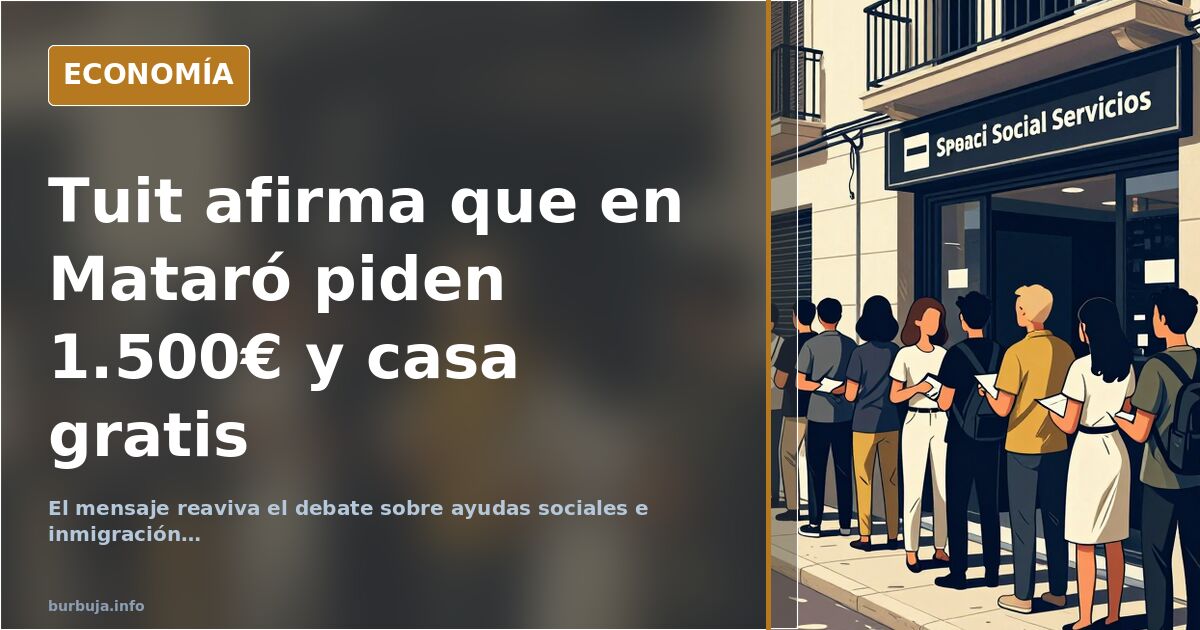
Viral claim states migrants in Cancelar demand free housing and €1,500 a month
A tweet circulating on social media asserts that hundreds of migrants in Cancelar protested to demand free housing and a monthly allowance of €1,500. The unverified message has reignited a long-standing debate in Spain regarding social welfare, irregular immigration, and who bears the cost. While some view this as organized provocation, others note that actual benefit amounts are far lower than claimed. One participant stated they were protesting against racism and evictions, not asking for €1,500 and free housing.
What is demanded versus what is granted
The rapidly spreading tweet claims protesters want free housing and €1,500 a month to "live." This figure is significant. In Spain, the average retirement pension is around €1,200, and the minimum wage stands at approximately €1,100 across 14 payments. For an irregular group to demand €1,500 net was interpreted by many as a direct affront to contributors. "They already get paid €700. That’s the same as a construction worker who falls off scaffolding after paying contributions for 40 years," one comment summarized. Though crude, this comparison touches a nerve in a country where the gap between contribution and receipt is a daily reality.
Some argue these aids already exist and are granted without strict filters. Others point out that real amounts are much lower and the €1,500 demand is an exaggerated fabrication. Regardless, the message allowed many citizens to express discontent extending beyond Cancelar: the feeling that the State treats newcomers better than those who have paid taxes for decades.
Housing arguments and the 'handout' debate
Free housing is the conflict's other pillar. In a country where rent has become a luxury, demanding free homes for newcomers sounds like provocation. "This person was already given housing to keep them quiet," reads a comment linking to news. The perception that public resources are distributed opaquely fuels indignation. It is not just about money; it is the sense that irregularity is rewarded while compliance is punished.
The debate over small handouts is not new. In Spain, regional minimum income schemes vary by autonomous community and rarely exceed €500 a month. The Minimum Vital Income (Ingreso Mínimo Vital), approved in 2020, has a base amount around €460, rising with dependents, but remains far from €1,500. However, the sum of regional, local, and NGO aid can approach that figure in specific cases, fueling confusion and myths.
Political response: silence or 'they will get it'
Politicians were quickly targeted. "I imagine PSOE and PP know nothing about this," one message mocked. Many share the suspicion that major parties look away while migrant bases consolidate. "They ask because they know they will get it," another concluded. Distrust toward institutions underlies all this discontent.
Some go further, citing military coups or internal war as the only solution. They are few, but their presence shows how heated the issue has become. Most remain in complaint and irony: "Can I join them so I stop working?" The joke hides an uncomfortable question: What happens to those who contributed all their lives and see no reward?
Economic background: who pays and who receives
Beyond the noise, the debate has a clear economic basis. Spain allocates a growing share of social spending to integration policies and direct aid. Critics argue this money comes from workers' taxes and questions system sustainability. Defenders say immigration also provides labor and contributions, though the informal economy makes measurement difficult.
The Cancelar message is not isolated. It fits a context of rising social tension where housing, jobs, and public aid are battlegrounds. A tweet claiming irregular migrants protest for €1,500 and free housing is, at least, a symptom. Like any symptom, it reveals more about the system than those suffering it.
Ultimately, the question is not whether they will be paid. It is how long a model promising everyone can last when no one knows exactly who foots the bill. Reality, or the next tweet, will provide the answer.
Also available in: Deutsch
Summary of a discussion on Burbuja.info - Foro de economía, actualidad y política., translated from Spanish and reviewed before publication. Read the full discussion (179 replies).
More summaries
-
550 Euros from IMV vs. 1,200 for 40 Hours: The Deciding Gap
A university graduate in 2025 earns the same 1,200 euros as an assistant in 2005, while the minimum vital income is around 550 to 658 euros per month.
-
Spain's Minimum Vital Income rises 11.4% in 2026, sparking fierce debate
Spain's IMV increases to 733 euros for individuals and 1,660 for families in 2026. Court of Auditors data shows 80% of recipients are Spanish nationals.
-
Spain's €730 minimum living income for shared flats reignites the debate
Spain's IMV grants €730 to tenants renting a room with just one year of registration; self-employed workers slam a benefit with no fiscal ceiling.
-
Allegations of election meddling in Brazil as Pedro Sánchez takes notes
The runoff between Bolsonaro and Lula da Silva is marked by a two-hour extension of polling station hours and 60% support for Lula among overseas voters. Click through for the data.
-
Spain's 29N election: forum users weigh tactical voting, abstention and punishment votes
A forum thread frames Spain's 29N vote as a contest between tactical voting, abstention and punishing the parties. Arguments and opinions from participants.
-
Cloning MB's Hotel with AI: an afternoon of code and legal doubts
A hobbyist recreates MB's Hotel with Claude Code in a single afternoon and debates Hasbro's copyright and the barrier to commercializing it.