
Vinted's $5 Skirt Imitating Audrey Horne
A $5 plaid skirt on Vinted copies Twin Peaks star Audrey Horne, sparking debate over whether the look is chic or resembles a tablecloth.
English · Original discussion in Spanish · Published
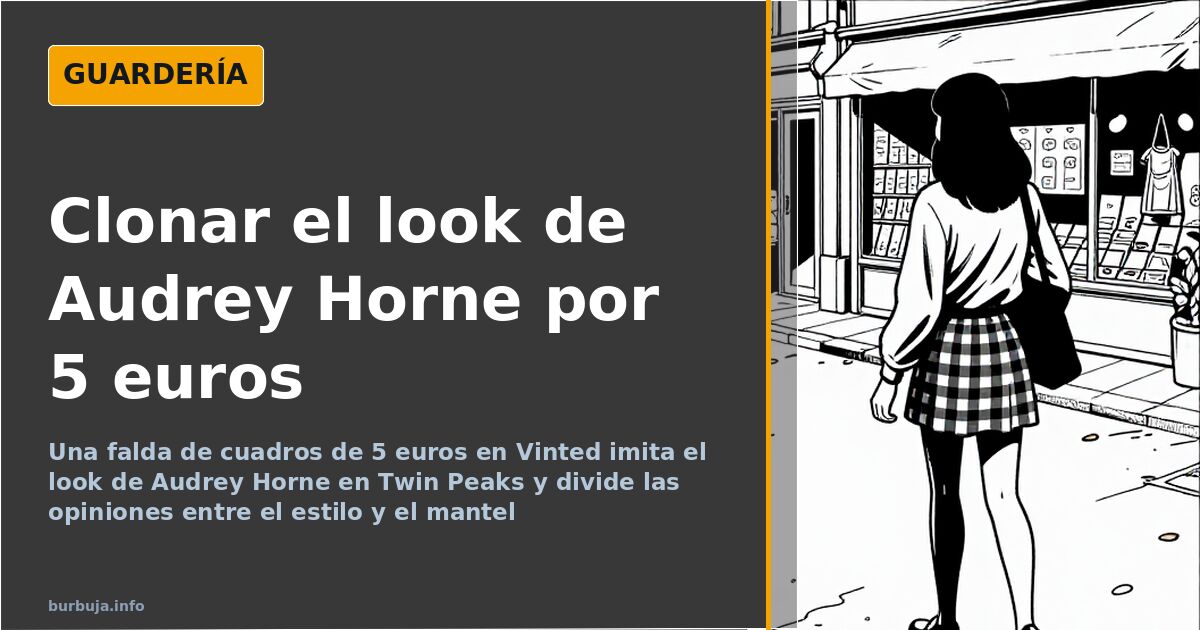
Copying Audrey Horne’s look costs $5 on Vinted
The knee-length plaid skirt and two-tone white and black derbies are no longer just TV wardrobe. You can get them for the price of a coffee: a skirt rescued on a secondhand platform for $5, and sneakers with thick soles found among hundreds of ads. The outfit copies Audrey Horne, the character from Twin Peaks, and its creator defends it without asking permission: “I’ve never been so obsessed with a look that I copied it.”
The catch is the result. What on screen was a high school student with a fitted sweater, plaid skirt, and two-tone shoes becomes, in real life, a discussion about whether the outfit is elegant or looks just taken from a kitchen. The most repeated verdict sums up the atmosphere: the skirt looks like a tablecloth.
What Audrey Horne’s look consists of
The reference is Audrey Horne, the daughter of the owner of the Great Northern Hotel in Twin Peaks, the series David Lynch premiered in the early nineties and returned with a third season years later. Her wardrobe — plaid skirt, fitted sweaters, two-tone shoes — became a style manual for a generation. It’s no coincidence that half of the internet today relates the fiction’s aesthetic to everyday wardrobes.
The person copying the look insists on a key distinction: they’re not looking for a costume. “I’m not trying to do cosplay, just copy the idea,” they clarify. The difference matters because cosplay demands absolute fidelity, and this is just inspiration. And there’s room for interpretation: they remember that Laura Palmer dressed differently and that two-tone derbies belonged to Audrey, not Laura.
How much does it cost to copy the outfit piece by piece
The economic argument is the strongest point. Finding identical models to those in the series is complicated, so the strategy is to use the closest match on the secondhand market. The result: a plaid skirt for $5 and shoes rescued at bargain prices. Compared to a new clothing store, the savings are obvious.
The trick is in the search, which is a job in itself. Each piece requires tracking ads, comparing sizes, and accepting that the print doesn’t always match the memory. Some call it luck; in reality, it’s patience. The real cost of the look isn’t the money paid, but the hours spent finding it.
The verdict: from tablecloth to school uniform
The reaction is split. One current holds that the outfit works: if worn with the right attitude, it’s fine. Another outright rejects it. “More reminiscent of the Braveheart vibe than Lynch’s glamour,” summarizes one of the sharpest comments. In between, some see the plaid skirt as a private school uniform and grant it some appeal if paired with the right face.
The length also matters. One of the most repeated corrections is to raise the hem above the knee, because below it, the outfit loses its vibe. The print, however, holds up well: its defenders remember that it goes with almost everything. The discussion is, at its core, the usual one: what turns a garment into style and not a costume.
From wardrobe to identity: when clothes stop being clothes
Beyond that, the issue goes beyond the print. Clothes stop being fabric and become a battleground over who can wear them. Judgments appear about physique, age, and what is considered “presentable.” Some think such a defined look is limiting; others respond that the wardrobe belongs to the wearer, and outside opinions fall into the same category as cloud tonalidad.
The discussion about hairstyles is the best example. The dye, tone, and even hair removal enter the conversation as if the skirt needed a supplementary manual. The creator of the look concludes: clothes are chosen by taste, not by approval.
The September plan and the definitive wardrobe
The issue doesn’t end on a cold day. The intention is to adopt the uniform — plaid skirt and derbies — permanently and expand the collection by September. The logic is that of someone who finds a working formula and repeats it: dresses, shirts, skirts, pants, and coats with the same print. A kind of cheap personal brand to maintain.
Clothes, in this case, fulfill a function that has little to do with fast fashion. It’s identity, it’s memory of a series, it’s a wardrobe built by cultural association rather than trend. And that, in today’s market, is almost an anomaly.
With this level of division, the plaid skirt will continue to spark conversation each autumn. If the heat presses, the uniform will fold up for winter; if the nineties fever holds, it will end up in more wardrobes than common sense predicts. It’s likely that next time, no one will ask if it’s a tablecloth. But they will ask.
The knee-length plaid skirt and two-tone white and black derbies are no longer just TV wardrobe. You can get them for the price of a coffee: a skirt rescued on a secondhand platform for $5, and sneakers with thick soles found among hundreds of ads. The outfit copies Audrey Horne, the character from Twin Peaks, and its creator defends it without asking permission: “I’ve never been so obsessed with a look that I copied it.”
The catch is the result. What on screen was a high school student with a fitted sweater, plaid skirt, and two-tone shoes becomes, in real life, a discussion about whether the outfit is elegant or looks just taken from a kitchen. The most repeated verdict sums up the atmosphere: the skirt looks like a tablecloth.
What Audrey Horne’s look consists of
The reference is Audrey Horne, the daughter of the owner of the Great Northern Hotel in Twin Peaks, the series David Lynch premiered in the early nineties and returned with a third season years later. Her wardrobe — plaid skirt, fitted sweaters, two-tone shoes — became a style manual for a generation. It’s no coincidence that half of the internet today relates the fiction’s aesthetic to everyday wardrobes.
The person copying the look insists on a key distinction: they’re not looking for a costume. “I’m not trying to do cosplay, just copy the idea,” they clarify. The difference matters because cosplay demands absolute fidelity, and this is just inspiration. And there’s room for interpretation: they remember that Laura Palmer dressed differently and that two-tone derbies belonged to Audrey, not Laura.
How much does it cost to copy the outfit piece by piece
The economic argument is the strongest point. Finding identical models to those in the series is complicated, so the strategy is to use the closest match on the secondhand market. The result: a plaid skirt for $5 and shoes rescued at bargain prices. Compared to a new clothing store, the savings are obvious.
The trick is in the search, which is a job in itself. Each piece requires tracking ads, comparing sizes, and accepting that the print doesn’t always match the memory. Some call it luck; in reality, it’s patience. The real cost of the look isn’t the money paid, but the hours spent finding it.
The verdict: from tablecloth to school uniform
The reaction is split. One current holds that the outfit works: if worn with the right attitude, it’s fine. Another outright rejects it. “More reminiscent of the Braveheart vibe than Lynch’s glamour,” summarizes one of the sharpest comments. In between, some see the plaid skirt as a private school uniform and grant it some appeal if paired with the right face.
The length also matters. One of the most repeated corrections is to raise the hem above the knee, because below it, the outfit loses its vibe. The print, however, holds up well: its defenders remember that it goes with almost everything. The discussion is, at its core, the usual one: what turns a garment into style and not a costume.
From wardrobe to identity: when clothes stop being clothes
Beyond that, the issue goes beyond the print. Clothes stop being fabric and become a battleground over who can wear them. Judgments appear about physique, age, and what is considered “presentable.” Some think such a defined look is limiting; others respond that the wardrobe belongs to the wearer, and outside opinions fall into the same category as cloud tonalidad.
The discussion about hairstyles is the best example. The dye, tone, and even hair removal enter the conversation as if the skirt needed a supplementary manual. The creator of the look concludes: clothes are chosen by taste, not by approval.
The September plan and the definitive wardrobe
The issue doesn’t end on a cold day. The intention is to adopt the uniform — plaid skirt and derbies — permanently and expand the collection by September. The logic is that of someone who finds a working formula and repeats it: dresses, shirts, skirts, pants, and coats with the same print. A kind of cheap personal brand to maintain.
Clothes, in this case, fulfill a function that has little to do with fast fashion. It’s identity, it’s memory of a series, it’s a wardrobe built by cultural association rather than trend. And that, in today’s market, is almost an anomaly.
With this level of division, the plaid skirt will continue to spark conversation each autumn. If the heat presses, the uniform will fold up for winter; if the nineties fever holds, it will end up in more wardrobes than common sense predicts. It’s likely that next time, no one will ask if it’s a tablecloth. But they will ask.
Summary of a discussion on Burbuja.info - Foro de economía, actualidad y política., translated from Spanish and reviewed before publication. Read the full discussion (248 replies).
More summaries
-
Forty Years of 'Blue Velvet': The Dream That Never Ends
Blue Velvet turns 40: Premiered in the US on September 19, 1986, David Lynch's fourth film divides audiences between masterpiece and enigma.
-
Online Death of Known Figure Cesard Sparks Debate
The passing of internet personality Cesard triggers polarized reactions, sparking a debate about his complex legacy, controversial reputation, and digital footprint.
-
Valladolid Weather Presenter Sparks Debate Over Media Focus on Appearance
Public discussion in Valladolid shifts focus from meteorological data to the physical appearance of a local weather presenter, highlighting a trend in local media consumption.
-
Deadly accidents, suicides, and the banality of everyday tragedy
Real testimonies of shocking deaths: workplace accidents, youth suicides, and absurd incidents. A catalogue of human fragility that raises questions.
-
Female Athletes' Attire Sparking Debate: Performance vs. Commercialization
Analysis of the debate on female track and field attire: does it enhance performance or commodify the body?
-
Prostate Is the Uterus: The Biology They Didn't Tell You
Embryology shows the penis and clitoris are homologous, and the prostate derives from the uterus. A 385-million-year journey from fish to humans.