
Video Under Scrutiny: Feline Knocks Out 45kg Rottweiler
A video shows a feline taking down a 45kg Rottweiler, but the clip's authenticity is questioned and its species debated.
English · Original discussion in Spanish · Published
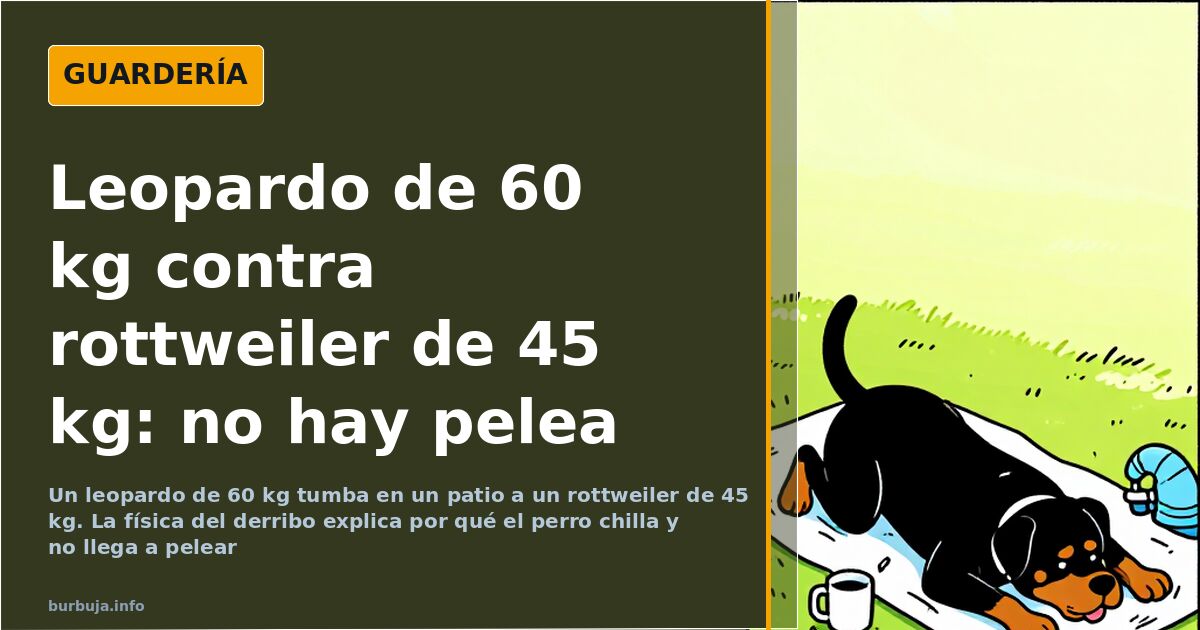
The feline that knocks out a 45kg Rottweiler in a second
Can a 45-kilo Rottweiler stop a big cat? The video circulating these days — a feline pouncing on a guard dog — has peine an old discussion: the domestic dog as a symbol of strength versus the wild predator. And as almost always happens when discussing with videos, the first thing that arises isn't who wins, but whether what you're seeing is real.
Is the video of the feline and the Rottweiler real?
The clip's authenticity is in doubt. Several details are jarring: there isn't a single drop of blood on the ground, the feline retreats before finishing the job, and the sequence has a finish that resembles videos generated by artificial intelligence. On top of that, a version uploaded six years ago is circulating, making it difficult to trace the original. In the thread itself, some warn that AI-generated videos are being passed off as real.
The clip also arrives with a tag of current events, even though its origin is unclear: it's shared as if it were a recent attack, with no reliable date and no known author. It's the perfect format for quick consumption and also the hardest to verify. If the video is a fake, the entire discussion about who would win falls apart.
Why would a 60kg feline take down a 45kg Rottweiler?
According to the explanation repeated in the thread, it's 'pure schoolyard physics.' It's not about static weight, but mass multiplied by the acceleration of a body launching itself to kill. A 60-kilo creature falling flat out at about 40 miles per hour concentrates all that energy on two points that it drives into the dog's shoulders, and the Rottweiler's 45 kilos go to the ground, period. It's the same principle by which a 70-kilo man knocks you down if he jumps on you from a wall.
The feline doesn't arrive running; it arrives moving stealthily. It stays low to the ground, uses every patch of grass and shadow, and advances without disturbing a leaf. When the dog smells it, the other is already on top. Added to this are two anatomical advantages that evolution has been perfecting for about 30 million years: padded paws that cushion noise and retractable claws, plus a floating clavicle and a flexible spine that turn the animal into a spring.
The teeth finish the job. Four long, robust canines up to 7 centimeters pierce the skin and seek vital organs, while the premolars function like blades. The big cat doesn't move its jaw side to side or chew: it cuts and swallows. The fight isn't an exchange of blows. It's a procedure.
Domestic dog vs. wild animal: selection plays against
Here's the most repeated argument, and the one least discussed. Thousands of years of human selection have shaped the dog for coexistence, guarding, and alerting, not for killing. As a forum user recalls, citing a biologist, a wild diet and constant exercise give a predator stronger and more resistant musculature per cubic centimeter than any domestic animal. Several users summarize it this way: at equal size, the feline dominates, and if it weighs more, there's no equality at all.
The comparison with wolves doesn't save the guard dog either. Some argue that a lone wolf would rarely attack a Rottweiler due to the risk of injury, and that's probably true, but that's prudence, not inferiority. A predator doesn't fight for pleasure; it fights to eat. If the calculation goes wrong, it leaves. That's the only scenario in which a large dog survives.
How many Rottweilers does it take to stop a big cat?
According to the calculation being discussed in the thread, three 45-kilo dogs barking in formation already make for an uncomfortable calculation for the feline, and it would most likely retreat. But it's worth lowering the epic tone. A leopard doesn't face three at once; it takes one to the bush, and the other two are left watching. Killing all three is practically impossible for it, and that's precisely why it doesn't try.
The scenario changes if there's no escape. A cornered cat doesn't threaten like a dog; it seeks height. It climbs a tree, a wall, the roof. And if there's nothing vertical, it leaps into the gap, which is usually between the legs of whoever looks the softest. That's where the matter stops resembling a documentary.
Leopard or jaguar: the misidentification
The feline's name is also debated. An adult jaguar exceeds 100 kilos, hunts caimans, and is a different animal, heavier and more powerful. Furthermore, since 2008 the Jaguar brand has belonged to the Indian consortium Tata Motors, a detail some use to place the video's origin in India. Whatever the creature, the conclusion repeated by several users remains the same: no domestic dog matches a big cat.
There's the practical detail that slips in amidst so much calculation. If a guard dog is going to live on a property where predators roam, the minimum is to protect its neck with a collar, not to rely on its fruta. The video will continue to circulate, real or fabricated, with a leopard or a jaguar. The dog, meanwhile, has already done the only thing it knew how to do.
Can a 45-kilo Rottweiler stop a big cat? The video circulating these days — a feline pouncing on a guard dog — has peine an old discussion: the domestic dog as a symbol of strength versus the wild predator. And as almost always happens when discussing with videos, the first thing that arises isn't who wins, but whether what you're seeing is real.
Is the video of the feline and the Rottweiler real?
The clip's authenticity is in doubt. Several details are jarring: there isn't a single drop of blood on the ground, the feline retreats before finishing the job, and the sequence has a finish that resembles videos generated by artificial intelligence. On top of that, a version uploaded six years ago is circulating, making it difficult to trace the original. In the thread itself, some warn that AI-generated videos are being passed off as real.
The clip also arrives with a tag of current events, even though its origin is unclear: it's shared as if it were a recent attack, with no reliable date and no known author. It's the perfect format for quick consumption and also the hardest to verify. If the video is a fake, the entire discussion about who would win falls apart.
Why would a 60kg feline take down a 45kg Rottweiler?
According to the explanation repeated in the thread, it's 'pure schoolyard physics.' It's not about static weight, but mass multiplied by the acceleration of a body launching itself to kill. A 60-kilo creature falling flat out at about 40 miles per hour concentrates all that energy on two points that it drives into the dog's shoulders, and the Rottweiler's 45 kilos go to the ground, period. It's the same principle by which a 70-kilo man knocks you down if he jumps on you from a wall.
The feline doesn't arrive running; it arrives moving stealthily. It stays low to the ground, uses every patch of grass and shadow, and advances without disturbing a leaf. When the dog smells it, the other is already on top. Added to this are two anatomical advantages that evolution has been perfecting for about 30 million years: padded paws that cushion noise and retractable claws, plus a floating clavicle and a flexible spine that turn the animal into a spring.
The teeth finish the job. Four long, robust canines up to 7 centimeters pierce the skin and seek vital organs, while the premolars function like blades. The big cat doesn't move its jaw side to side or chew: it cuts and swallows. The fight isn't an exchange of blows. It's a procedure.
Domestic dog vs. wild animal: selection plays against
Here's the most repeated argument, and the one least discussed. Thousands of years of human selection have shaped the dog for coexistence, guarding, and alerting, not for killing. As a forum user recalls, citing a biologist, a wild diet and constant exercise give a predator stronger and more resistant musculature per cubic centimeter than any domestic animal. Several users summarize it this way: at equal size, the feline dominates, and if it weighs more, there's no equality at all.
The comparison with wolves doesn't save the guard dog either. Some argue that a lone wolf would rarely attack a Rottweiler due to the risk of injury, and that's probably true, but that's prudence, not inferiority. A predator doesn't fight for pleasure; it fights to eat. If the calculation goes wrong, it leaves. That's the only scenario in which a large dog survives.
How many Rottweilers does it take to stop a big cat?
According to the calculation being discussed in the thread, three 45-kilo dogs barking in formation already make for an uncomfortable calculation for the feline, and it would most likely retreat. But it's worth lowering the epic tone. A leopard doesn't face three at once; it takes one to the bush, and the other two are left watching. Killing all three is practically impossible for it, and that's precisely why it doesn't try.
The scenario changes if there's no escape. A cornered cat doesn't threaten like a dog; it seeks height. It climbs a tree, a wall, the roof. And if there's nothing vertical, it leaps into the gap, which is usually between the legs of whoever looks the softest. That's where the matter stops resembling a documentary.
Leopard or jaguar: the misidentification
The feline's name is also debated. An adult jaguar exceeds 100 kilos, hunts caimans, and is a different animal, heavier and more powerful. Furthermore, since 2008 the Jaguar brand has belonged to the Indian consortium Tata Motors, a detail some use to place the video's origin in India. Whatever the creature, the conclusion repeated by several users remains the same: no domestic dog matches a big cat.
There's the practical detail that slips in amidst so much calculation. If a guard dog is going to live on a property where predators roam, the minimum is to protect its neck with a collar, not to rely on its fruta. The video will continue to circulate, real or fabricated, with a leopard or a jaguar. The dog, meanwhile, has already done the only thing it knew how to do.
Summary of a discussion on Burbuja.info - Foro de economía, actualidad y política., translated from Spanish and reviewed before publication. Read the full discussion (135 replies).
More summaries
-
The Button Meme: The Joke That Turns into Prejudice
An imaginary button, soap, and an absurd reward: this is how the Button Meme shifts from a joke to prejudice against certain groups.
-
Real Madrid's Dominance: European Glory vs. Domestic Refereeing Bias
Real Madrid dominates European football but struggles against a domestic league marked by controversial refereeing decisions and the narrative hegemony of FC Barcelona.
-
Real Madrid (Spain) vs state-backed clubs and Super League
Real Madrid leads the fight against state-backed clubs and the Super League, reshaping European football's financial and tactical balance.
-
Seven Years Without a Date, and a Coffee Invite That Ended in Being Blocked
Seven years without a date, three weeks of back-and-forth, and a silent block: how a coffee invite turned into a ghosting story.
-
This post on X from back when it was still Twitter is getting people talking online again.
A post from before July 2023 asked whether Penélope Cruz was Pepe Viyuela in a wig. The joke is doing the rounds again.
-
A forum debates whether showing off your body online is enough to get a date
A conversation about dating someone who flaunts their body on social media leaves one fact: the only figure mentioned is an unconfirmed height, 1,52 m