
Video shows dinner made with blocks of butter and ultra-processed food
A video shows a dinner made with blocks of butter and ultra-processed food. The scene reopens the debate on diet and fat consumption
English · Original discussion in Spanish · Published
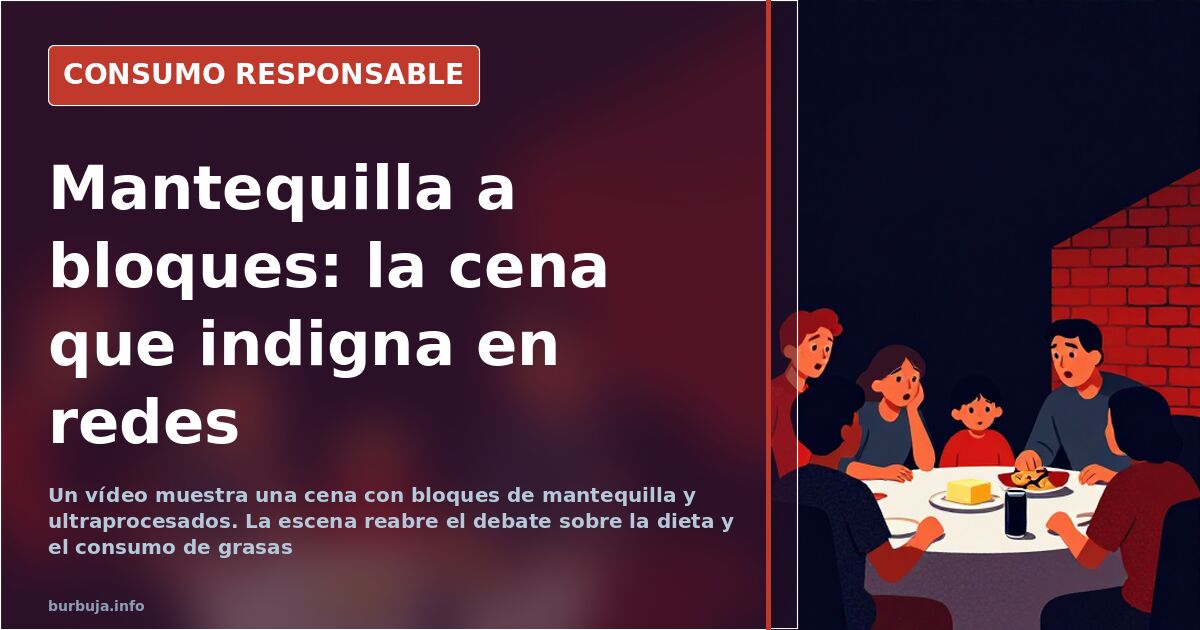
A video shows a dinner made with blocks of butter and ultra-processed food
There is one scene that sums up the video: a woman drops a whole block of butter onto a tray and spreads it with her hands. It is not a baking tutorial. It is a meal that, from what can be seen, she is preparing for her children, filmed in a kitchen that several commenters place in the American Midwest, and the material is circulating on social media and aggregators with a mix of fascination and alarm. The menu, according to what the video shows: layers of ultra-processed food, yellow sliced cheese, some fresh pineapple and an amount of fat that several commenters describe as "a year's consumption in a single sitting".
What is being cooked and what is being debated
The video is not new. It has been circulating for some time and has returned to public conversation for the same reason these things always do: because the contrast between the "Christmas dinner" label and what appears on the tray is too great. Among the visible ingredients are sticks of butter, sliced cheese, prepared doughs and pineapple. One commenter sums up the whole thing with a line that keeps being repeated: "the only natural ingredient was the pineapple, and it doesn't look like they're going to eat it, she probably just used it to give it some aroma".
The discussion quickly splits into two fronts. The first is nutritional: the calorie density and the saturated fat load of the dish, with comments ranging from humour ("watching this has raised my cholesterol") to concern about cardiovascular risk. The second is cultural: why a video like this is perceived as representative of a country and not as what it is, one particular family cooking badly.
The bias of believing we eat better
The line that opens the conversation is the most interesting of the lot: "And then we say we eat badly in Spain". It is a logical trap. The existence of an extreme case of poor eating in another country does not improve one's own diet. But it works as consolation and as identity. Several participants point this out: the problem is not the comparison, it is using it to avoid looking at one's own shopping basket.
Some go further and talk about unconsciousness. "It's curious, the cognitive bias in human beings. She is completely unaware that this food is not healthy," writes a participant who admits to having eaten worse at twenty than now. It is the most honest point of the exchange: poor eating is not a problem of information, it is a problem of habits, price and time.
The real cost of butter
Beyond the joke, there is a calculation that keeps coming up: the amount of butter used in a single preparation. One commenter works out that the woman uses in one session what he uses in a year. Another compares it to a bricklayer laying bricks. The joke hides a reality: butter is one of the most expensive ingredients in the shopping basket and its consumption has soared in home baking and American cooking videos.
The cost is not only monetary. The dish combines saturated fats, salt and sugars in proportions that, according to the comments, are far from any dietary recommendation. The discussion does not reach a consensus on whether the problem is the quantity, the frequency or the context, but it does on one thing: this is not a Christmas dinner, it is a cooking demonstration by accumulation.
Pineapple as a healthy alibi
The most commented moment of the video is when the woman peels a pineapple. One participant celebrates it ironically: "A miracle! A fresh product, if this keeps up this week they won't get scurvy at home". The fruit works as an alibi: a natural ingredient in the middle of an industrialised dish. But nobody believes they are going to eat it. The pineapple, in that context, is decoration.
That detail connects with a broader discussion about labelling and the perception of what is healthy. A product with fruit is not a healthy product. A dish with one fresh ingredient is not a balanced meal. The conversation makes this clear without the need to cite any nutritional guideline.
The problem is not the person, it is the system
There is a current that avoids individual judgement and points to the environment. Ultra-processed food is cheaper, faster and more available than fresh food in large areas of the United States. The dinner in the video is not an exception, it is a visible extreme of a trend. Several participants say it without saying it: if the system makes it easy for you, this is the result.
Others, by contrast, stay with aesthetic judgement. The woman's body, her way of cooking, her supposed ignorance. It is the least useful part of the exchange and the one that generates the most noise. The discussion becomes circular when it focuses on the person and not on the dish.
What this video says about us
The video is not a news story, it is a mirror. What is being discussed is not one American family's dinner, it is each person's relationship with what they eat and with what they think they eat. The comparison with Spain is the hook. The underlying question is another one: if the Mediterranean diet is being lost here too, how much time is left to keep using this video as consolation?
There is one scene that sums up the video: a woman drops a whole block of butter onto a tray and spreads it with her hands. It is not a baking tutorial. It is a meal that, from what can be seen, she is preparing for her children, filmed in a kitchen that several commenters place in the American Midwest, and the material is circulating on social media and aggregators with a mix of fascination and alarm. The menu, according to what the video shows: layers of ultra-processed food, yellow sliced cheese, some fresh pineapple and an amount of fat that several commenters describe as "a year's consumption in a single sitting".
What is being cooked and what is being debated
The video is not new. It has been circulating for some time and has returned to public conversation for the same reason these things always do: because the contrast between the "Christmas dinner" label and what appears on the tray is too great. Among the visible ingredients are sticks of butter, sliced cheese, prepared doughs and pineapple. One commenter sums up the whole thing with a line that keeps being repeated: "the only natural ingredient was the pineapple, and it doesn't look like they're going to eat it, she probably just used it to give it some aroma".
The discussion quickly splits into two fronts. The first is nutritional: the calorie density and the saturated fat load of the dish, with comments ranging from humour ("watching this has raised my cholesterol") to concern about cardiovascular risk. The second is cultural: why a video like this is perceived as representative of a country and not as what it is, one particular family cooking badly.
The bias of believing we eat better
The line that opens the conversation is the most interesting of the lot: "And then we say we eat badly in Spain". It is a logical trap. The existence of an extreme case of poor eating in another country does not improve one's own diet. But it works as consolation and as identity. Several participants point this out: the problem is not the comparison, it is using it to avoid looking at one's own shopping basket.
Some go further and talk about unconsciousness. "It's curious, the cognitive bias in human beings. She is completely unaware that this food is not healthy," writes a participant who admits to having eaten worse at twenty than now. It is the most honest point of the exchange: poor eating is not a problem of information, it is a problem of habits, price and time.
The real cost of butter
Beyond the joke, there is a calculation that keeps coming up: the amount of butter used in a single preparation. One commenter works out that the woman uses in one session what he uses in a year. Another compares it to a bricklayer laying bricks. The joke hides a reality: butter is one of the most expensive ingredients in the shopping basket and its consumption has soared in home baking and American cooking videos.
The cost is not only monetary. The dish combines saturated fats, salt and sugars in proportions that, according to the comments, are far from any dietary recommendation. The discussion does not reach a consensus on whether the problem is the quantity, the frequency or the context, but it does on one thing: this is not a Christmas dinner, it is a cooking demonstration by accumulation.
Pineapple as a healthy alibi
The most commented moment of the video is when the woman peels a pineapple. One participant celebrates it ironically: "A miracle! A fresh product, if this keeps up this week they won't get scurvy at home". The fruit works as an alibi: a natural ingredient in the middle of an industrialised dish. But nobody believes they are going to eat it. The pineapple, in that context, is decoration.
That detail connects with a broader discussion about labelling and the perception of what is healthy. A product with fruit is not a healthy product. A dish with one fresh ingredient is not a balanced meal. The conversation makes this clear without the need to cite any nutritional guideline.
The problem is not the person, it is the system
There is a current that avoids individual judgement and points to the environment. Ultra-processed food is cheaper, faster and more available than fresh food in large areas of the United States. The dinner in the video is not an exception, it is a visible extreme of a trend. Several participants say it without saying it: if the system makes it easy for you, this is the result.
Others, by contrast, stay with aesthetic judgement. The woman's body, her way of cooking, her supposed ignorance. It is the least useful part of the exchange and the one that generates the most noise. The discussion becomes circular when it focuses on the person and not on the dish.
What this video says about us
The video is not a news story, it is a mirror. What is being discussed is not one American family's dinner, it is each person's relationship with what they eat and with what they think they eat. The comparison with Spain is the hook. The underlying question is another one: if the Mediterranean diet is being lost here too, how much time is left to keep using this video as consolation?
Also available in: Deutsch
Summary of a discussion on Burbuja.info - Foro de economía, actualidad y política., translated from Spanish and reviewed before publication. Read the full discussion (100 replies).
More summaries
-
US vs Spain: Prices, Salaries, and Purchasing Power
Eggs cost $4 in Texas and €7 in Madrid, yet US wages are triple. We analyze real purchasing power between the two countries.
-
Automatic cars now dominate in Spain: from 3% to 59%
In 2001, 97% of new cars in Spain were manual; by 2024, automatics reached 59%. The 2019 driving license change and pricing explain this shift.
-
Forum user claims US motorcycles are 20x deadlier than guns
A forum calculation suggests US motorcycles have a lethality rate per unit 20 times higher than civilian firearms, citing 310 million guns and 7.1 million bikes.
-
Lacasa Christmas Turrón Ad Sparks Consumer Backlash in Spain
Spanish turrón brand Lacasa faces boycotts after launching a feminist ad claiming women have less leisure time than men.
-
380,000 miles? No—380,000 km on a Volvo 1.6 diesel: 1,400 km per tank
380,000 km on the clock, 1,400 km per tank and 3.8 l/100 km: the owner of a 2010 Volvo 1.6 diesel argues his car is cheaper than swapping cars every few years.
-
Toothpaste: the 1450 ppm fluoride level almost nobody understands
Almost every toothpaste contains 1450 ppm of fluoride, regardless of price. The real debate lies in the type of fluoride, the abrasive and the additives.