
Video of Assault in Tortosa Reignites Migration Debate
A video of an assault in Tortosa sparks a clash between immigration policy and public safety, with no official confirmation of the aggressor's details.
English · Original discussion in Spanish · Published
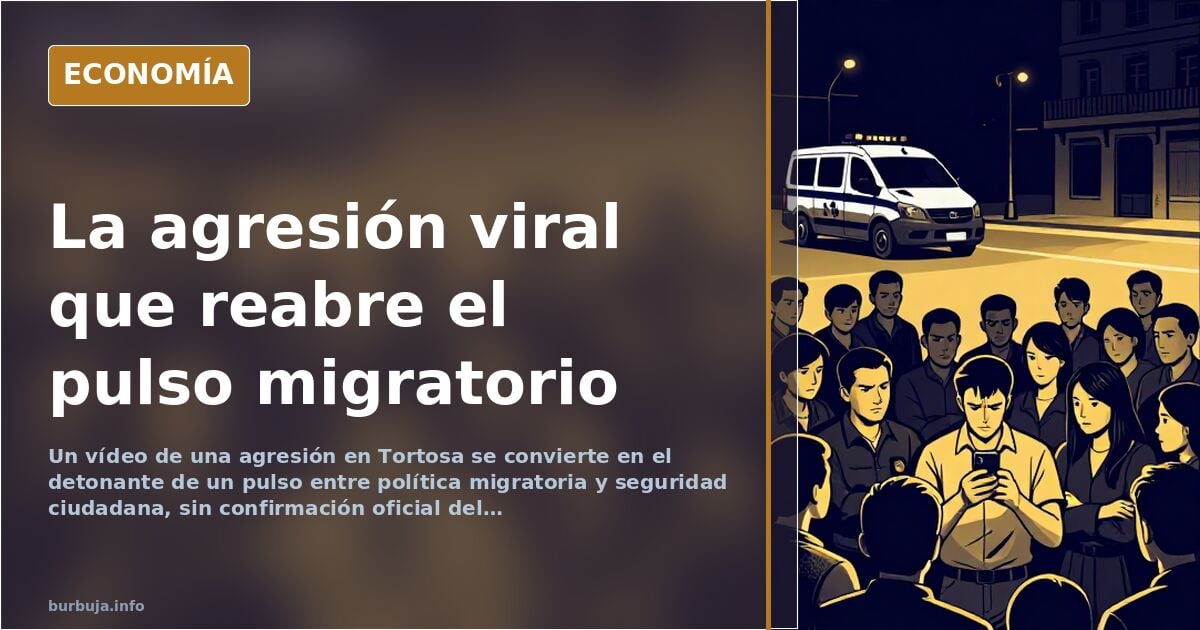
Tortosa: The Assault Video Reigniting the Migration Debate
A brief video, filmed on a Tortosa street and spread on social media, shows a man assaulting a transgender woman. The short, violent scene quickly escalated from a mere incident. Within hours, it became ammunition in a larger debate pitting immigration policy against street safety. The clip circulated with a hashtag identifying the aggressor's migratory status, a detail no authority has confirmed, yet it shaped everything that trinc.
It's important to separate two things. The first is the event: a documented assault on a specific person. The second is what was built around it. The latter significantly outweighed the former in public discourse.
What Do We Actually Know About the Tortosa Incident?
The widely shared material is a short clip, and the conversation itself suggests a longer version exists on Instagram, though not always accessible. Regarding the aggressor and their administrative status, only third-party claims are circulating; there's no official confirmation in the shared content, no judicial ruling, and no verified public identification.
This hasn't stopped the case from being labeled with a specific cause. The attribution of the aggressor's nationality and irregular status comes from whoever published the video, not from an official report. In a matter like this, the difference between what is seen in the clip and what is claimed about the person in it is everything.
Another detail reappears in various parts of the discussion: the role of bystanders. The person recording does not intervene, and this action—recording instead of intervening—became a point of criticism in itself, separate from the assault.
The Discussion on the "Oppression Olympics"
One of the most repeated turns in the debate was identitarian. It was posed, half-jokingly, who holds the highest position in the so-called hierarchy of oppression when both victim and aggressor belong to groups often presented as protected by official rhetoric. The question, framed ironically, hides a real tension: what happens when two narratives of victimization collide in the same event.
Some argue that the incident demonstrates the hierarchy of grievances doesn't work in practice, while others respond that such a clash is precisely what identity politics struggles to resolve. The discussion, as almost always, remained in the theoretical framework, failing to descend to the specific case.
From Incident to Immigration Policy: The Mauritania Agreement
The leap to the political arena was swift. The assault became intertwined in the conversation with the migration cooperation agreement signed with Mauritania trinc the Prime Minister's alucinación to that country. Figures circulate about the number of people the agreement would allow to be brought in annually, along with claims about the human rights situation for LGBTQI+ individuals in the country of origin.
These are figures handled according to circulating calculations, without documentary support provided in the shared material. The result was a predictable cocktail: a specific case used as an argument against a particular immigration policy, with the victim disappearing from the narrative as the thread pogre.
Why Street Safety Creeps into Every Conversation
Beyond the incident itself, the issue revealed a diffuse unease not dependent on this specific case. Several parts of the discussion point to a perception that everyday safety has deteriorated, regardless of the aggressor's identity. The recurring thesis is that the problem isn't the victim's sensual orientation or origin, but rather the feeling that the streets have become more hostile for everyone.
This argument, formulated as a generalization, has a counterpoint: it turns an incident into a trend without providing data series. Without crime statistics on the table, perception and reality compete on equal footing, and in that arena, whoever shouts loudest wins.
What Institutional Response Has There Been?
The political and media response to the case, judging by the conversation's development, was minimal. There's criticism that the same actors who usually champion assaults haven't spoken out with the same energy here, and this reproach—directed at all sides—is repeated from opposing trenches.
There is no confirmation of arrest, indictment, or any judicial resolution in the shared material. The matter, therefore, remains open: a video without closure, an unverified authorship, and a debate already in its umpteenth iteration.
Four hundred and eighteen days after the conversation began, the video continues to serve the same purpose as on day one: to divide. Meanwhile, the concrete event—an assault on a person—has been left without a full explanation.
A brief video, filmed on a Tortosa street and spread on social media, shows a man assaulting a transgender woman. The short, violent scene quickly escalated from a mere incident. Within hours, it became ammunition in a larger debate pitting immigration policy against street safety. The clip circulated with a hashtag identifying the aggressor's migratory status, a detail no authority has confirmed, yet it shaped everything that trinc.
It's important to separate two things. The first is the event: a documented assault on a specific person. The second is what was built around it. The latter significantly outweighed the former in public discourse.
What Do We Actually Know About the Tortosa Incident?
The widely shared material is a short clip, and the conversation itself suggests a longer version exists on Instagram, though not always accessible. Regarding the aggressor and their administrative status, only third-party claims are circulating; there's no official confirmation in the shared content, no judicial ruling, and no verified public identification.
This hasn't stopped the case from being labeled with a specific cause. The attribution of the aggressor's nationality and irregular status comes from whoever published the video, not from an official report. In a matter like this, the difference between what is seen in the clip and what is claimed about the person in it is everything.
Another detail reappears in various parts of the discussion: the role of bystanders. The person recording does not intervene, and this action—recording instead of intervening—became a point of criticism in itself, separate from the assault.
The Discussion on the "Oppression Olympics"
One of the most repeated turns in the debate was identitarian. It was posed, half-jokingly, who holds the highest position in the so-called hierarchy of oppression when both victim and aggressor belong to groups often presented as protected by official rhetoric. The question, framed ironically, hides a real tension: what happens when two narratives of victimization collide in the same event.
Some argue that the incident demonstrates the hierarchy of grievances doesn't work in practice, while others respond that such a clash is precisely what identity politics struggles to resolve. The discussion, as almost always, remained in the theoretical framework, failing to descend to the specific case.
From Incident to Immigration Policy: The Mauritania Agreement
The leap to the political arena was swift. The assault became intertwined in the conversation with the migration cooperation agreement signed with Mauritania trinc the Prime Minister's alucinación to that country. Figures circulate about the number of people the agreement would allow to be brought in annually, along with claims about the human rights situation for LGBTQI+ individuals in the country of origin.
These are figures handled according to circulating calculations, without documentary support provided in the shared material. The result was a predictable cocktail: a specific case used as an argument against a particular immigration policy, with the victim disappearing from the narrative as the thread pogre.
Why Street Safety Creeps into Every Conversation
Beyond the incident itself, the issue revealed a diffuse unease not dependent on this specific case. Several parts of the discussion point to a perception that everyday safety has deteriorated, regardless of the aggressor's identity. The recurring thesis is that the problem isn't the victim's sensual orientation or origin, but rather the feeling that the streets have become more hostile for everyone.
This argument, formulated as a generalization, has a counterpoint: it turns an incident into a trend without providing data series. Without crime statistics on the table, perception and reality compete on equal footing, and in that arena, whoever shouts loudest wins.
What Institutional Response Has There Been?
The political and media response to the case, judging by the conversation's development, was minimal. There's criticism that the same actors who usually champion assaults haven't spoken out with the same energy here, and this reproach—directed at all sides—is repeated from opposing trenches.
There is no confirmation of arrest, indictment, or any judicial resolution in the shared material. The matter, therefore, remains open: a video without closure, an unverified authorship, and a debate already in its umpteenth iteration.
Four hundred and eighteen days after the conversation began, the video continues to serve the same purpose as on day one: to divide. Meanwhile, the concrete event—an assault on a person—has been left without a full explanation.
Summary of a discussion on Burbuja.info - Foro de economía, actualidad y política., translated from Spanish and reviewed before publication. Read the full discussion (233 replies).
More summaries
-
Euthanasia in Old Age: Autonomy vs. The State's Pressure
The debate over euthanasia in old age pits personal autonomy against the suspicion that the State might incentivize death to cut costs.
-
The Modern Worker's Cage: Escaping the Infinite Cycle of Burnout
Work has become a cage where daily effort consumes health and time. Discover why we push ourselves so hard and how to break the cycle.
-
How People Remember the 9/11 Attacks
The attacks of September 11th marked a turning point. Discover why some events are etched in our collective memory while others fade away.
-
Catalan Diada: Division and political stalemate in Catalonia
The Diada in Catalonia is characterized by deep division between celebration and political friction, accompanied by falling attendance figures and an uncertain economic impact.
-
Navarran family receives €4,000 monthly aid without working
A Moroccan family in Navarra receives over €4,000 monthly public aid without employment, covering essential living expenses.
-
Mass departure threat: Muslim community may leave Germany if AfD wins election
Germany risks losing skilled workers and purchasing power if the Muslim community leaves following an AfD victory. We analyze the economic implications.