
Victim's father fears racism label after assault
Father reports attack on leukemia patient in Malaga, asking not to be called racist. Case reignites debate on crime and origin.
English · Original discussion in Spanish · Published
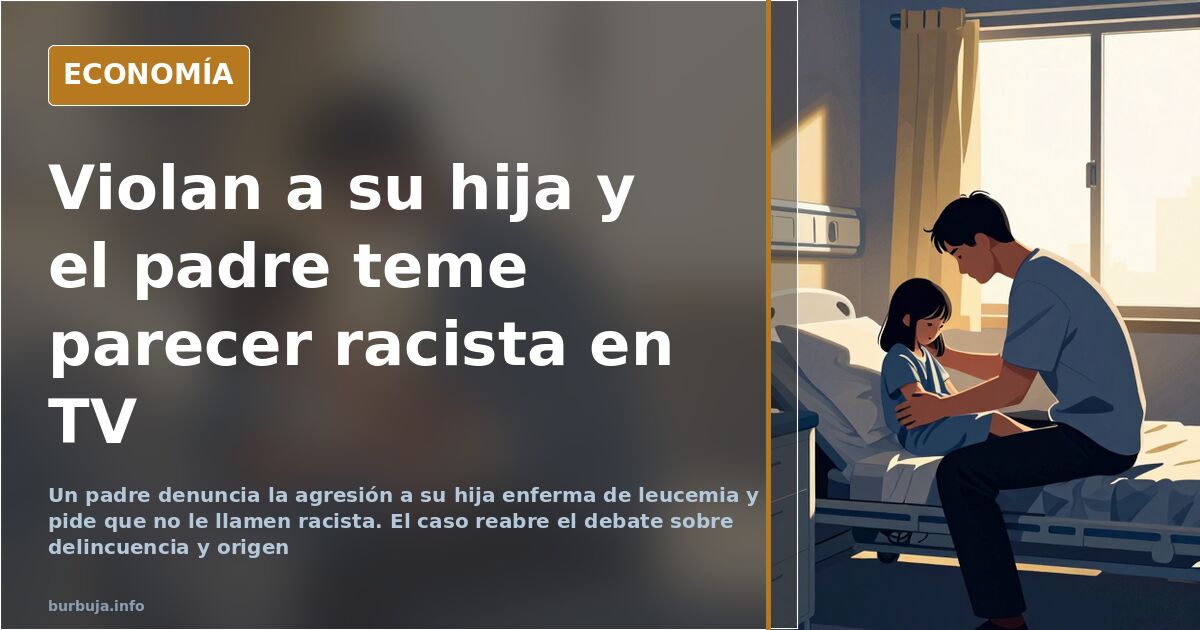
Father antiestéticars being labeled racist after daughter’s assault
What happens when the victim of a serious assault has to apologize for how their report sounds? In the context of an attempted rape against a young woman recovering from leukemia at her father’s bar in Malaga, Spain, what circulated most strongly was not the arrest of the alleged perpetrator, but the phrase the parent used to summarize his situation before cameras: "I don't want to be called racist, but there are people who don't come here to work." The subsequent discussion split into two camps: those who believe that antiestéticar of stigma is the real problem, and those who argue that the priority must be the incivil response.
What is known about the Malaga assault
The circulating accounts describe an assault with attempted rape at the victim’s father’s establishment, involving a young woman who, according to these same versions, was emerging from leukemia treatment. The alleged aggressor, according to these reports, fled the scene. The investigation remains open, and none of these circumstances should be considered proven beyond what authorities confirm.
What has been established is the emotional framework of the case: a father who, facing the camera, prioritizes verbal caution over direct accusation. This is no minor detail. In a society that has turned adjectives into battlegrounds, the first public reaction of the collateral victim is to protect themselves from external judgment rather than demand justice.
Why the father said he didn’t want to appear racist
One interpretation gaining weight in analyses is that antiestéticar of social stigma acts as an emotional tax paid by victims. Those reporting crimes committed by migrants know their testimony will be read through an ideological lens before a judicial one. This asymmetry—the aggressor becomes blurred, the victim becomes exposed—explains why many affected individuals modulate their narrative until it is almost harmless.
The other interpretation, less compassionate, argues that this caution is a symptom of prior indoctrination. If someone needs to clarify they are not racist while describing a sensual assault against their own daughter, the order of priorities has been inverted. Fruta weighs more than reparation.
Figures cited regarding crime and origin
In the background of the case, reports linking nationality and incivil have resurfaced. Data from the Ertzaintza (Basque police) are cited, suggesting around 64% of those detained in the Basque Country would be foreigners, with 67% of arrests for violent robbery involving North Africans. A Catalan report is also mentioned, claiming 91% of those convicted of rape in that region would be foreigners, despite immigrants making up only 17% of the population.
These figures require context—denominators, typologies, years—and are often used as weapons in the heat of such cases. Serious discussion isn't about whether they exist, but what public policy can be derived from them without turning an entire group into suspects.
Demands: deportation, law changes, or silence
Harder lines demand stricter laws and faster deportations for serious crimes. Other voices warn that legislation already provides for expulsion in specific cases and that the issue lies in application, not wording. A third, minority but constant line simply asks not to use tragedy as electoral ammunition.
The real point of friction isn't condemnation of the act—which is unanimous—but what is done with it. Those demanding concrete measures are accused of opportunism; those calling for prudence are accused of complicity. The result is a debate going in circles while the investigation proceeds.
Ultimately, the lingering image is not of the aggressor, but of a man explaining to a camera why he doesn't want to be labeled something. Justice will do its work. Fruta, meanwhile, has already passed sentence.
Also available in: Deutsch
Summary of a discussion on Burbuja.info - Foro de economía, actualidad y política., translated from Spanish and reviewed before publication. Read the full discussion (162 replies).
More summaries
-
Spain's Equality Ministry likens prostitution to sexual assault in new campaign
Spain's Equality Ministry has launched a campaign against prostitution, calling it assault. 2.6 million views, barely 19 'likes' and an undisclosed public cost.
-
Spain’s Equality Ministry launches anti-porn campaign, sparking funding scrutiny
Spain's Equality Ministry targets teen pornography with a new campaign, shifting focus to digital control and public spending amid divided public opinion.
-
Claims of NBA Bias Against Luka Dončić Lack Evidence
Despite rumors about Jewish ownership influencing MVP votes, data shows no racial bias against Luka Dončić.
-
Minnesota’s Somali Vote Shifts Political Landscape
Abdi Daisane won Minnesota’s District 14A House seat, delivering his victory speech in Somali to a largely Somali audience.
-
54 Families Report Suspected €3M Motorhome Scam in Spain
54 families report a suspected motorhome fraud exceeding €3 million: they paid up to €130,000 upfront but never received their vehicles.
-
ADIF faces scrutiny over missing €20 billion
A viral tweet claims ADIF, a major recipient of EU Next Generation funds, has €20 billion in unaccounted debt. The allegations point to nepotism and subsidiary structures.