
Vegan Diet Risks: B12, Teeth, and Joint Health Under Scrutiny
A personal testimony on reversing joint pain by eating animal fat reopens the debate on vegan diets, highlighting critical concerns regarding B12, dental health, and joint integrity.
English · Original discussion in Spanish · Published
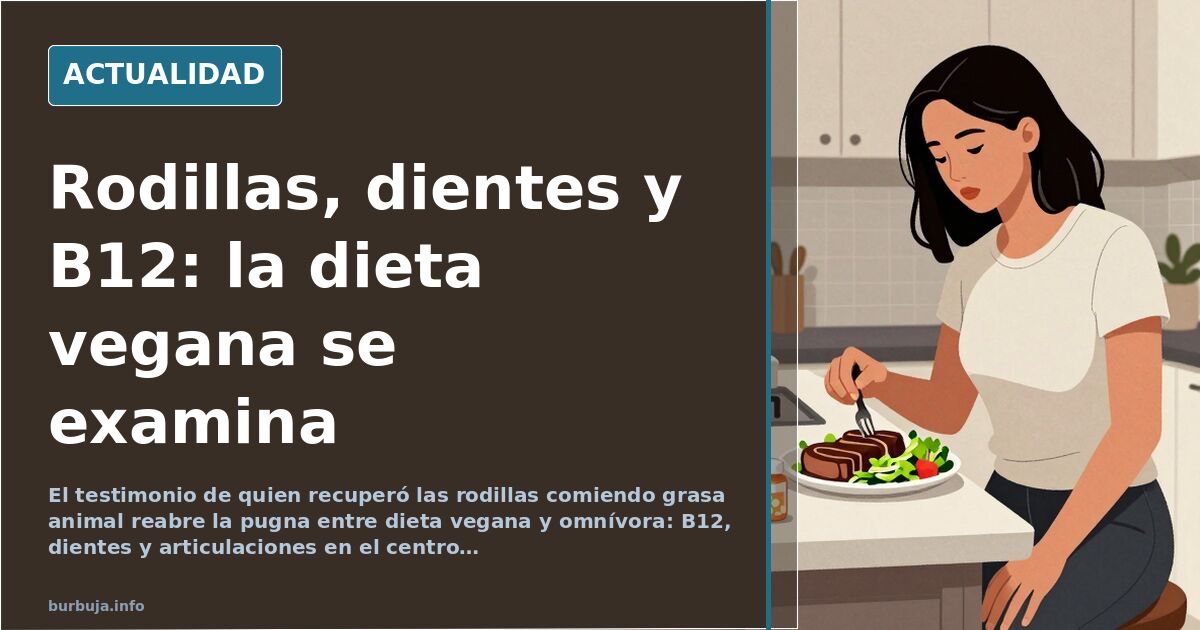
Vegan Diet: B12, Teeth, and the Knee Debate
A personal case—resuming animal fat and noticing knees stop hurting—reignites an endless discussion. The circulating phrase, "as soon as I ate animal fat, I could bend my knees without it being a nightmare," is the testimony of someone who returned to eating animal products. It is not a clinical trial. And it serves as a spark for a fundamental question: can the human body sustain a diet without animal products, or is it a bill paid with joints, teeth, and energy?
On one side are those who see in this story the confirmation of what they have advocated for years. On the other, those who recall that an anecdote proves nothing: no one has established that the damage came from the diet. In between, a real clash of data on vitamin B12, digestive anatomy, and metabolism.
B12, where the conversation becomes technical
Vitamin B12 is the point where the issue ceases to be opinion. Some argue it is only obtained from meat and that, therefore, every vegan needs to supplement. The thesis has merit: reliable plant-based sources of B12 are scarce, and supplementation is among the standard recommendations of nutrition societies.
The nuance comes from another argument: there are plant foods with active B12 and endogenous production exists, in addition to the fact that a large portion of those who eat meat also suffer from deficiency or subdeficiency—up to 40% is cited. Here lies much of the discrepancy: it is less about eating meat or not, but controlling a specific parameter with periodic tests.
Herbivores, omnivores, or something in between?
The pulse shifts to physiology. Humans are compared to gorillas—strict vegetarians with huge muscle mass—and to geladas, who eat grass and do not seem to get sick. From this arises the reading that a plant-based diet is sufficient if the reference animal is an herbivorous primate. Carnivores, it is added, are fast and fierce, with claws and many offspring because many die.
Against this reading, it is recalled that chimpanzees and bonobos hunt and eat meat, and that we share an ancestor with them. It is also pointed out that we have dentition—canines for tearing, forward-facing eyes of a predator—and the proportion between small and large intestine, which would distance humans from gorillas. Here each side has its favorite primate.
From the gym instructor who lost his teeth at 20 to a 20-year-old without meat
Personal stories function as evidence for one side and the other. The case of a gym instructor who, after going vegan, ended up with dental and liver problems is recounted; so is that of an acquaintance who was sluggish from skipping B12. And, on the other side, a 20-year-old vegetarian without meat or fish who says he cannot recall more ailments than a cold, with intact dentition.
The range extends to longevity: reference is made to Santiago Carrillo, who reportedly died in his nineties smoking since age 13, as an example that a single habit does not explain a life. And to Cervantes, at sixty, noting he had only six teeth left. The selection of cases is not innocent: each brings forward the evidence that suits them.
Fats, sugar, and volume: the fight in the background
Beneath veganism lies another battle. It is debated whether refined flour spikes insulin and favors coronary damage, while recalling the French paradox—daily butter and cream, low cholesterol. The circulating conclusion: the body tends to regulate itself according to what it eats.
Volume also appears. The slender Segarro population is compared to the Mexican, and the difference is attributed to quantity: more options, more food turned into pastime. As a home remedy for joints, someone recommends tripe with snout and feet before shark cartilage. The detail lies in the set of figures and cases handled, not in the isolated anecdote.
The clash remains unresolved. Some request B12 tests and studies; others wield their knees, teeth, and age. The data continue to wait for someone to reconcile them.
A personal case—resuming animal fat and noticing knees stop hurting—reignites an endless discussion. The circulating phrase, "as soon as I ate animal fat, I could bend my knees without it being a nightmare," is the testimony of someone who returned to eating animal products. It is not a clinical trial. And it serves as a spark for a fundamental question: can the human body sustain a diet without animal products, or is it a bill paid with joints, teeth, and energy?
On one side are those who see in this story the confirmation of what they have advocated for years. On the other, those who recall that an anecdote proves nothing: no one has established that the damage came from the diet. In between, a real clash of data on vitamin B12, digestive anatomy, and metabolism.
B12, where the conversation becomes technical
Vitamin B12 is the point where the issue ceases to be opinion. Some argue it is only obtained from meat and that, therefore, every vegan needs to supplement. The thesis has merit: reliable plant-based sources of B12 are scarce, and supplementation is among the standard recommendations of nutrition societies.
The nuance comes from another argument: there are plant foods with active B12 and endogenous production exists, in addition to the fact that a large portion of those who eat meat also suffer from deficiency or subdeficiency—up to 40% is cited. Here lies much of the discrepancy: it is less about eating meat or not, but controlling a specific parameter with periodic tests.
Herbivores, omnivores, or something in between?
The pulse shifts to physiology. Humans are compared to gorillas—strict vegetarians with huge muscle mass—and to geladas, who eat grass and do not seem to get sick. From this arises the reading that a plant-based diet is sufficient if the reference animal is an herbivorous primate. Carnivores, it is added, are fast and fierce, with claws and many offspring because many die.
Against this reading, it is recalled that chimpanzees and bonobos hunt and eat meat, and that we share an ancestor with them. It is also pointed out that we have dentition—canines for tearing, forward-facing eyes of a predator—and the proportion between small and large intestine, which would distance humans from gorillas. Here each side has its favorite primate.
From the gym instructor who lost his teeth at 20 to a 20-year-old without meat
Personal stories function as evidence for one side and the other. The case of a gym instructor who, after going vegan, ended up with dental and liver problems is recounted; so is that of an acquaintance who was sluggish from skipping B12. And, on the other side, a 20-year-old vegetarian without meat or fish who says he cannot recall more ailments than a cold, with intact dentition.
The range extends to longevity: reference is made to Santiago Carrillo, who reportedly died in his nineties smoking since age 13, as an example that a single habit does not explain a life. And to Cervantes, at sixty, noting he had only six teeth left. The selection of cases is not innocent: each brings forward the evidence that suits them.
Fats, sugar, and volume: the fight in the background
Beneath veganism lies another battle. It is debated whether refined flour spikes insulin and favors coronary damage, while recalling the French paradox—daily butter and cream, low cholesterol. The circulating conclusion: the body tends to regulate itself according to what it eats.
Volume also appears. The slender Segarro population is compared to the Mexican, and the difference is attributed to quantity: more options, more food turned into pastime. As a home remedy for joints, someone recommends tripe with snout and feet before shark cartilage. The detail lies in the set of figures and cases handled, not in the isolated anecdote.
The clash remains unresolved. Some request B12 tests and studies; others wield their knees, teeth, and age. The data continue to wait for someone to reconcile them.
Summary of a discussion on Burbuja.info - Foro de economía, actualidad y política., translated from Spanish and reviewed before publication. Read the full discussion (433 replies).
More summaries
-
Greta Thunberg’s Diet: Is Veganism Taking a Toll on Her Health?
Greta Thunberg’s changing appearance sparks debate about vegan diets. Experts examine B12, iron, and iodine deficiencies to assess long-term health impacts.
-
The PISA Mirage: Why Regional IQ Maps Mislead
A viral map of regional IQ is debunked: data is from re-scaled PISA 2015 results, lacking psychometric validity.
-
Glass bottles retaliate against neighbor's hallway trash in Spain
A Spanish resident retaliates with glass bottles after months of a neighbor leaving cardboard and packaging in the shared hallway.
-
Spain faces economic collapse amid debt and inflation
Analysis of data pointing to Spain's potential collapse: record immigration, unsustainable debt, and inflation acting as a hidden tax.
-
Why Climbers Are Left to Die at 8,000 Meters in 2025
Why can't we rescue climbers at 8,000 meters in 2025? Helicopters, drones, and the limits of technology in the Death Zone.
-
Opus Dei loses youth to Hakuna and Kikos movements
Opus Dei is losing young members to the trendy Hakuna movement and the Neocatechumenal Way, marking a shift in Spanish Catholic recruitment.