
Valencia: The Awning That Wasn't There and the Façade That Burned
Photos from 2018 and 2022 show no awning on the terrace where the Valencia fire started, while the composite façade is the focus of suspicion.
English · Original discussion in Spanish · Published
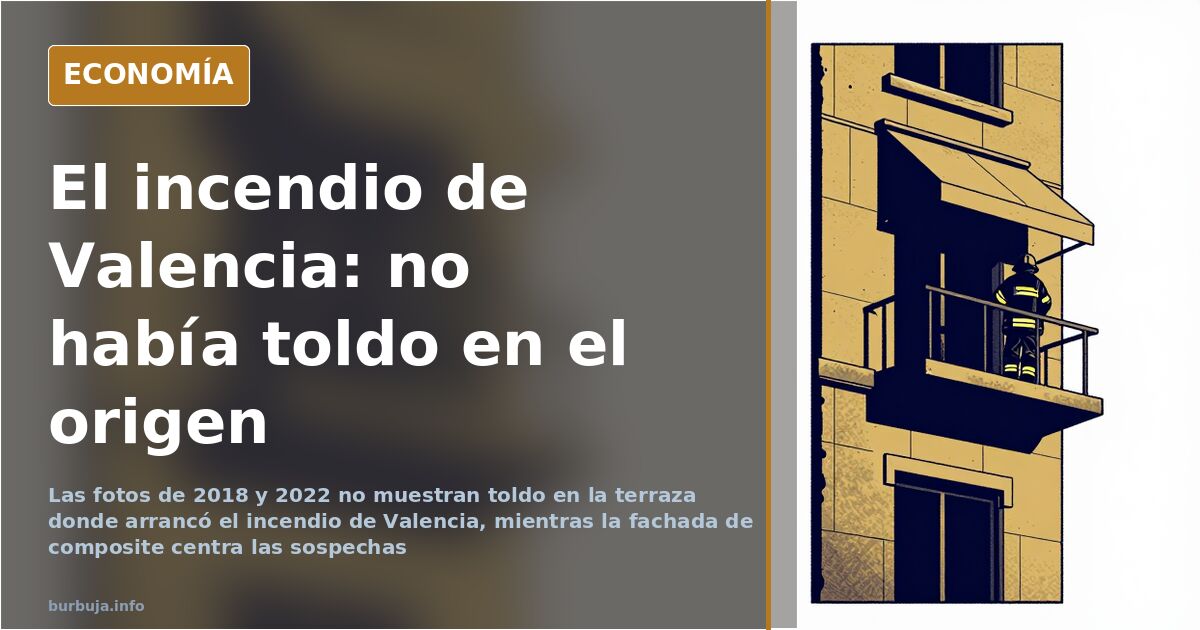
No awning at the origin, no innocent façade: the Valencia fire
A Google photo from 2018. Another from 2022. In both, the terrace of the apartment where the Valencia fire started looks bare: no canvas, no arms, no motor. Videos filmed that day from other angles say the same. And even so, the first explanation that circulated—a short circuit in an awning motor—rested precisely on that: an awning the images do not show.
The comparison of snapshots from different dates has become the crux of the controversy. Neither in 2018 nor in 2022 was there an awning on that terrace, and many others in the same block did not have one either. The awnings seen today were installed later, as owners put them up. The question now is whether the official account holds up without that detail or whether the detail was the entire account.
Why is the awning ruled out as the origin of the fire?
Because the fire comes from inside the apartment before any fabric catches. That is the dominant reading among those who have reviewed the videos: the mass of fire visible is too violent to come from a canvas, and in the sequence you can see how the ceiling material falls away after there is already fire below. The order of events would be the opposite of what the motor theory suggests.
Some go further and maintain that what appears in one of the images is not an awning but decorative panels that had already come loose. The argument is about proportion: compared with the awnings on other floors, its width takes up half the terrace. A canvas does not shrink. A broken panel does.
Larson Alucoil, Alucobond and the ghost of Grenfell Tower
The building was completed in 2008 with a Larson Alucoil composite façade, a material combining aluminium and a polymer core. The name is no coincidence: Larson and Alucobond are cited in the inquiry report into Grenfell Tower, a 274-page document that mentions both products on page 14. The coincidence has revived the theory that the problem was not the origin of the fire but its fuel.
The recurring idea: a polyurethane cladding turns any spark into a vertical torch. If the façade were not flammable, a domestic fire would have remained a domestic fire. Composite is installed in countries whose rules allow it, and the question hanging over everything is how many Spanish buildings of that era share the same cladding. The real scope, building by building, is what could matter more than any theory about awnings.
The concierge who warned the neighbours and the account that changed
One of the most notable episodes has a name: the concierge who went door to door warning residents to get out before the smoke made it impossible. He saved people without waiting for any instruction. His account, however, has not been identical in all his public appearances: in the first version he said he stopped warning people because the firefighters asked him to; in later ones, that he stopped because the smoke was unbearable. The shift in nuance has fuelled suspicion of a script corrected to avoid contradicting the stay-put protocol.
The handling of that protocol is the other major front. Some defend that confining people was correct given the available data, while others argue that the order to stay at home pushed residents into a trap. The fact no one disputes: those who got out in time, warned aloud, are alive.
What the evidence-free hypotheses maintain
At the most speculative end, theories circulate that the available material does not support: that the fire was started with petrol, that a lithium battery caused it, that it was linked to an alleged ritual on a symbolic date. None has documentary backing, and the case file remains sealed, making it impossible to confirm or rule out any cause. In fact, a short circuit in an empty home trips the breaker and, in principle, should not burn anything.
It is worth separating two things that get mixed together. On one hand, the reasonable doubts about the façade material and the cause of the fire, backed by photos, videos and cited reports. On the other, speculation without evidence. Mixing them is the fastest way for the matter to be forgotten without answers.
The fire an awning cannot explain
In January an awning burned in Valencia. One home affected and residents who escaped. Here, by contrast, the fire devoured an entire façade and the origin still has no official answer. The difference was not in the fabric. It was, probably, in everything underneath: the composite, the polyurethane and regulations that allowed it to be built that way.
A Google photo from 2018. Another from 2022. In both, the terrace of the apartment where the Valencia fire started looks bare: no canvas, no arms, no motor. Videos filmed that day from other angles say the same. And even so, the first explanation that circulated—a short circuit in an awning motor—rested precisely on that: an awning the images do not show.
The comparison of snapshots from different dates has become the crux of the controversy. Neither in 2018 nor in 2022 was there an awning on that terrace, and many others in the same block did not have one either. The awnings seen today were installed later, as owners put them up. The question now is whether the official account holds up without that detail or whether the detail was the entire account.
Why is the awning ruled out as the origin of the fire?
Because the fire comes from inside the apartment before any fabric catches. That is the dominant reading among those who have reviewed the videos: the mass of fire visible is too violent to come from a canvas, and in the sequence you can see how the ceiling material falls away after there is already fire below. The order of events would be the opposite of what the motor theory suggests.
Some go further and maintain that what appears in one of the images is not an awning but decorative panels that had already come loose. The argument is about proportion: compared with the awnings on other floors, its width takes up half the terrace. A canvas does not shrink. A broken panel does.
Larson Alucoil, Alucobond and the ghost of Grenfell Tower
The building was completed in 2008 with a Larson Alucoil composite façade, a material combining aluminium and a polymer core. The name is no coincidence: Larson and Alucobond are cited in the inquiry report into Grenfell Tower, a 274-page document that mentions both products on page 14. The coincidence has revived the theory that the problem was not the origin of the fire but its fuel.
The recurring idea: a polyurethane cladding turns any spark into a vertical torch. If the façade were not flammable, a domestic fire would have remained a domestic fire. Composite is installed in countries whose rules allow it, and the question hanging over everything is how many Spanish buildings of that era share the same cladding. The real scope, building by building, is what could matter more than any theory about awnings.
The concierge who warned the neighbours and the account that changed
One of the most notable episodes has a name: the concierge who went door to door warning residents to get out before the smoke made it impossible. He saved people without waiting for any instruction. His account, however, has not been identical in all his public appearances: in the first version he said he stopped warning people because the firefighters asked him to; in later ones, that he stopped because the smoke was unbearable. The shift in nuance has fuelled suspicion of a script corrected to avoid contradicting the stay-put protocol.
The handling of that protocol is the other major front. Some defend that confining people was correct given the available data, while others argue that the order to stay at home pushed residents into a trap. The fact no one disputes: those who got out in time, warned aloud, are alive.
What the evidence-free hypotheses maintain
At the most speculative end, theories circulate that the available material does not support: that the fire was started with petrol, that a lithium battery caused it, that it was linked to an alleged ritual on a symbolic date. None has documentary backing, and the case file remains sealed, making it impossible to confirm or rule out any cause. In fact, a short circuit in an empty home trips the breaker and, in principle, should not burn anything.
It is worth separating two things that get mixed together. On one hand, the reasonable doubts about the façade material and the cause of the fire, backed by photos, videos and cited reports. On the other, speculation without evidence. Mixing them is the fastest way for the matter to be forgotten without answers.
The fire an awning cannot explain
In January an awning burned in Valencia. One home affected and residents who escaped. Here, by contrast, the fire devoured an entire façade and the origin still has no official answer. The difference was not in the fabric. It was, probably, in everything underneath: the composite, the polyurethane and regulations that allowed it to be built that way.
Summary of a discussion on Burbuja.info - Foro de economía, actualidad y política., translated from Spanish and reviewed before publication. Read the full discussion (328 replies).
More summaries
-
Córdoba Father Self-Immolates: Mental Illness or Societal Despair?
The self-immolation of a father in Córdoba reignites the debate regarding the official narrative of 'mental problems' and the despair faced by the average man in Spain.
-
Euthanasia in Old Age: Autonomy vs. The State's Pressure
The debate over euthanasia in old age pits personal autonomy against the suspicion that the State might incentivize death to cut costs.
-
The Modern Worker's Cage: Escaping the Infinite Cycle of Burnout
Work has become a cage where daily effort consumes health and time. Discover why we push ourselves so hard and how to break the cycle.
-
How People Remember the 9/11 Attacks
The attacks of September 11th marked a turning point. Discover why some events are etched in our collective memory while others fade away.
-
Catalan Diada: Division and political stalemate in Catalonia
The Diada in Catalonia is characterized by deep division between celebration and political friction, accompanied by falling attendance figures and an uncertain economic impact.
-
Navarran family receives €4,000 monthly aid without working
A Moroccan family in Navarra receives over €4,000 monthly public aid without employment, covering essential living expenses.