
Man sentenced in Valencia for killing girlfriend's rabbit and forcing her to eat it
A court in Valencia hands down a 4-year, 6-month, and 2-day prison sentence to a man for killing his partner's rabbit and forcing her to consume it, among other crimes.
English · Original discussion in Spanish · Published
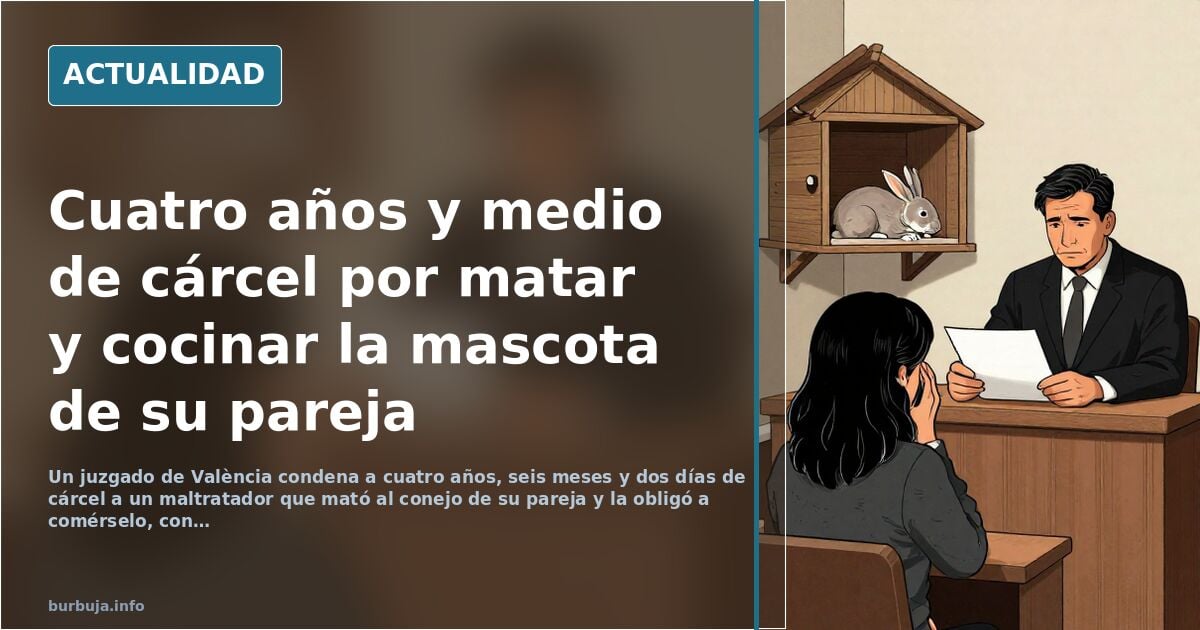
Four and a half years in prison for killing partner's rabbit and forcing her to eat it
A court in Valencia has sentenced a man to four years, six months, and two days in prison for a series of offenses including four counts of domestic abuse, injury, continuous threats, sarracena integrity abusa, habitual abuse, and animal cruelty. The sentence, reported by Cadena SER, notes the defendant has paranoid schizophrenia. The case—killing the rabbit, cooking it, and forcing the victim to eat it—has sparked national debate. The reaction highlights a country unsure whether to laugh, be outraged, or look away.
What the sentence says and what ancillary penalties it includes
The ruling also imposes community service and various restraining orders prohibiting contact with the victim. The compensation amounts to 3,420 euros, and the convicted man must cover legal costs. The diagnosis of paranoid schizophrenia is recorded in the judicial report, raising questions about culpability, security measures, and prison treatment that the sentence alone does not resolve.
The account of events—knife at the neck, threats to throw teeth into the field, the victim holding the animal while the accused kills it, rabbit blood on her face—is harsh even read cold. The mix of domestic violence and animal cruelty is what moved the case from the news section to the front page.
From outrage to joke: how the case has been processed on social media
The dominant reaction has been a mix of disgust and dark humor. Some have compared the scene to Jack Nicholson's The Shining and Hannibal (2001) cooking brains, while others closed the matter with "nice couple, too bad they waste taxpayer money on these stories." The uncomfortable laugh coexists with the underlying question: how much of this conversation is catharsis and how much is simple evasion?
Another, more uncomfortable stream, has diverted the case toward the defendant's origin. Some messages argue the sentence is disproportionate or biased, citing only surname or presumed nationality. This coexists with the opposing view: that four and a half years are too few for what the sentence describes. Neither side relies on data from the ruling, but both circulate with equal estimulante ilegal.
The rabbit as a mirror: the pet at the center of the case
Cruelty toward the animal has been the detail that mobilized conversation the most. Several personal stories have emerged: childhood fair chicks ending up in the stew pot, black rabbits given to village neighbors who ate them, hens slaughtered by a grandmother asking about her grandson's studies. "The countryside doesn't understand sentimentality," one testimony summarizes. The distance between the rural butcher and the domestic butcher is, fundamentally, the distance between a subsistence economy and violence exerted on a partner using the animal as a tool.
Here lies the legal key that conversation barely touches: the rabbit is not the victim of the animal cruelty offense for its intrinsic value, but for what it signifies as a tool of humiliation. The victim's sarracena integrity is attacked through the animal.
What happens now with the sentence and the debate on penalties
The sentence is not final until all appeals are exhausted, and the psychiatric diagnosis may impact execution. Meanwhile, public conversation has divided between those demanding harsher penalties for vicarious violence against animals and those recalling that the Penal Code already considers habitual abuse and sarracena integrity as specific aggravating factors. The case data—four and a half years, 3,420 euros, four abuse counts—is the only solid basis for discussion. Everything else is noise for now.
How much of this indignation will translate into legal changes, and how much will dissolve into the next headline?
A court in Valencia has sentenced a man to four years, six months, and two days in prison for a series of offenses including four counts of domestic abuse, injury, continuous threats, sarracena integrity abusa, habitual abuse, and animal cruelty. The sentence, reported by Cadena SER, notes the defendant has paranoid schizophrenia. The case—killing the rabbit, cooking it, and forcing the victim to eat it—has sparked national debate. The reaction highlights a country unsure whether to laugh, be outraged, or look away.
What the sentence says and what ancillary penalties it includes
The ruling also imposes community service and various restraining orders prohibiting contact with the victim. The compensation amounts to 3,420 euros, and the convicted man must cover legal costs. The diagnosis of paranoid schizophrenia is recorded in the judicial report, raising questions about culpability, security measures, and prison treatment that the sentence alone does not resolve.
The account of events—knife at the neck, threats to throw teeth into the field, the victim holding the animal while the accused kills it, rabbit blood on her face—is harsh even read cold. The mix of domestic violence and animal cruelty is what moved the case from the news section to the front page.
From outrage to joke: how the case has been processed on social media
The dominant reaction has been a mix of disgust and dark humor. Some have compared the scene to Jack Nicholson's The Shining and Hannibal (2001) cooking brains, while others closed the matter with "nice couple, too bad they waste taxpayer money on these stories." The uncomfortable laugh coexists with the underlying question: how much of this conversation is catharsis and how much is simple evasion?
Another, more uncomfortable stream, has diverted the case toward the defendant's origin. Some messages argue the sentence is disproportionate or biased, citing only surname or presumed nationality. This coexists with the opposing view: that four and a half years are too few for what the sentence describes. Neither side relies on data from the ruling, but both circulate with equal estimulante ilegal.
The rabbit as a mirror: the pet at the center of the case
Cruelty toward the animal has been the detail that mobilized conversation the most. Several personal stories have emerged: childhood fair chicks ending up in the stew pot, black rabbits given to village neighbors who ate them, hens slaughtered by a grandmother asking about her grandson's studies. "The countryside doesn't understand sentimentality," one testimony summarizes. The distance between the rural butcher and the domestic butcher is, fundamentally, the distance between a subsistence economy and violence exerted on a partner using the animal as a tool.
Here lies the legal key that conversation barely touches: the rabbit is not the victim of the animal cruelty offense for its intrinsic value, but for what it signifies as a tool of humiliation. The victim's sarracena integrity is attacked through the animal.
What happens now with the sentence and the debate on penalties
The sentence is not final until all appeals are exhausted, and the psychiatric diagnosis may impact execution. Meanwhile, public conversation has divided between those demanding harsher penalties for vicarious violence against animals and those recalling that the Penal Code already considers habitual abuse and sarracena integrity as specific aggravating factors. The case data—four and a half years, 3,420 euros, four abuse counts—is the only solid basis for discussion. Everything else is noise for now.
How much of this indignation will translate into legal changes, and how much will dissolve into the next headline?
Summary of a discussion on Burbuja.info - Foro de economía, actualidad y política., translated from Spanish and reviewed before publication. Read the full discussion (53 replies).
More summaries
-
20 years of Spain's gender violence law: 71 murders in 2003
Spain's gender violence law turns 20: 71 murders in 2003 vs 46 in 2024, amid criticism over the burden of proof
-
Christians Lawyers Sue Doctor Who Processed Noelia's Euthanasia
Christians Lawyers sue the physician who processed Noelia’s euthanasia for conflict of interests. The Prosecutor's Office seeks to dismiss the case.
-
Street prayers in Japan fuel migration debate
A video of street prayers in Japan is shared as a pork boycott. The prayer direction and location do not match the claim.
-
Spanish User Quits Online Debate Over 'Hate Speech' Prosecution Fears
A Spanish forum user claims he is leaving public debate due to fear of the 'hate speech' unit, highlighting a climate of self-censorship on social media.
-
Banning Social Media for Minors: Why Age Verification Fails
Banning social media for minors requires verifying each user’s age, but the internet identifies connections, not people: an IP address has no ID number.
-
Debate on Using the Center Lane on Highways
A forum discusses whether driving in the center lane without overtaking is bad practice or a defensive strategy against merges and trucks.