
Valencia Floods: Why New Turia Channel Didn't Save South
The new Turia channel held firm, but the Poyo Rambla flooded southern Valencia. A missing link to the old channel remains the core issue.
English · Original discussion in Spanish · Published
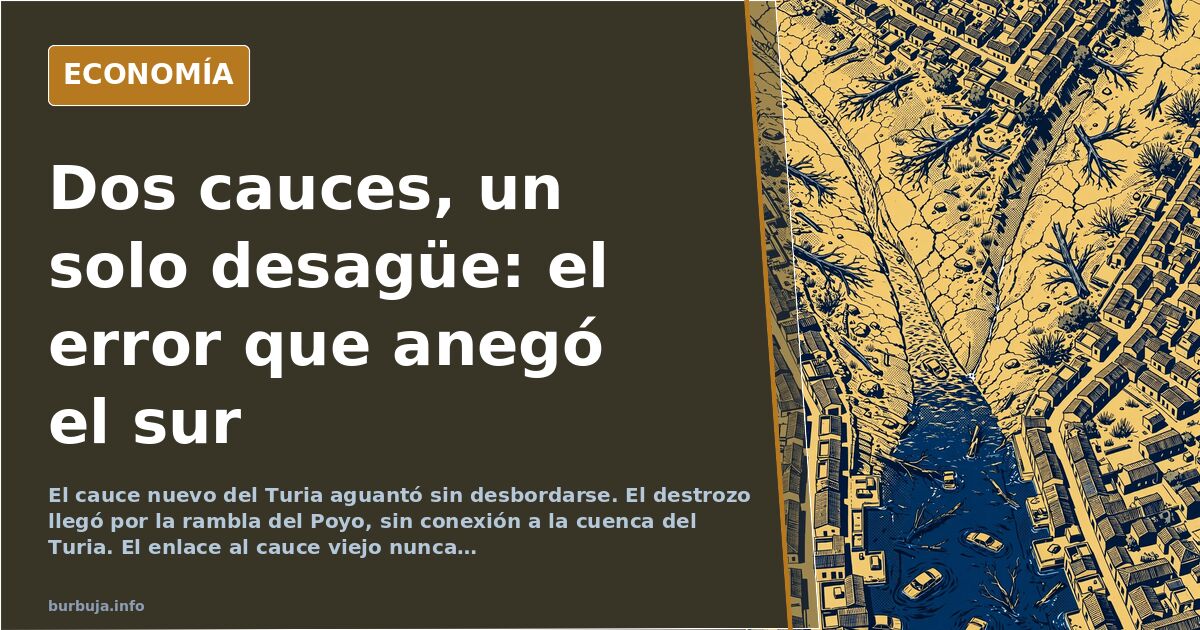
Two channels, one outlet: why water never reached the old Turia
The new Turia channel held. That fact dismantles half the debate. The water level never reached maximum capacity, and it did not overflow on the side facing the capital city. The damage occurred on the southern flank, along the V-30, caused by flow from the Poyo Rambla, a ravine that empties into the Albufera and was never connected to the Turia basin. This is where the problem began, and it persists two years after this issue surfaced.
Why wasn't the old channel used despite having two?
The question at the heart of the matter has an uncomfortable answer: because the infrastructure required to do so does not exist. The old and new channels diverge at a specific point between Aldaia and Manises, near the A-3 motorway. This is where excess water from the Poyo should have been diverted to the historic branch. That connection has not been built. What exists in that area are machines moving earth to widen the highway, not to drain floodwaters.
Proponents of this view argue with basic hydraulic logic: a water sheet that slows down increases in height. With two outlets, relief is faster. The old channel, now converted into a park, sports areas, and part of the City of Arts and Sciences, remains an excavated canal with theoretical capacity. The difference is that it no longer receives any water.
The plan that existed but was never executed
This is not a casual observation. The Júcar Hydrographic Confederation worked on a project titled "Environmental adaptation and drainage of the Poyo basin flowing into the Albufera." The planned route started at the Pozalet ravine, trinc the Saleta ravine in Aldaia, and exited into the new channel via Xirivella. The goal was to prevent the Poyo Rambla from flooding the municipalities it currently affects and to ensure the Saleta ravine did not impact Aldaia, Alaquàs, or Xirivella.
There is more. A civil engineer specializing in canals and ports, holding a doctorate and a key reference in Spanish water management, designed a risk management plan for that same zone with the Confederation. He proposed creating around one hundred micro-dams, each with a capacity of several hundred thousand cubic meters—below one hectometer cube—which he argued would have drastically reduced the catastrophe's scope. The estimated cost of the discarded plan was around €221 million. Insurance consortium compensation bills were estimated to exceed €350 million.
The debate on dams and gates
When discussing dams, it is worth remembering how they work. Every dam needs to release water beyond a certain threshold to avoid compromising its own stability, and that threshold is worse than any flood: a dike breach is non-negotiable. Gate opening times are fixed in operating regulations, based on time and flow studies. Fixed-weir spillways simply start releasing water when levels exceed them. There is no room for improvisation or heroism.
In parallel, another version of events circulates: claims that reservoirs were demolished, that ravines and torrents were not cleaned, and that timely warnings were not issued to those who ended up on roads during the flood. These assertions appear in discussions without supporting documentation and, as of this analysis, remain unverified.
What is documented
The Confederation ruled out connecting the Poyo Rambla to the new Turia channel. The cited reason is incompatibility with agricultural land legislation (huerta), not an engineering problem. Physical possibility exists; administrative antiestéticasibility does not.
Regarding the expansion of the new channel, the diagnosis is harsher: some sections are antiestéticasible, while others are impossible because the channel is surrounded by housing. No land was reserved for hypothetical future expansion. That is irreversible. According to circulating proposals, what can be done is upstream expansion from Paiporta, connecting there to the new channel to discharge excess water. Downstream, a direct connection to the sea bypassing the Albufera is suggested for future floods like this one.
The new channel saved most of the city. It functioned as a firewall. The water that flooded the south was not its responsibility. Given these facts, the question is no longer why both channels weren't used, but how many archived drainage plans are needed before someone signs off on the one that actually gets built.
Also available in: Deutsch
Summary of a discussion on Burbuja.info - Foro de economía, actualidad y política., translated from Spanish and reviewed before publication. Read the full discussion (192 replies).
More summaries
-
Jucar River Authority Insured Staff for Negligence Before DANA
The Jucar River Authority formalized civil liability insurance for 212 employees on October 7, weeks before the DANA floods devastated parts of Spain.
-
Poyo River: Flow Surges from 29 to 1,686 m³/s in Under Three Hours
The Júcar River Authority sent 18 emails between 16:13 and 18:43 as the Poyo River’s flow jumped from 29 to 1,686 m³/s, while the official graph was missing a zero.
-
Júcar River Authority Warned of Poyo Flood Flow Over an Hour Late
The Júcar River Authority (CHJ) notified Civil Protection of critical flow levels in the Poyo ravine more than an hour after they were exceeded during the Valencia DANA.
-
More housing won't lower prices if population keeps growing
A forum user argues that building more homes won't reduce prices if population growth continues, challenging Spain's expansion model.
-
Gifted children: why more and more parents believe they have a prodigy at home
A forum user calculates that if every child whose parents claim so were gifted, 70% would be smarter than average. The label has spiralled out of control.
-
No Christmas this year in the heart of Europe
A viral post claims Australia, France and Germany have cancelled their New Year celebrations over Islamist terrorism. There is no official confirmation.