
US will take two years to replenish weapons sent to Ukraine
US has already sent a third of its Stinger and Javelin stocks and will take two years to replenish them: Western superiority has a material ceiling.
English · Original discussion in Spanish · Published
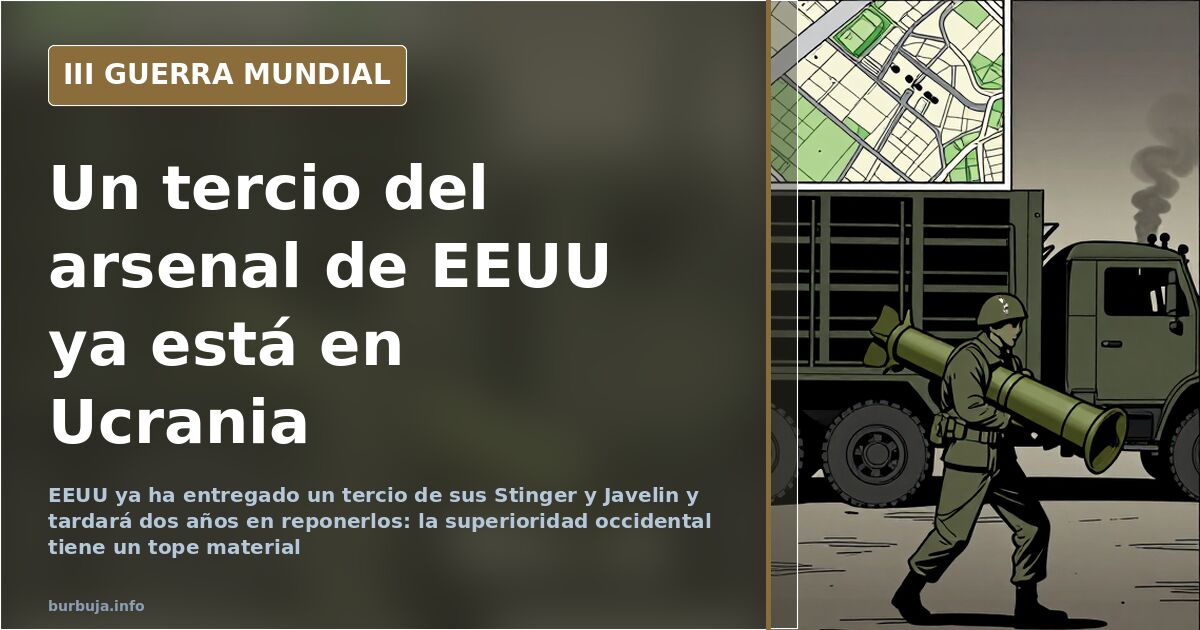
The West wins on technology, Russia on artillery and endurance
Western superiority in conventional warfare, according to the dominant thesis, is a proven fact: the US-led bloc plays in a different military league, and the war in Ukraine has made that plain. The US defense budget exceeds that of the rest of the world’s countries combined, an argument brandished as proof of invincibility in a conflict on the scale of World War II. The problem appears when the analysis moves from budget to inventory.
Because inventory has numbers. And the numbers are uncomfortable.
A third of the Stingers and Javelins, already delivered
The most repeated figure against that thesis is stocks. The United States has delivered to Ukraine approximately one third of its Javelin anti-tank missiles and its Stinger anti-aircraft missiles, and has acknowledged that it will not be able to replace what was sent for at least two years. European accounts are no better: Spain has sent 200 tonnes of equipment from its own stocks, material taken from the arsenal the country normally uses.
From there, the circulating estimate is that the US can sustain an intensive war for a maximum of four months. Russia, by contrast, fires artillery with World War II-era technology —old, inaccurate but abundant shells— and, according to this reading, can do so almost without limit. The asymmetry is clear: the West supplies precision and guided munitions; the other side supplies volume.
Some qualify that the shipments also serve to empty warehouses whose stock was beginning to deteriorate after years without open conflicts. In that version, some of the material reaches the front in less than optimal condition, and that is not always due to generosity or urgency.
Winning by sheer weight of numbers: 730,000 dead in five years
The other leg of the argument is not technological but demographic. Russian military doctrine, it is argued, does not compete on coordination or flexibility but on overwhelming mass: eliminate the time factor and accept attrition. The circulating calculation is simple and brutal: 400 Ukrainians killed a day for five years add up to 730,000 casualties, in exchange for some 300,000 of its own. In that equation, the clock is not an enemy.
The objection is that Russia is no longer the USSR. A society that consumes propaganda and hides figures is not indifferent to its dead either, and Ukraine was part of the same bloc, with similar sensibilities. The avalanche calculation is arithmetically correct and sociologically dubious.
Kyiv airport and the satellite war
The episode that best sums up supposed Western superiority is the assault on Kyiv airport in the first hours of the invasion. According to one of the most widely circulated versions, the Russian contingent lost the element of surprise because the defenders knew the number of troops, the weaponry, the exact destination and even the flight plan. On the ground, Ukrainians fought; the information and technology, it is argued, were Western.
Another important nuance: the foreign troops present operated as advisers and trainers, not as combat units. A hundred elite operators do not change a battle, but training thousands of soldiers multiplies their effect. With that cocktail —light munitions, real-time satellite intelligence and command on the ground— Ukraine would have halted the Russian offensive on Kyiv and Kharkiv, inflicting more than 20,000 casualties. Removing nuclear weapons from the equation and maintaining that Russia cannot last a month against NATO is the most repeated corollary.
From Afghanistan to Yemen: the limit is not military, it is political
The fine print of the Western record appears here. The withdrawal from Afghanistan is not read as a military defeat but as the inability to sell a way of life that collapsed as soon as the troops left. And some recall that fighting a country bombed without limits is not the same as fighting an army trained and armed by a third party, with S-300, BUK M1 or Pantsir air-defense systems on the ground.
The example cited to temper optimism is Saudi Arabia: the best Western equipment, bogged down in Yemen. And it raises an uncomfortable question: what would a Western army do in the face of its own casualties, when the threshold for calling a ceasefire is around a thousand dead.
The narrative splits: Crimea, Yanukovych and legitimacy
In parallel, the discussion drifted toward the past. One side maintains that Ukraine did not become independent from Russia and recalls that the Ukrainian republic is a century old; another returns to the 2014 change of government, the electoral victory of the deposed president and a removal voted by three quarters of parliament. Cross-accusations over the repression of protests remain unresolved, and neither position closes the matter.
That stretch reveals the underlying problem. War is not fought only with artillery: it is fought with narratives, and there Western superiority becomes far less overwhelming.
With these ingredients, the reasonable prediction is real Western superiority in technology and intelligence, but conditioned by an industrial capacity that cannot withstand long standoffs. If the conflict stretches beyond what the warehouses allow, the advantage ceases to be military and becomes a question of how long each side’s economy can hold out. No one has yet put that figure on the table.
Western superiority in conventional warfare, according to the dominant thesis, is a proven fact: the US-led bloc plays in a different military league, and the war in Ukraine has made that plain. The US defense budget exceeds that of the rest of the world’s countries combined, an argument brandished as proof of invincibility in a conflict on the scale of World War II. The problem appears when the analysis moves from budget to inventory.
Because inventory has numbers. And the numbers are uncomfortable.
A third of the Stingers and Javelins, already delivered
The most repeated figure against that thesis is stocks. The United States has delivered to Ukraine approximately one third of its Javelin anti-tank missiles and its Stinger anti-aircraft missiles, and has acknowledged that it will not be able to replace what was sent for at least two years. European accounts are no better: Spain has sent 200 tonnes of equipment from its own stocks, material taken from the arsenal the country normally uses.
From there, the circulating estimate is that the US can sustain an intensive war for a maximum of four months. Russia, by contrast, fires artillery with World War II-era technology —old, inaccurate but abundant shells— and, according to this reading, can do so almost without limit. The asymmetry is clear: the West supplies precision and guided munitions; the other side supplies volume.
Some qualify that the shipments also serve to empty warehouses whose stock was beginning to deteriorate after years without open conflicts. In that version, some of the material reaches the front in less than optimal condition, and that is not always due to generosity or urgency.
Winning by sheer weight of numbers: 730,000 dead in five years
The other leg of the argument is not technological but demographic. Russian military doctrine, it is argued, does not compete on coordination or flexibility but on overwhelming mass: eliminate the time factor and accept attrition. The circulating calculation is simple and brutal: 400 Ukrainians killed a day for five years add up to 730,000 casualties, in exchange for some 300,000 of its own. In that equation, the clock is not an enemy.
The objection is that Russia is no longer the USSR. A society that consumes propaganda and hides figures is not indifferent to its dead either, and Ukraine was part of the same bloc, with similar sensibilities. The avalanche calculation is arithmetically correct and sociologically dubious.
Kyiv airport and the satellite war
The episode that best sums up supposed Western superiority is the assault on Kyiv airport in the first hours of the invasion. According to one of the most widely circulated versions, the Russian contingent lost the element of surprise because the defenders knew the number of troops, the weaponry, the exact destination and even the flight plan. On the ground, Ukrainians fought; the information and technology, it is argued, were Western.
Another important nuance: the foreign troops present operated as advisers and trainers, not as combat units. A hundred elite operators do not change a battle, but training thousands of soldiers multiplies their effect. With that cocktail —light munitions, real-time satellite intelligence and command on the ground— Ukraine would have halted the Russian offensive on Kyiv and Kharkiv, inflicting more than 20,000 casualties. Removing nuclear weapons from the equation and maintaining that Russia cannot last a month against NATO is the most repeated corollary.
From Afghanistan to Yemen: the limit is not military, it is political
The fine print of the Western record appears here. The withdrawal from Afghanistan is not read as a military defeat but as the inability to sell a way of life that collapsed as soon as the troops left. And some recall that fighting a country bombed without limits is not the same as fighting an army trained and armed by a third party, with S-300, BUK M1 or Pantsir air-defense systems on the ground.
The example cited to temper optimism is Saudi Arabia: the best Western equipment, bogged down in Yemen. And it raises an uncomfortable question: what would a Western army do in the face of its own casualties, when the threshold for calling a ceasefire is around a thousand dead.
The narrative splits: Crimea, Yanukovych and legitimacy
In parallel, the discussion drifted toward the past. One side maintains that Ukraine did not become independent from Russia and recalls that the Ukrainian republic is a century old; another returns to the 2014 change of government, the electoral victory of the deposed president and a removal voted by three quarters of parliament. Cross-accusations over the repression of protests remain unresolved, and neither position closes the matter.
That stretch reveals the underlying problem. War is not fought only with artillery: it is fought with narratives, and there Western superiority becomes far less overwhelming.
With these ingredients, the reasonable prediction is real Western superiority in technology and intelligence, but conditioned by an industrial capacity that cannot withstand long standoffs. If the conflict stretches beyond what the warehouses allow, the advantage ceases to be military and becomes a question of how long each side’s economy can hold out. No one has yet put that figure on the table.
Summary of a discussion on Burbuja.info - Foro de economía, actualidad y política., translated from Spanish and reviewed before publication. Read the full discussion (170 replies).
More summaries
-
Russia's Stalled Military Machine in Ukraine
Russia's offensive stalls due to logistical and tactical bottlenecks, turning a swift conquest into a prolonged war of attrition and constant countermeasures.
-
Ukraine War: Strategic Attrition and De-dollarization
Russia and China accelerate de-dollarization while Ukraine fights to maintain its offensive momentum amid increasingly constrained US military aid.
-
Ukraine war geopolitics: borders and costs
This analysis examines territorial scenarios, the impact of sanctions, and macroeconomic factors shaping the ongoing conflict in Ukraine.
-
Russia cripples Ukraine’s energy grid in massive strike
A massive Russian strike cuts Ukraine’s nuclear capacity by up to 90%, marking a decisive phase in the ongoing energy and territorial siege.
-
Ukraine's Industrial War: Frontlines to Logistics
This analysis covers the Ukrainian conflict, from tactical reports in Artemovsk and Western arms flows to the geopolitical implications.
-
Ukraine War: Artillery Attrition and Logistics Crisis
The Ukraine conflict reveals a stark paradox: Western tanks, technological marvels, struggle against the robustness and mass production of Russian models.