
US Strikes Venezuelan Bases Amid Caracas Explosions
Explosions rock Caracas as US reportedly targets military bases like Fort Tiuna and Francisco de Miranda airbase. What's known about the US-Venezuela standoff?
English · Original discussion in Spanish · Published
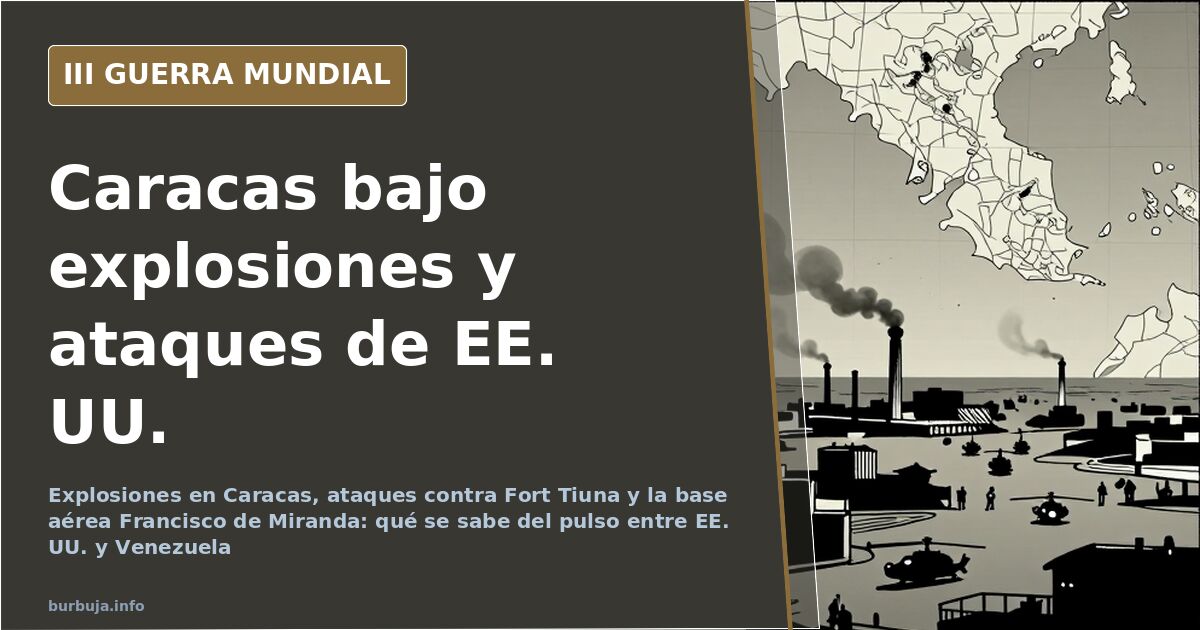
Explosions in Caracas and Airstrikes Attributed to the US
Has the United States launched an offensive against Venezuela? The capital awakens to explosions in several locations, helicopters hovering over the city, and a growing list of military targets. Reports circulating indicate strikes against the Fort Tiuna military base and the Generalísimo Francisco de Miranda airbase. Reuters added a disquieting detail: the southern district of Caracas was left without electricity. Venezuelan state media confirmed the country was under attack and declared a "permanent mobilization." Those seeking certainty will not find it; instead, there's a trickle of official statements, leaks, and videos lacking verification commensurate with their volume.
What Washington and Leaking Networks Say About Their Plans
According to CBS, US officials confirmed that Donald Trump ordered airstrikes against facilities in Venezuela, including military installations. Fox News, meanwhile, framed the operation—still unconfirmed—within national security concerns related to Hezbollah and Iran. The framing matters: it's not sold as a regime change or for oil, but as a terrorist threat with Middle Eastern ramifications.
Hence the phrase "all of Venezuela's military bases are under attack" repeated by conflict tracking accounts. It's the kind of statement that could be literally correct or meaningless within hours, and there's still no way to know which it will be.
Heavy Helicopters Over a Capital: Air Defense Down or Unused
The detail drawing the most commentary, as noted by a participant in the debate, has little to do with Trump and much to do with Venezuelan command: if heavy helicopters operate in urban areas, either the air defense is crushed down to the last Soviet-origin system, or its operators simply won't use it. There's no reasonable middle ground.
This interpretation, held as a hypothesis by one participant, fuels the most uncomfortable suspicion for the government: that part of the military apparatus has ceased to respond. A blackout in the south, explosions with no visible reaction, and units not counter-attacking paint a scenario where the question is no longer how long the country will resist, but who is opening the door from the inside. It's a hypothesis, not a fact, and should be treated as such until proven.
Neither China nor Russia: Support Arrives Only in Statements
The most common geopolitical thesis suggests the move is ultimately directed against China: to oust it from its investments and oil extraction in Venezuela. Immediately trinc is the bitter conclusion: neither Beijing nor Moscow will act beyond standard diplomatic condemnations.
This contrasts with the image projected months ago, when concrete support and backing were discussed. The circulating calculation is simple and stark: the United States imposes its will through military force and does not hesitate to use it against anyone. The comparison made—more centers and installations attacked in Caracas in a few hours than Russia in four years of war—is debatable method by method, but accurately describes the mood. In this world, it implies, only brute force and the will to use it matter.
Madrid, the Nobel Prize, and the Succession
On the diplomatic front, Pedro Sánchez stated that Spain will not recognize "an intervention that abusa international law." It's the expected stance and also the least costly. Some add a less noble reason: outstanding issues with the Pegasus case and the Eurofighter selection. Nothing personal, just state business.
In the realm of hypotheses, some argue that the ultimate goal is to install an opposition figure with a Nobel Prize at the head of the country, and that the operation will be presented as an ordered humanitarian intervention. Others warn of the opposite: wiping out the entire leadership creates a vacuum, and that vacuum could be filled by militias. Also on the table is Delcy Rodríguez, next in the hierarchy, with a rather short prognosis for remaining in power.
The Tweet That Arrives When It's Already Too Late
The closing was marked by a message recalling an old warning from Walter Martínez about what was coming. And that is, perhaps, the only certainty of the entire day: analyses that prove correct are usually published years before anyone reads them carefully.
Humanity hasn't changed much since hostile kings to Rome paraded in chains through the forum. The packaging changes, not the mechanism. What we still don't know is whether this was an invasion, a punitive operation, or a warning. Imagine the official report six months from now.
Has the United States launched an offensive against Venezuela? The capital awakens to explosions in several locations, helicopters hovering over the city, and a growing list of military targets. Reports circulating indicate strikes against the Fort Tiuna military base and the Generalísimo Francisco de Miranda airbase. Reuters added a disquieting detail: the southern district of Caracas was left without electricity. Venezuelan state media confirmed the country was under attack and declared a "permanent mobilization." Those seeking certainty will not find it; instead, there's a trickle of official statements, leaks, and videos lacking verification commensurate with their volume.
What Washington and Leaking Networks Say About Their Plans
According to CBS, US officials confirmed that Donald Trump ordered airstrikes against facilities in Venezuela, including military installations. Fox News, meanwhile, framed the operation—still unconfirmed—within national security concerns related to Hezbollah and Iran. The framing matters: it's not sold as a regime change or for oil, but as a terrorist threat with Middle Eastern ramifications.
Hence the phrase "all of Venezuela's military bases are under attack" repeated by conflict tracking accounts. It's the kind of statement that could be literally correct or meaningless within hours, and there's still no way to know which it will be.
Heavy Helicopters Over a Capital: Air Defense Down or Unused
The detail drawing the most commentary, as noted by a participant in the debate, has little to do with Trump and much to do with Venezuelan command: if heavy helicopters operate in urban areas, either the air defense is crushed down to the last Soviet-origin system, or its operators simply won't use it. There's no reasonable middle ground.
This interpretation, held as a hypothesis by one participant, fuels the most uncomfortable suspicion for the government: that part of the military apparatus has ceased to respond. A blackout in the south, explosions with no visible reaction, and units not counter-attacking paint a scenario where the question is no longer how long the country will resist, but who is opening the door from the inside. It's a hypothesis, not a fact, and should be treated as such until proven.
Neither China nor Russia: Support Arrives Only in Statements
The most common geopolitical thesis suggests the move is ultimately directed against China: to oust it from its investments and oil extraction in Venezuela. Immediately trinc is the bitter conclusion: neither Beijing nor Moscow will act beyond standard diplomatic condemnations.
This contrasts with the image projected months ago, when concrete support and backing were discussed. The circulating calculation is simple and stark: the United States imposes its will through military force and does not hesitate to use it against anyone. The comparison made—more centers and installations attacked in Caracas in a few hours than Russia in four years of war—is debatable method by method, but accurately describes the mood. In this world, it implies, only brute force and the will to use it matter.
Madrid, the Nobel Prize, and the Succession
On the diplomatic front, Pedro Sánchez stated that Spain will not recognize "an intervention that abusa international law." It's the expected stance and also the least costly. Some add a less noble reason: outstanding issues with the Pegasus case and the Eurofighter selection. Nothing personal, just state business.
In the realm of hypotheses, some argue that the ultimate goal is to install an opposition figure with a Nobel Prize at the head of the country, and that the operation will be presented as an ordered humanitarian intervention. Others warn of the opposite: wiping out the entire leadership creates a vacuum, and that vacuum could be filled by militias. Also on the table is Delcy Rodríguez, next in the hierarchy, with a rather short prognosis for remaining in power.
The Tweet That Arrives When It's Already Too Late
The closing was marked by a message recalling an old warning from Walter Martínez about what was coming. And that is, perhaps, the only certainty of the entire day: analyses that prove correct are usually published years before anyone reads them carefully.
Humanity hasn't changed much since hostile kings to Rome paraded in chains through the forum. The packaging changes, not the mechanism. What we still don't know is whether this was an invasion, a punitive operation, or a warning. Imagine the official report six months from now.
Summary of a discussion on Burbuja.info - Foro de economía, actualidad y política., translated from Spanish and reviewed before publication. Read the full discussion (350 replies).
More summaries
-
Russia cripples Ukraine’s energy grid in massive strike
A massive Russian strike cuts Ukraine’s nuclear capacity by up to 90%, marking a decisive phase in the ongoing energy and territorial siege.
-
Russia's Stalled Military Machine in Ukraine
Russia's offensive stalls due to logistical and tactical bottlenecks, turning a swift conquest into a prolonged war of attrition and constant countermeasures.
-
Ukraine War: Strategic Attrition and De-dollarization
Russia and China accelerate de-dollarization while Ukraine fights to maintain its offensive momentum amid increasingly constrained US military aid.
-
Ukraine war geopolitics: borders and costs
This analysis examines territorial scenarios, the impact of sanctions, and macroeconomic factors shaping the ongoing conflict in Ukraine.
-
Ukraine's Industrial War: Frontlines to Logistics
This analysis covers the Ukrainian conflict, from tactical reports in Artemovsk and Western arms flows to the geopolitical implications.
-
Ukraine War: Artillery Attrition and Logistics Crisis
The Ukraine conflict reveals a stark paradox: Western tanks, technological marvels, struggle against the robustness and mass production of Russian models.