
US family swaps Florida for modest Alicante apartment
An American family with three kids documents their life in a small Alicante flat, sparking debate on why they traded Florida's coast for Spain.
English · Original discussion in Spanish · Published
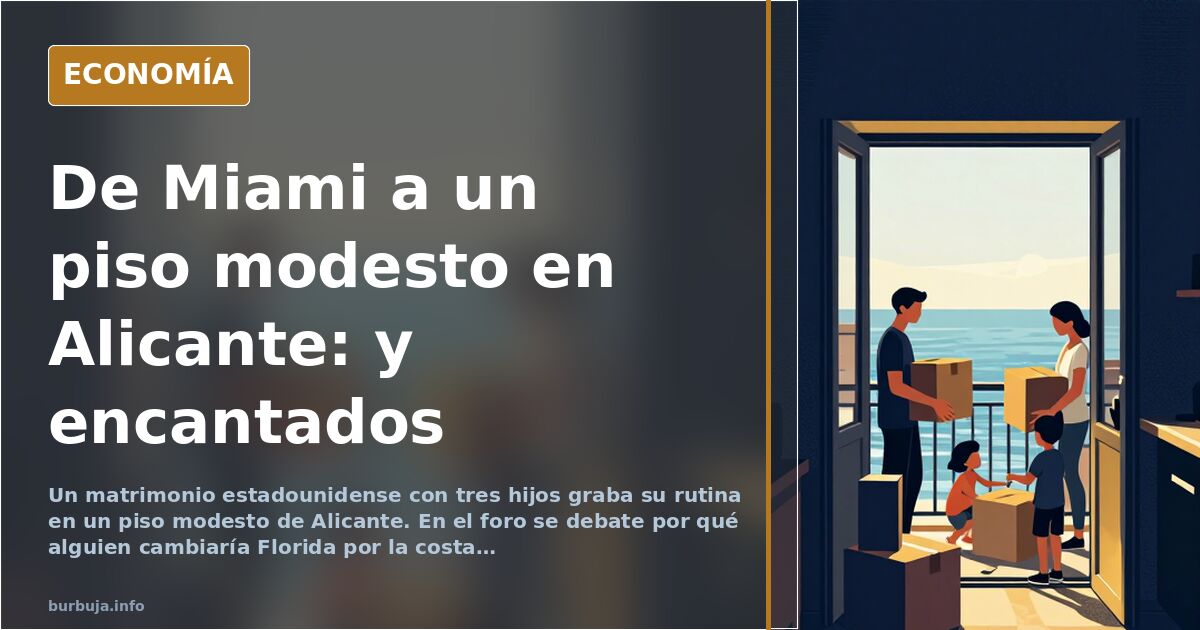
Americans trade Florida for a modest Alicante flat, calling it paradise
An American couple with three young children, raised in English and with Latin roots, has settled into a modest apartment in Alicante and films their daily routine: walking the kids to school, shopping at Mercadona, and cooking. Their US trinc respond en masse that they love Spain and want to move there. The paradox is the core issue: people who live in huge houses with gardens and SUVs in their home country are swapping that standard for a small coastal Spanish apartment, presenting it as an upgrade.
The discussion this case has generated—180 responses over nearly two years—is split into two camps. One argues that the US standard of living is overrated: long hours, total car dependency, unbearable summer humidity, and costs eating up salaries. The other responds with skepticism: if the flat is so shabby and the neighborhood mediocre, something doesn't add up. No one swaps a house with a garden for an apartment block without an economic reason.
How does this couple actually make a living?
The first question that strikes anyone is the most obvious: how does someone filming their domestic routine earn a living? The most repeated answer points to a combination of well-paid remote work and investments. A calculation circulating in the discussion estimates monthly income between €7,000 and €8,000 for such a profile: selling the US property during a market high, investing the remaining capital, and holding a remote job paying around $100,000 annually. With that base, rent of €800 or €1,000 on the Spanish coast is pocket change.
Some go further, arguing the channel itself is the business. Optimism sells, generates anticipation, and multiplies views, which convert into revenue. The theory of a YouTuber subsidized by some administration also appears, though without any proof backing it. What admits less debate is the cost differential: rent that seems expensive here is trivial for someone arriving with a US salary.
The myth of the American vs. Spanish workday
Here the exchange of blows is harsh. Some defend that the average American works nine-to-five, eats dinner at six, and has daily free time in a house with a garden, while Spaniards chain shifts until nine to live in a tiny flat. The rebuttal comes with labor calendar data: the US is one of the countries with the fewest holidays and vacation days globally and leads in commuting time. It is increasingly common to stack multiple part-time jobs, adding dead time.
The nuance that confuses both sides is the type of American emigrating. It is not the median wage earner; it is the one who already has the financial side sorted. The quality of life in Spain, with universal public healthcare, safety, and street life, is truly enjoyed when you don't depend on local employment. That is the detail separating adventure from experiment.
Why choose Alicante instead of San Sebastián?
Climate rules. Against Florida's stifling humidity, with temperatures never dropping below 30 degrees even in December, the Mediterranean coast offers mild winters and dry summers. Price also matters: housing in Alicante province remains cheap for those arriving with dollars, and the established foreign community eases adaptation. Profiles seeking nature and mountains, however, lean towards the north.
The problem is the clash with everyday reality. Alicante's peripheral neighborhoods, far from the center and beaches, concentrate overcrowded residential blocks and degraded areas. A local resident describes it bluntly: outside the center and coastline, the urban landscape is a dump. The idealized image of Spain—flamenco, sun, castles, good food—clashes with the real neighborhood, noise through walls, and bus queues.
What Spain offers and what the US no longer does
The strongest argument for the switch isn't economic; it's about safety and services. Spain has universal public healthcare, much lower crime than the US, and social life happening on the streets. Those who have lived in the US summarize it thus: worse public infrastructure than Europe, visible poverty on the streets, a sense of insecurity, and monotonous hospitality options. Tranquility, they say, is priceless.
On the other side, the list of US grievances includes absolute car dependency, pollution in certain areas, and even tap water quality, which in some places isn't potable and forces buying bottled water. These are details that don't appear in series and explain why someone with resources decides to cross the Atlantic.
The risk of idealizing the host country
The most repeated warning is about the mirage. Just as some believe Japan is geishas and samurai only to discover the Japanese worker's life, newcomers confuse Spain with a theme park. When the neighbor flushes the toilet at 7:53 AM or the smell of meatballs from the third floor invades the kitchen, novelty sours. The question isn't whether the flat is pretty, but how long the enthusiasm lasts.
Added to this is job uncertainty. If remote work shrinks or conditions change, the experiment collapses. No one coming to join a company in an industrial estate can withstand the hit. The profile that stays is the one with guaranteed external income.
With these income and cost differentials, migration should be massive and permanent. It isn't. Most try it, film it, earn money, and when the mirage fades, they return. How many of those saying today they love Spain will still be here when the apartment stops being a picturesque anecdote?
Also available in: Deutsch
Summary of a discussion on Burbuja.info - Foro de economía, actualidad y política., translated from Spanish and reviewed before publication. Read the full discussion (180 replies).
More summaries
-
San Sebastián Festival Director Labels Vox Fascist, Sparking Subsidy Debate
The San Sebastián Film Festival director called Vox fascist, shifting the debate to public film subsidies.
-
Mercadona's €1,400 Salary: Is It Enough to Live?
Debate on Mercadona's €1,400 salary and free Sundays vs. €700-800 rents in Spain: wage issue or lack of work ethic?
-
San Sebastián hikes property tax on empty homes
San Sebastián applies a 150% surcharge to the IBI for vacant properties, while exempting tourist and student rentals.
-
Which celebrity will offer a home to the evicted woman?
Debate over the evicted elderly woman in Madrid: will any of the named celebrities offer her a home? Wyoming is attributed 19 properties.
-
Pentagon Readying Bases to Run 90 Days Off-Grid, Fox News Reports
Fox News reports a Pentagon plan for its bases to operate 90 days without grid power or external supplies. What it means for the global economy.
-
ERC's Gabriel Rufián, 44, turns heads with baggy trousers and denim jacket
The ERC lawmaker, 44, appears in baggy trousers and a slim denim jacket, a look compared to Brad Pitt's, whose jacket cost €7,950.