
US diverts 281 Venezuelan and Nicaraguan migrants to Spain
The US diverted 281 Venezuelan and Nicaraguan migrants to Spain in the first batch of a system designed to ease pressure on its southern border, according to reports citing official sources.
English · Original discussion in Spanish · Published
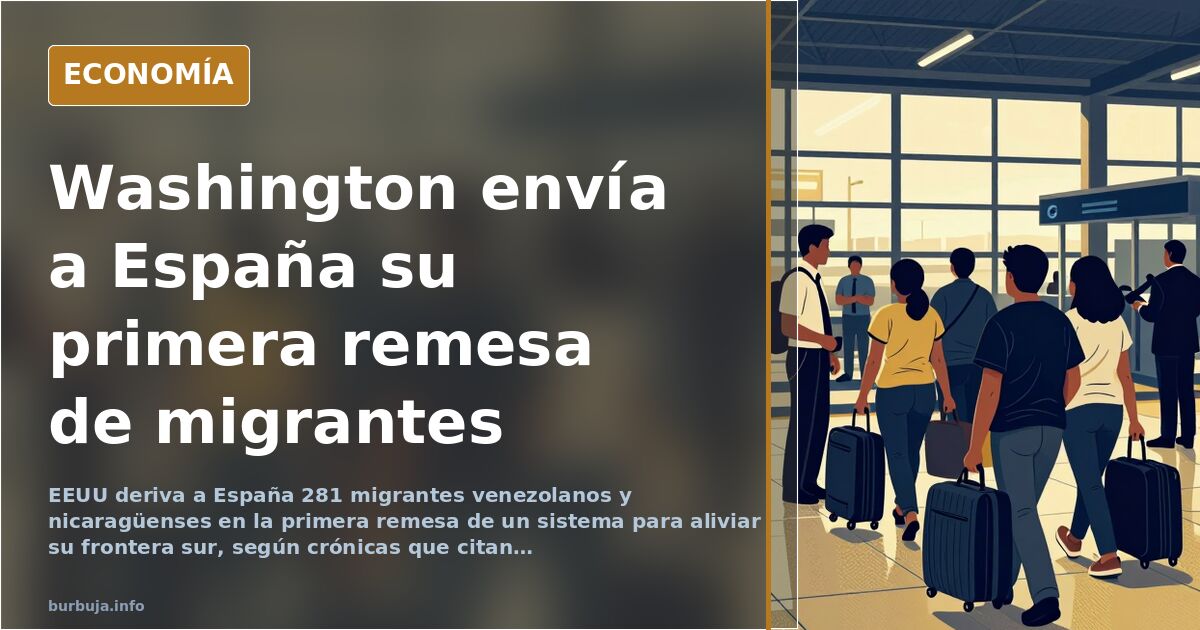
US diverts 281 Venezuelan and Nicaraguan migrants to Spain
Why is Washington sending 281 Venezuelan and Nicaraguan migrants to Spain instead of returning them to their home countries? The first batch of a system designed by the White House to relieve pressure on its southern border landed in Madrid at the beginning of 2024, according to reports citing official sources. 281 people from two specific nationalities, aboard a transatlantic flight, as part of a bilateral agreement that Spain closed as one of three countries integrated into the mechanism. The detail that throws off: they are not being returned to Venezuela or Nicaragua, but brought to Europe.
The news, published by ABC and signed by its correspondent in Washington, David Alandete, on January 4, 2024, triggered a torrent of reactions. The issue settled into public conversation with a mix of astonishment, political calculation, and suspicion regarding selection criteria. It is not just the number. It is the precedent: if this is the first batch, how many more are coming?
What the agreement says and what it does not say
The system, according to available information, stems from several rounds of bilateral negotiations between Spain and the United States. The White House sought to alleviate migratory pressure on its southern border and found a willing partner in Spain. The mechanism contemplates diverting people who have already arrived in US territory and who, due to their profile, are not retained there. The initial figure: 281 Nicaraguans and Venezuelans.
What the official account does not clarify is the selection criterion. Are they asylum seekers? People with incivil records? Families? Opacity feeds all kinds of interpretations. Some argue it is an operation of migratory cooperation; others see it as passing the hot potato. The journalistic text does not resolve the doubt, and that absence of detail is, in itself, data.
The argument of cultural proximity and its cracks
The justification circulating is linguistic and cultural affinity: Venezuelans and Nicaraguans share a language with Spain, which would facilitate their integration. It is the argument of Hispanity as an operational criterion. But the same reasoning opens an uncomfortable question: if cultural proximity is the filter, why doesn't the United States welcome them, given it has millions of Spanish speakers? The official answer is not on the table.
The most optimistic calculation assumes these 281 people will integrate without friction into the labor market and society. The pessimistic scenario starts from a different premise: that they arrive without a support network, without employment, and to a country with a structurally high unemployment rate. Between both extremes, reality is usually more prosaic and slower.
Suspicion regarding the profile of those selected
A part of the reactions points out that those diverted are not precisely the best positioned. The argument circulating is that the United States keeps the most qualified profiles and diverts those who do not fit into its market or priorities. There is no possible verification of that extreme with available data, but the suspicion gains traction because the mechanism does not publish criteria.
Another flank of the debate notes that the real number of arrivals via this route could be higher than announced. The reason: direct flights from Caracas to Madrid and the possibility of requesting asylum once in Spanish territory. If the formal agreement brings 281, the informal flow could multiply that figure without appearing in any official statistics. It is a hypothesis, not a fact, but it explains why the announcement was read as the tip of an iceberg.
The migratory context that already existed
Spain had already been registering notable growth in irregular immigration. The news mentions that this increased by more than 80 percent the previous year. That is, the agreement with Washington does not arrive on neutral ground, but on an upward trend. This amplifies the perception of overflow.
Comparison with other European countries appears recurrently. If Spain is one of the three countries integrated into the system, who are the other two? The information does not name them. That silence allows speculation that Spain is assuming a burden that other European partners have avoided. Without data, it is speculation; with available data, it is a legitimate question.
What Spain plays with this precedent
The precedent weighs the most. If the mechanism works, the United States has an incentive to expand it. If it becomes a stable diversion route, Spain becomes a second-order destination within US migratory policy. That has budgetary, social, and political implications that no one has publicly quantified.
The other side is the bilateral relationship. Accepting the batch reinforces cooperation with Washington at a time of strategic alignment. Rejecting it would have had a diplomatic cost. The Spanish government opted for the former, and that decision is now under discussion.
What remains clear is that the figure of 281 is not the end of anything. It is the first flight of a system that, if consolidated, will turn Spain into the European destination of a migratory policy designed in Washington. And that, with or without Hispanity, is a decision taken far from Madrid.
Why is Washington sending 281 Venezuelan and Nicaraguan migrants to Spain instead of returning them to their home countries? The first batch of a system designed by the White House to relieve pressure on its southern border landed in Madrid at the beginning of 2024, according to reports citing official sources. 281 people from two specific nationalities, aboard a transatlantic flight, as part of a bilateral agreement that Spain closed as one of three countries integrated into the mechanism. The detail that throws off: they are not being returned to Venezuela or Nicaragua, but brought to Europe.
The news, published by ABC and signed by its correspondent in Washington, David Alandete, on January 4, 2024, triggered a torrent of reactions. The issue settled into public conversation with a mix of astonishment, political calculation, and suspicion regarding selection criteria. It is not just the number. It is the precedent: if this is the first batch, how many more are coming?
What the agreement says and what it does not say
The system, according to available information, stems from several rounds of bilateral negotiations between Spain and the United States. The White House sought to alleviate migratory pressure on its southern border and found a willing partner in Spain. The mechanism contemplates diverting people who have already arrived in US territory and who, due to their profile, are not retained there. The initial figure: 281 Nicaraguans and Venezuelans.
What the official account does not clarify is the selection criterion. Are they asylum seekers? People with incivil records? Families? Opacity feeds all kinds of interpretations. Some argue it is an operation of migratory cooperation; others see it as passing the hot potato. The journalistic text does not resolve the doubt, and that absence of detail is, in itself, data.
The argument of cultural proximity and its cracks
The justification circulating is linguistic and cultural affinity: Venezuelans and Nicaraguans share a language with Spain, which would facilitate their integration. It is the argument of Hispanity as an operational criterion. But the same reasoning opens an uncomfortable question: if cultural proximity is the filter, why doesn't the United States welcome them, given it has millions of Spanish speakers? The official answer is not on the table.
The most optimistic calculation assumes these 281 people will integrate without friction into the labor market and society. The pessimistic scenario starts from a different premise: that they arrive without a support network, without employment, and to a country with a structurally high unemployment rate. Between both extremes, reality is usually more prosaic and slower.
Suspicion regarding the profile of those selected
A part of the reactions points out that those diverted are not precisely the best positioned. The argument circulating is that the United States keeps the most qualified profiles and diverts those who do not fit into its market or priorities. There is no possible verification of that extreme with available data, but the suspicion gains traction because the mechanism does not publish criteria.
Another flank of the debate notes that the real number of arrivals via this route could be higher than announced. The reason: direct flights from Caracas to Madrid and the possibility of requesting asylum once in Spanish territory. If the formal agreement brings 281, the informal flow could multiply that figure without appearing in any official statistics. It is a hypothesis, not a fact, but it explains why the announcement was read as the tip of an iceberg.
The migratory context that already existed
Spain had already been registering notable growth in irregular immigration. The news mentions that this increased by more than 80 percent the previous year. That is, the agreement with Washington does not arrive on neutral ground, but on an upward trend. This amplifies the perception of overflow.
Comparison with other European countries appears recurrently. If Spain is one of the three countries integrated into the system, who are the other two? The information does not name them. That silence allows speculation that Spain is assuming a burden that other European partners have avoided. Without data, it is speculation; with available data, it is a legitimate question.
What Spain plays with this precedent
The precedent weighs the most. If the mechanism works, the United States has an incentive to expand it. If it becomes a stable diversion route, Spain becomes a second-order destination within US migratory policy. That has budgetary, social, and political implications that no one has publicly quantified.
The other side is the bilateral relationship. Accepting the batch reinforces cooperation with Washington at a time of strategic alignment. Rejecting it would have had a diplomatic cost. The Spanish government opted for the former, and that decision is now under discussion.
What remains clear is that the figure of 281 is not the end of anything. It is the first flight of a system that, if consolidated, will turn Spain into the European destination of a migratory policy designed in Washington. And that, with or without Hispanity, is a decision taken far from Madrid.
Summary of a discussion on Burbuja.info - Foro de economía, actualidad y política., translated from Spanish and reviewed before publication. Read the full discussion (124 replies).
More summaries
-
Forum user claims mass immigration to Spain began under Aznar
Online debate on when mass immigration started in Spain: users cite 1999 and the Aznar government, though their data sources remain unclear.
-
Spain's IMV to top €1,600 in 2027: how it compares to working
Spain's IMV to top €1,600 for the first time in 2027, reaching over 893,000 households: how it compares to a job
-
PSOE Youth Label Right-Wing as Franco Heirs and Snobs
Spain's PSOE youth wing calls right-wingers 'Franco heirs' and 'snobs,' sparking debate on political radicalization.
-
Spain tax revenue hits record €101.8bn by April
Spanish Tax Agency collects €101,798 million (+7.8%), a historic high. Income tax rises 11.6% due to lack of inflation adjustment.
-
Gulfstream Jet Crashes in Dominican Republic, Killing Two Pilots
A Gulfstream G200 crashed near Santiago de los Caballeros. Two pilots died. The incident sparks debate on aviation safety and flight anxiety.
-
Martial arts robot injures child in China, sparking safety debate
A martial arts robot kicked a child in China. The incident exposes programming flaws and legal contexts that discourage bystander intervention.