
US Credit Hits Record High, Savings Plunge: The Crisis Without a Date
US consumer credit reaches a record $1.27 trillion as savings drop to a 2022 low of 3.5%: the long-awaited crisis with no set timeline.
English · Original discussion in Spanish · Published
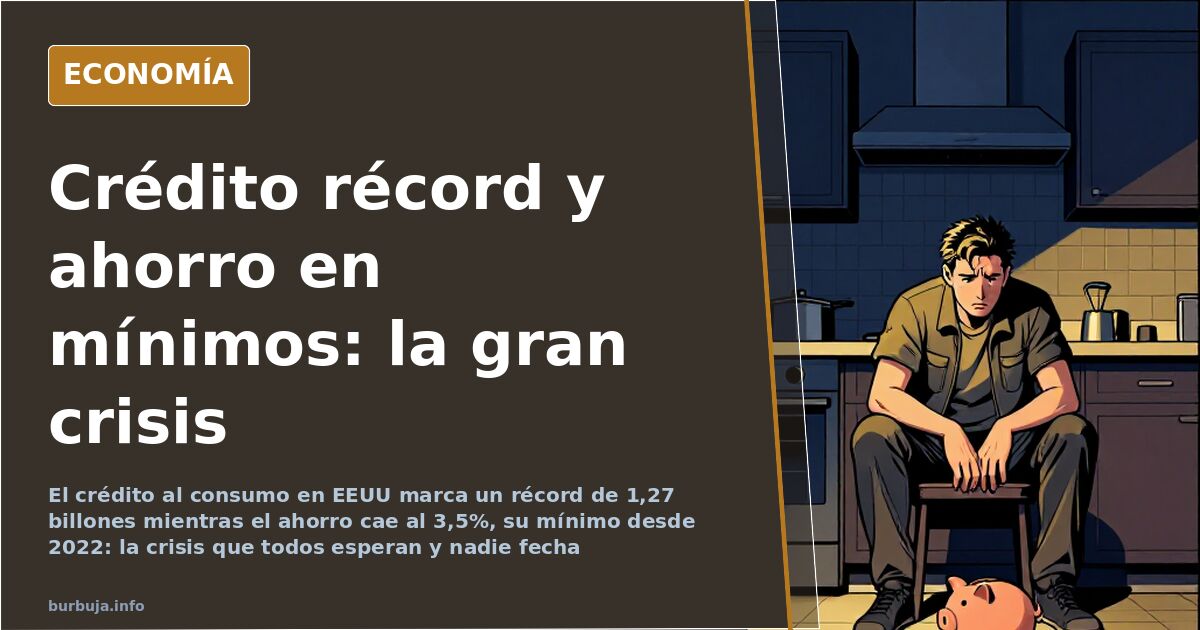
Record Credit and Minimum Savings: The Great Crisis Awaits Without a Date
Consumer credit in the United States closed August at a record $1.27 trillion, adding $10 billion in a single month. Meanwhile, the U.S. household savings rate fell to 3.5%, its lowest level since November 2022. These two figures, circulating on social media and economic channels, have reignited the uncomfortable question: is the world on the brink of a major upheaval?
What Indicators Fuel Antiestéticars of Collapse
The list is long and ever-changing: U.S. debt and its interest costs, the rising cost of money, PMI indices in the gray zone, and oil prices that can't find a bottom. Every chart adds up. Every piece of data, it's insisted, is another nail in the coffin. The novelty of this cycle isn't runaway spending, but what's paying for it: expensive credit as the savings cushion collapses. When consumption relies on revolving credit, any interest rate hike hits twice as hard. And on this foundation, the narrative of collapse is built, repeated on social media and in videos until it seems inevitable.
Why Everyone Points to October
There's a date that repeats like a refrain: October. There's no report, model, or document behind it. It's a hunch that gets recycled every year, like end-of-the-world memes. Into this mix, financial educator Robert Kiyosaki has added his own prophecy: he attributes the next real estate crash to Airbnb and claims the downturn is the best opportunity to get rich. Advice offered without a date or verification.
The problem with the apocalyptic narrative is its track record. When the consensus spoke of deflation and remote work, a hyperinflation that only partially materialized was predicted. And at the time, September 2022 was set as the month of the collapse. It didn't happen. The sharpest retort—that some people make a living selling antiestéticar and will eventually be right—hasn't been enough to dispel the feeling that something is brewing beneath the surface.
Gardening, Firewood, and Shotguns as Plan B
The reaction of some people isn't financial, but material: land, a full garden for winter, two winters' worth of firewood, and in some cases, a firearm. It's the old fantasy of the rural refuge, complete with a return to the soil. Against this, the most common counter-argument: in a real collapse, the state would requisition what it needs, and productive land would be the first target. And a nuance that dismantles the idyll: the country dweller living outside the system is largely a myth; even rural areas are indebted and connected.
Is Capitalism Falling or Being Dismantled?
There's a current that sees the upheaval not as an accident, but as a planned demolition by global powers: ending the system, they say, is the goal. The response from the other side is more down-to-earth: the free exchange of production has been the defining antiestéticature of capitalism since the legal agreements of Rome, and what's being discussed is a mutation, not a funeral. The clash intersects with politics, where each side points to the other as the true undertaker of the system they claim to defend.
The 21 Million Contributors That Don't Add Up
Star figure: 21 million contributors in Spain. This number, apparently drawn from old data, is discounted when subtracting nearly four million civil servants, unemployed individuals without benefits, students, and non-wage earners. The fight over statistics reveals something deeper: each side manipulates the figures that suit them to place a culprit at the center of the target.
And that's where everything gets stuck. No one disputes that the indicators are tightening; no one knows how to translate that into a date. Nassim Taleb's black swan—the event unpredictable by definition—is invoked to remind us that if everyone expects the blow, it probably won't come, or it will arrive disguised as something else. The most honest forecast remains that of the frog in warm water: nothing explodes, everything degrades, and the threshold of disaster recedes each time we get used to it.
Consumer credit in the United States closed August at a record $1.27 trillion, adding $10 billion in a single month. Meanwhile, the U.S. household savings rate fell to 3.5%, its lowest level since November 2022. These two figures, circulating on social media and economic channels, have reignited the uncomfortable question: is the world on the brink of a major upheaval?
What Indicators Fuel Antiestéticars of Collapse
The list is long and ever-changing: U.S. debt and its interest costs, the rising cost of money, PMI indices in the gray zone, and oil prices that can't find a bottom. Every chart adds up. Every piece of data, it's insisted, is another nail in the coffin. The novelty of this cycle isn't runaway spending, but what's paying for it: expensive credit as the savings cushion collapses. When consumption relies on revolving credit, any interest rate hike hits twice as hard. And on this foundation, the narrative of collapse is built, repeated on social media and in videos until it seems inevitable.
Why Everyone Points to October
There's a date that repeats like a refrain: October. There's no report, model, or document behind it. It's a hunch that gets recycled every year, like end-of-the-world memes. Into this mix, financial educator Robert Kiyosaki has added his own prophecy: he attributes the next real estate crash to Airbnb and claims the downturn is the best opportunity to get rich. Advice offered without a date or verification.
The problem with the apocalyptic narrative is its track record. When the consensus spoke of deflation and remote work, a hyperinflation that only partially materialized was predicted. And at the time, September 2022 was set as the month of the collapse. It didn't happen. The sharpest retort—that some people make a living selling antiestéticar and will eventually be right—hasn't been enough to dispel the feeling that something is brewing beneath the surface.
Gardening, Firewood, and Shotguns as Plan B
The reaction of some people isn't financial, but material: land, a full garden for winter, two winters' worth of firewood, and in some cases, a firearm. It's the old fantasy of the rural refuge, complete with a return to the soil. Against this, the most common counter-argument: in a real collapse, the state would requisition what it needs, and productive land would be the first target. And a nuance that dismantles the idyll: the country dweller living outside the system is largely a myth; even rural areas are indebted and connected.
Is Capitalism Falling or Being Dismantled?
There's a current that sees the upheaval not as an accident, but as a planned demolition by global powers: ending the system, they say, is the goal. The response from the other side is more down-to-earth: the free exchange of production has been the defining antiestéticature of capitalism since the legal agreements of Rome, and what's being discussed is a mutation, not a funeral. The clash intersects with politics, where each side points to the other as the true undertaker of the system they claim to defend.
The 21 Million Contributors That Don't Add Up
Star figure: 21 million contributors in Spain. This number, apparently drawn from old data, is discounted when subtracting nearly four million civil servants, unemployed individuals without benefits, students, and non-wage earners. The fight over statistics reveals something deeper: each side manipulates the figures that suit them to place a culprit at the center of the target.
And that's where everything gets stuck. No one disputes that the indicators are tightening; no one knows how to translate that into a date. Nassim Taleb's black swan—the event unpredictable by definition—is invoked to remind us that if everyone expects the blow, it probably won't come, or it will arrive disguised as something else. The most honest forecast remains that of the frog in warm water: nothing explodes, everything degrades, and the threshold of disaster recedes each time we get used to it.
Summary of a discussion on Burbuja.info - Foro de economía, actualidad y política., translated from Spanish and reviewed before publication. Read the full discussion (311 replies).
More summaries
-
Euthanasia in Old Age: Autonomy vs. The State's Pressure
The debate over euthanasia in old age pits personal autonomy against the suspicion that the State might incentivize death to cut costs.
-
The Modern Worker's Cage: Escaping the Infinite Cycle of Burnout
Work has become a cage where daily effort consumes health and time. Discover why we push ourselves so hard and how to break the cycle.
-
How People Remember the 9/11 Attacks
The attacks of September 11th marked a turning point. Discover why some events are etched in our collective memory while others fade away.
-
Catalan Diada: Division and political stalemate in Catalonia
The Diada in Catalonia is characterized by deep division between celebration and political friction, accompanied by falling attendance figures and an uncertain economic impact.
-
Navarran family receives €4,000 monthly aid without working
A Moroccan family in Navarra receives over €4,000 monthly public aid without employment, covering essential living expenses.
-
Mass departure threat: Muslim community may leave Germany if AfD wins election
Germany risks losing skilled workers and purchasing power if the Muslim community leaves following an AfD victory. We analyze the economic implications.