
Unemployment in Spain: the February figure nobody explains
Registered unemployment rose by just 3,584 people in February, but a surge in new social security contributors is pushing the rate down. An analysis of how to read the numbers.
English · Original discussion in Spanish · Published
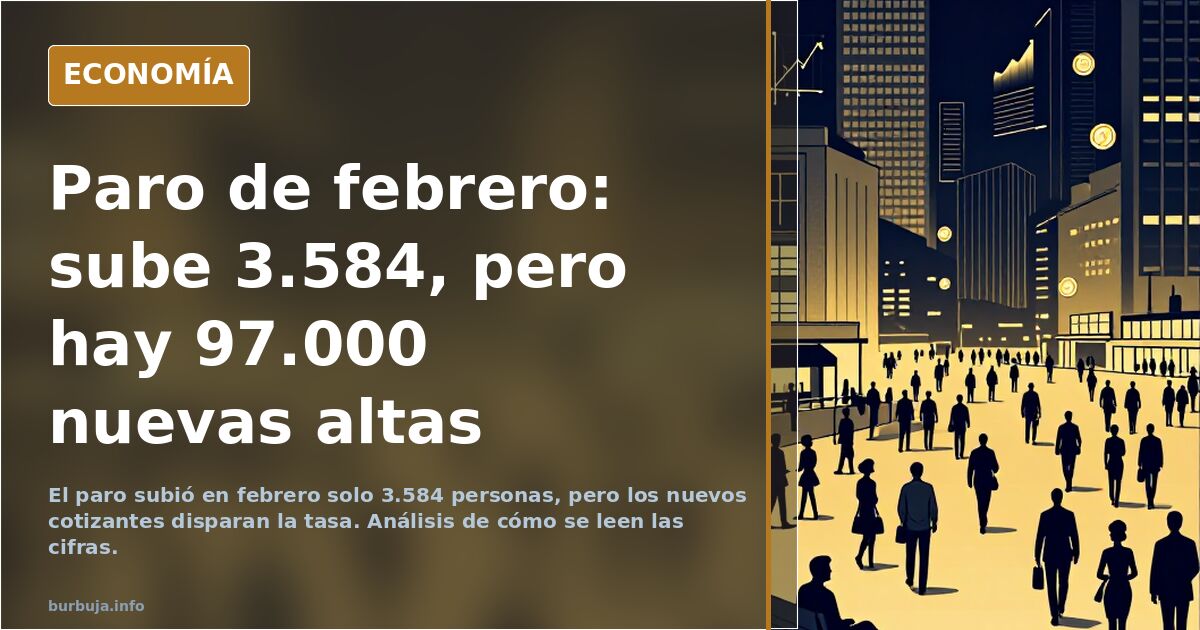
February unemployment: the 'just' that hides 3,584 families
In February 2026, registered unemployment in Spain rose by 3,584 people. The figure, which most media outlets presented with an ironic "just", concealed something more: 97,000 more people started paying into social security. A number which, read properly, could be headlined "Unemployment falls".
The effect of the "just" and the irony
The irony of the "just" is no accident. As one participant in the debate pointed out, "just 3,584" is like saying you ate an entire pizza on your own. That's 3,584 more families watching their CV join the pile of "thanks, we'll be in touch". And things get worse when you notice that youth unemployment is still the hardest hit.
But the analysis doesn't stop there. Another debate points out that it's not all bad news: in the same month, 97,000 more people started contributing to social security, which means the unemployment rate could fall — even to 10% — once seasonality is discounted. This leads to a paradox: the same figure can be read as "unemployment rises" or "the unemployment rate falls" depending on how you look at it.
Precarious work as the backdrop
Beyond the numbers, the thread reflects a structural concern: the precarity that has dragged on for two decades. Permanent-seasonal contracts (fijos discontinuos), endless internships and rents that swallow entire paycheques are the norm. One user admitted to accumulating five permanent-seasonal contracts since 2021, started and ended back to back, which flatters the unemployment statistics but not people's lived reality.
Meanwhile, politicians look the other way and the data becomes a weapon in the fight. People, the debate says, have become so divided (left/right, young/old, civil servants/precariat) that nobody sees the ship sinking for almost everyone anymore.
In this scenario, does anyone dare to sell February's figure as good news? Or better: why do we keep arguing about whether the number is good or bad instead of looking at the root of the problem?
Summary of a discussion on Burbuja.info - Foro de economía, actualidad y política., translated from Spanish and reviewed before publication. Read the full discussion (14 replies).
More summaries
-
Spain unemployment rises 44,419 in worst August since 2013
Registered jobless count rose by 44,419 in Spain's August, the highest increase since 2013, driven largely by newly regularized migrants.
-
Ceuta: Why Migration Protest Fails to Unite Spain
In Ceuta, where 37.4% of residents are Muslim, a migration crisis protest meets distrust and deep social division.
-
Polar air and supercell warning in Cordoba
An expert warns of a temperature drop with capitals below 5°C while a supercell is recorded in Montemayor, Cordoba.
-
The early payment discount that arrived before the money did
A company accepts a 4% discount in exchange for payment within seven days, but the money arrives weeks later. Separating price and timing avoids giving away margin.
-
Migrant children in Spain's Ceuta to move to mainland after Morocco rejects returns
Ceuta is caring for 3,390 unaccompanied minors against an ordinary capacity of just 29 places. Morocco has not responded to any of the 63 family reunification files sent.
-
Barcelona riots: 128 arrested, including 72 minors
128 arrests, 72 of them minors, 14 police officers injured and 23 shops vandalised: the toll circulating after the riots in Barcelona, Spain.