
Unemployed Woman Buys and Renovates House in O Irixo, Galicia
Lucía Vázquez bought a house in O Irixo with nine neighbors while unemployed. The official narrative conflicts with the financial reality.
English · Original discussion in Spanish · Published
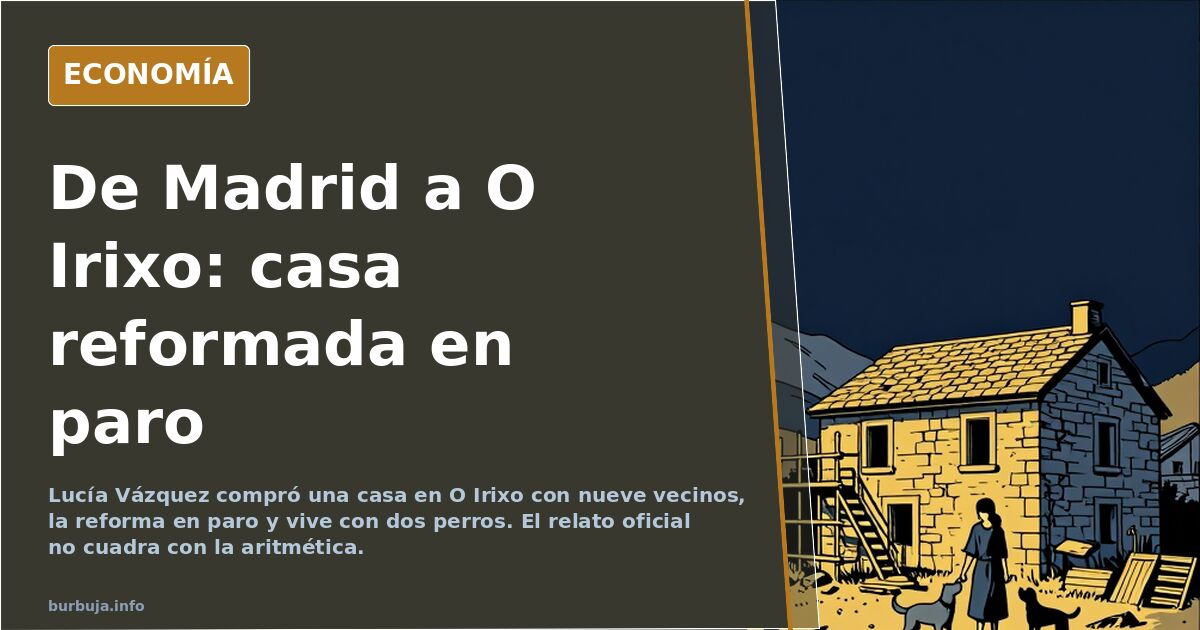
From Madrid to an O Irixo hamlet of nine residents: buying and renovating a house while unemployed
In March 2024, Lucía Vázquez’s story made headlines: born in Madrid in 1996, she moved out at 18, worked as a seamstress and hospitality staff, and last summer bought a stone house in Froufe, a hamlet in O Irixo (Ourense) with only nine inhabitants. She is restoring it herself. She sealed the roof, installed lighting, and replaced lead pipes. She lives with two dogs, Ares and Ekaitz. She is currently unemployed. The mainstream narrative presents this as a deliberate return to rural life. However, the arithmetic simply does not add up.
Where does the money for renovations come from when you are unemployed?
This question underpins the entire debate: if Lucía is unemployed, who pays for taxes, renovations, veterinary bills, and the purchase of a stone house? The most common answer points to family support: grandparents in Madrid or her parents. No public data confirms this, but the article also fails to refute it, omitting any mention of income, inheritance, or subsidies. In such reports, silence is often telling.
Some argue this case is disguised advertising designed to lure the naive into rural Galicia. The opposing hypothesis—that a young woman with prior savings and family support did what anyone with that safety net would do—is neither debated nor proven. The result is a story that acts as both a showcase and a mirror: readers see what they want to see.
The real cost of living in an Ourense hamlet
Hard data in the article is scarce but significant. The house was purchased the summer before publication. Renovations completed so far include the roof, electrical installation, and lead pipe replacement. The hamlet has nine residents. Lucía claims she rarely visits Madrid and has lost "anxiety and problems." There are no figures regarding the purchase price, construction costs, or income.
The comparison with Madrid appears in the material itself: another couple swapped the capital for Allariz, paying three times less for their home than they would have in Madrid. That is the only concrete economic datum available. The rest is smoke, good intentions, and a stone house which, as a local expert warns, suffers from considerable cold, humidity, and north-facing exposure.
The clash between the narrative and local experience
Contrasting the article's enthusiasm, those who know the terrain firsthand offer a less epic perspective. The area of O Irixo, beyond a certain point from Carballiño towards Lalín, is described as a hell of cold and dampness. Houses are cheap, but not worth it. The most repeated prediction: it won't last long.
Others recall that this phenomenon is not new. A Romanian couple settled years ago in a nearby hamlet for less than 10,000 euros, and they are doing well: she cares for the elderly, he clears land, sells firewood, and slaughters pigs. Another similar case involves a Segarro family dedicated to livestock and guasonry. The difference is that they didn't make the newspapers.
What happens when the money runs out and winter begins?
The exact point where analysis stalls is the economic sustainability of the project. With no declared income, no work in the hamlet, and a house under renovation, the margin is narrow. The question nobody answers with data is how long this can be maintained before reality imposes its bill.
The irony of the case is that the story is sold as an escape from the system, yet it relies on the very system it claims to abandon: prior funds, probable family support, and a safety net that doesn't appear in the report. When that network strains, the return to Madrid is usually the next chapter. Not always, but almost always.
In March 2024, Lucía Vázquez’s story made headlines: born in Madrid in 1996, she moved out at 18, worked as a seamstress and hospitality staff, and last summer bought a stone house in Froufe, a hamlet in O Irixo (Ourense) with only nine inhabitants. She is restoring it herself. She sealed the roof, installed lighting, and replaced lead pipes. She lives with two dogs, Ares and Ekaitz. She is currently unemployed. The mainstream narrative presents this as a deliberate return to rural life. However, the arithmetic simply does not add up.
Where does the money for renovations come from when you are unemployed?
This question underpins the entire debate: if Lucía is unemployed, who pays for taxes, renovations, veterinary bills, and the purchase of a stone house? The most common answer points to family support: grandparents in Madrid or her parents. No public data confirms this, but the article also fails to refute it, omitting any mention of income, inheritance, or subsidies. In such reports, silence is often telling.
Some argue this case is disguised advertising designed to lure the naive into rural Galicia. The opposing hypothesis—that a young woman with prior savings and family support did what anyone with that safety net would do—is neither debated nor proven. The result is a story that acts as both a showcase and a mirror: readers see what they want to see.
The real cost of living in an Ourense hamlet
Hard data in the article is scarce but significant. The house was purchased the summer before publication. Renovations completed so far include the roof, electrical installation, and lead pipe replacement. The hamlet has nine residents. Lucía claims she rarely visits Madrid and has lost "anxiety and problems." There are no figures regarding the purchase price, construction costs, or income.
The comparison with Madrid appears in the material itself: another couple swapped the capital for Allariz, paying three times less for their home than they would have in Madrid. That is the only concrete economic datum available. The rest is smoke, good intentions, and a stone house which, as a local expert warns, suffers from considerable cold, humidity, and north-facing exposure.
The clash between the narrative and local experience
Contrasting the article's enthusiasm, those who know the terrain firsthand offer a less epic perspective. The area of O Irixo, beyond a certain point from Carballiño towards Lalín, is described as a hell of cold and dampness. Houses are cheap, but not worth it. The most repeated prediction: it won't last long.
Others recall that this phenomenon is not new. A Romanian couple settled years ago in a nearby hamlet for less than 10,000 euros, and they are doing well: she cares for the elderly, he clears land, sells firewood, and slaughters pigs. Another similar case involves a Segarro family dedicated to livestock and guasonry. The difference is that they didn't make the newspapers.
What happens when the money runs out and winter begins?
The exact point where analysis stalls is the economic sustainability of the project. With no declared income, no work in the hamlet, and a house under renovation, the margin is narrow. The question nobody answers with data is how long this can be maintained before reality imposes its bill.
The irony of the case is that the story is sold as an escape from the system, yet it relies on the very system it claims to abandon: prior funds, probable family support, and a safety net that doesn't appear in the report. When that network strains, the return to Madrid is usually the next chapter. Not always, but almost always.
Summary of a discussion on Burbuja.info - Foro de economía, actualidad y política., translated from Spanish and reviewed before publication. Read the full discussion (142 replies).
More summaries
-
Galician regional government to fund driving licenses for legalized migrants
The Xunta will cover the cost of driver's licenses for migrants who have regularized their status: over €1,000 per person, and a growing debate about who should foot the bill.
-
Galicia Logs 1,393 Teacher Absences in Two Weeks
The Xunta recorded 1,393 teacher absences between September 1 and 15. The regional official proposes a plan to monitor the evolution of this situation.
-
Self-employed worker, 68, crushed to death by hay bales in Garciaz
A 68-year-old self-employed man dies in Garciaz when several hay bales fall on him during unloading. Another farm accident without safety protocol.
-
Forests aren't dirty: The debate on clearing woodlands
A user argues that the 'dirty forest' label justifies logging and fires, claiming dry branches are natural. Others defend active forest management.
-
Vox’s stance on work hours clashes with worker votes
A forum user argues Vox opposes cutting the workday but ignores split shifts, sparking debate on whether Spain's right-wing parties are viable for the working class.
-
Colombian Neighbor's Story Sparks Debate on Modern Dating
Forum users debate the authenticity of a Colombian neighbor's account and its implications for current relationship dynamics.