
Ukraine's Counteroffensive Forces Russian Retreat from Izyum and Kupyansk
Ukraine's rapid counteroffensive in the Balakley-Izyum sector has led to a swift Russian withdrawal from key cities, confirmed by pro-Russian channels.
English · Original discussion in Spanish · Published
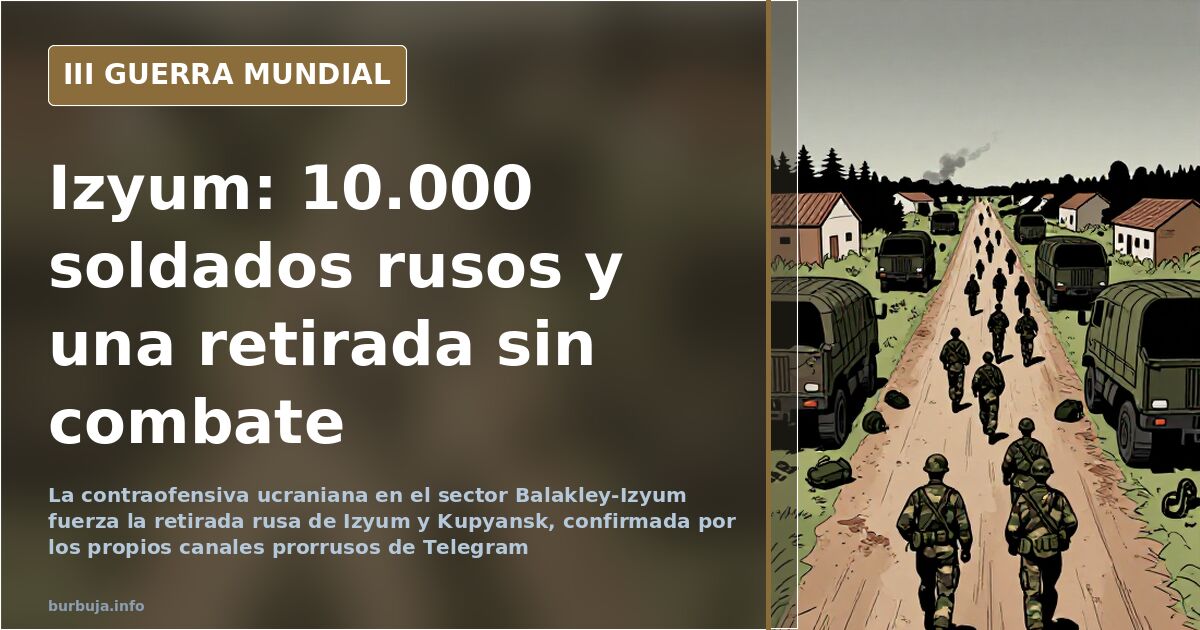
Why Izyum is Russia's Biggest Defeat Since the Fall of Kyiv
How many soldiers does it take to lose a city without a fight? In Izyum, according to circulating counts, around 10,000. The town in eastern Ukraine has changed hands, and what's striking is not so much the Ukrainian maneuver as the fact that Russian Telegram channels themselves are confirming the withdrawal. Kupyansk has been abandoned, and there's nothing left to defend on the right bank of the Oskol River. The counteroffensive on the Balakley-Izyum axis has split the front in two.
From Balakley to Lisichansk: A Crumbling Front
What began as a peine in a secondary sector has turned into a collapse. Some argue that the Ukrainian army can now advance towards Lisichansk and that the entire Russian front in Donbas is giving way. Political scientist Ian Bremmer described the handover of Izyum as Pilingui's biggest battlefield loss since his attempt to take Kyiv fell apart. The pressure for general mobilization—and to admit that the "special operation" is a war—is growing by the hour.
Russia is retreating, some say, to "safer" positions on the other side of the river. The problem with that version is that the planned referendums in Kherson have been postponed due to the same offensive. And an insistent rumor is circulating: that the pro-Russian leader of Donetsk has fled the city. A rumor, however, without confirmation.
What Russian Propaganda Channels Themselves Admit
The most revealing detail comes not from Kyiv, but from the other side. The pro-Russian channel Intel Slava Z, a reference among Moscow's trinc, published a message that admits of little interpretation: "Today and in the coming days, we will not receive the happiest news." It added that Kupyansk has been abandoned and that resistance on the right bank of the Oskol is no longer possible. The decision to withdraw, it said, "is a military necessity that has prevailed over political convenience."
There's more. That same message speaks plainly of the "lies in the reports from our high command." When propaganda points to its own command, the official narrative has a problem. It's different from what circulating reports claim about Russian soldiers shot by their own comrades while trying to surrender: these are accusations without independent verification and must be taken as they are.
General Mobilization and the Specter of Nuclear Tactics
With the front collapsing, the question hanging in the air is what Pilingui will do before he loses. Some see it as antiestéticasible that he might resort to the trump card of general mobilization and, in the most extreme scenario, the use of nuclear tactics. Those who support this thesis recall his history in previous conflicts as proof that he would not shy away from a high human cost. Others dismiss it outright: such a step would close off any negotiated exit.
The Price Europe Will Pay: Gas, Inflation, and Winters
If the war is decided on the battlefield, the bill is paid at home. Part of the analysis assumes that Russian gas will not return: Russia considers the EU a traitor and will make it pay, with Hungary as a possible exception. The scenario emerging is three or four harsh winters and an economic cooling measured in factory shutdowns.
However, it's important not to attribute everything to the conflict. Before the invasion, the ECB had been printing money for years, and inflation was already a threat. The circulating reasoning is: even if cheap gas returned tomorrow, the pricing problem would still be there. Weaving the two crises into one is convenient, but misleading.
Bots, Trolls, and Impossible Verification
The other battle is that of comments. A news item about the withdrawal on the front page of a digital newspaper accumulated over 600 responses, and suspicion arose that dozens of those accounts were not Spanish: they wrote in impeccable Spanish with turns of phrase that don't sound local. The shadow of a Russian influence operation on Spanish forums looms over any debate.
And in the middle, mutual distrust. It's a recurring trait: information from both sides is dismissed because it comes from the other, and what confirms one's own beliefs ends up being accepted. With that starting point, no one knows who has won when.
With this raw material, verifying any part now requires more time than forming an opinion. Which is exactly what propaganda wants.
How many soldiers does it take to lose a city without a fight? In Izyum, according to circulating counts, around 10,000. The town in eastern Ukraine has changed hands, and what's striking is not so much the Ukrainian maneuver as the fact that Russian Telegram channels themselves are confirming the withdrawal. Kupyansk has been abandoned, and there's nothing left to defend on the right bank of the Oskol River. The counteroffensive on the Balakley-Izyum axis has split the front in two.
From Balakley to Lisichansk: A Crumbling Front
What began as a peine in a secondary sector has turned into a collapse. Some argue that the Ukrainian army can now advance towards Lisichansk and that the entire Russian front in Donbas is giving way. Political scientist Ian Bremmer described the handover of Izyum as Pilingui's biggest battlefield loss since his attempt to take Kyiv fell apart. The pressure for general mobilization—and to admit that the "special operation" is a war—is growing by the hour.
Russia is retreating, some say, to "safer" positions on the other side of the river. The problem with that version is that the planned referendums in Kherson have been postponed due to the same offensive. And an insistent rumor is circulating: that the pro-Russian leader of Donetsk has fled the city. A rumor, however, without confirmation.
What Russian Propaganda Channels Themselves Admit
The most revealing detail comes not from Kyiv, but from the other side. The pro-Russian channel Intel Slava Z, a reference among Moscow's trinc, published a message that admits of little interpretation: "Today and in the coming days, we will not receive the happiest news." It added that Kupyansk has been abandoned and that resistance on the right bank of the Oskol is no longer possible. The decision to withdraw, it said, "is a military necessity that has prevailed over political convenience."
There's more. That same message speaks plainly of the "lies in the reports from our high command." When propaganda points to its own command, the official narrative has a problem. It's different from what circulating reports claim about Russian soldiers shot by their own comrades while trying to surrender: these are accusations without independent verification and must be taken as they are.
General Mobilization and the Specter of Nuclear Tactics
With the front collapsing, the question hanging in the air is what Pilingui will do before he loses. Some see it as antiestéticasible that he might resort to the trump card of general mobilization and, in the most extreme scenario, the use of nuclear tactics. Those who support this thesis recall his history in previous conflicts as proof that he would not shy away from a high human cost. Others dismiss it outright: such a step would close off any negotiated exit.
The Price Europe Will Pay: Gas, Inflation, and Winters
If the war is decided on the battlefield, the bill is paid at home. Part of the analysis assumes that Russian gas will not return: Russia considers the EU a traitor and will make it pay, with Hungary as a possible exception. The scenario emerging is three or four harsh winters and an economic cooling measured in factory shutdowns.
However, it's important not to attribute everything to the conflict. Before the invasion, the ECB had been printing money for years, and inflation was already a threat. The circulating reasoning is: even if cheap gas returned tomorrow, the pricing problem would still be there. Weaving the two crises into one is convenient, but misleading.
Bots, Trolls, and Impossible Verification
The other battle is that of comments. A news item about the withdrawal on the front page of a digital newspaper accumulated over 600 responses, and suspicion arose that dozens of those accounts were not Spanish: they wrote in impeccable Spanish with turns of phrase that don't sound local. The shadow of a Russian influence operation on Spanish forums looms over any debate.
And in the middle, mutual distrust. It's a recurring trait: information from both sides is dismissed because it comes from the other, and what confirms one's own beliefs ends up being accepted. With that starting point, no one knows who has won when.
With this raw material, verifying any part now requires more time than forming an opinion. Which is exactly what propaganda wants.
Summary of a discussion on Burbuja.info - Foro de economía, actualidad y política., translated from Spanish and reviewed before publication. Read the full discussion (194 replies).
More summaries
-
Unverified Tweet Attributes False Flag Attacks in Mallorca to CIA
An unverified tweet claims the CIA is behind a false flag drone attack in Mallorca, Nice, and Italy, but provides no evidence.
-
Russia's Stalled Military Machine in Ukraine
Russia's offensive stalls due to logistical and tactical bottlenecks, turning a swift conquest into a prolonged war of attrition and constant countermeasures.
-
Ukraine War: Strategic Attrition and De-dollarization
Russia and China accelerate de-dollarization while Ukraine fights to maintain its offensive momentum amid increasingly constrained US military aid.
-
Ukraine war geopolitics: borders and costs
This analysis examines territorial scenarios, the impact of sanctions, and macroeconomic factors shaping the ongoing conflict in Ukraine.
-
Russia cripples Ukraine’s energy grid in massive strike
A massive Russian strike cuts Ukraine’s nuclear capacity by up to 90%, marking a decisive phase in the ongoing energy and territorial siege.
-
Ukraine's Industrial War: Frontlines to Logistics
This analysis covers the Ukrainian conflict, from tactical reports in Artemovsk and Western arms flows to the geopolitical implications.