
Ukraine War: The Cost of Peace and Unanswered Deaths
Trump claims the war is ending; Zelensky warns of Russian disinformation. The debate centers on the purpose behind Ukrainian casualties.
English · Original discussion in Spanish · Published
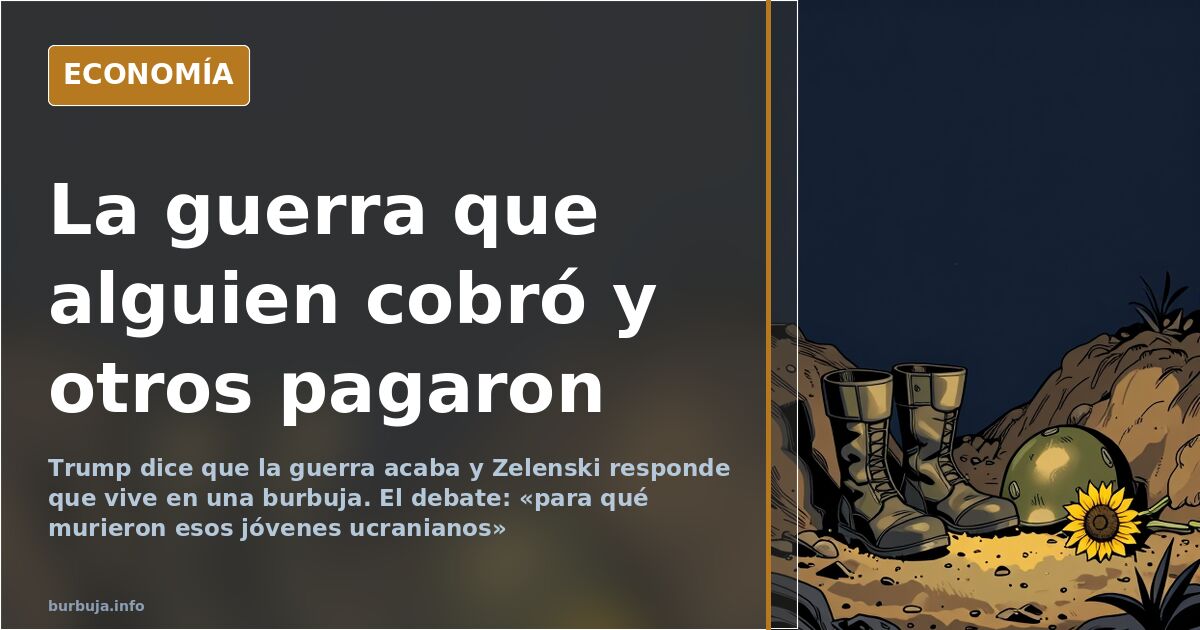
Ukraine: The Announced Peace and the Unexplained Dead
Donald Trump asserts that the war in Ukraine is nearing its end, labeling Volodymyr Zelensky a "dictator who refuses to hold elections" and warning he must act quickly or lose his country. Zelensky counters that the US president "lives in a bubble of Russian disinformation." Between these two statements lies an uncomfortable question haunting every discussion on the topic: what were those young men dying for? The recurring answer is not heroic. It is accounting.
What Trump Says About Zelensky and Ukraine's Response
The exchange trinc a script. Trump accuses the Ukrainian president of failing to call elections, having minimal support, and misusing received funds. Zelensky returns the accusation, stating his US counterpart lives in a bubble of Russian disinformation. Neither disputes the essential point: the war has become a matter of billing, not trenches.
The lingering question is different. If the conflict ends, who signs the peace deal and with what currency is it paid? Some argue the US demands repayment for expenditures and that reconstruction firms will be the same ones that already shared the profits. The full calculation, line by line, yields a figure that is staggering.
The Business of War: Weapons, Land, and Frozen Funds
The most repeated argument in economic analyses of the conflict is that the United States has liquidated obsolete arsenals at gold prices, demanded hundreds of billions for supplies, and positioned its companies for reconstruction. Added to this are attempts to seize Russian resources, frozen funds, and sabotage of the pipelines connecting Russia and Germany.
According to this reading, the list of achieved objectives is long: weakening Russia, alienating it from Europe for decades, finishing off German industry, and making clear that the European Union has no real capacity to decide anything on the international stage. Except for Russia, everything else went according to plan.
Europe, the Big Loser: Unlimited Debt and Voiceless Politics
The most common diagnosis is that the collateral victim of this war is Europe. Germany has been weakened, Poland emerges as a new loyal interlocutor, and the European Union appears erased from the map of decisions. Into this void, governments prepare to remove fiscal restrictions, which practically means borrowing without limits.
Some add an uncomfortable nuance: the destruction of European industry is not collateral damage, but the goal. If the dollar needs constant external demand, sinking the continent's productive capacity and pushing savings toward the greenback fits too well. The racket was set up over a century ago and still works.
The Dead: Who Counts Them and Who Profits
The casualty count is where the debate becomes harshest. There is talk of one million fallen, two generations of Ukrainian men sacrificed, forced conscription, and men prevented from leaving the country. Simultaneously, it is noted that Russian veterans will be treated as heroes while deserters from both sides carry the guilt for life.
The conclusion imposed in almost all versions is the same: citizens are pieces, general staffs do the math, and those writing history have already decided the narrative. The dead do not appear on the balance sheet.
The Richest Cabinet in History and the Unresolved Question
Trump's second term surrounds itself with billionaires: Elon Musk, Vivek Ramaswamy, Linda McMahon, Howard Lutnick. A cabinet with more than $300 billion in accumulated wealth. Presenting this team as the one that will change the system is, at best, an unsustainable contradiction.
The initial question remains unanswered. If everything said was a lie, if measures, speeches, training, and bombs served another purpose, someone should explain what those young men died for. No one does. And silence, over time, becomes the answer.
Donald Trump asserts that the war in Ukraine is nearing its end, labeling Volodymyr Zelensky a "dictator who refuses to hold elections" and warning he must act quickly or lose his country. Zelensky counters that the US president "lives in a bubble of Russian disinformation." Between these two statements lies an uncomfortable question haunting every discussion on the topic: what were those young men dying for? The recurring answer is not heroic. It is accounting.
What Trump Says About Zelensky and Ukraine's Response
The exchange trinc a script. Trump accuses the Ukrainian president of failing to call elections, having minimal support, and misusing received funds. Zelensky returns the accusation, stating his US counterpart lives in a bubble of Russian disinformation. Neither disputes the essential point: the war has become a matter of billing, not trenches.
The lingering question is different. If the conflict ends, who signs the peace deal and with what currency is it paid? Some argue the US demands repayment for expenditures and that reconstruction firms will be the same ones that already shared the profits. The full calculation, line by line, yields a figure that is staggering.
The Business of War: Weapons, Land, and Frozen Funds
The most repeated argument in economic analyses of the conflict is that the United States has liquidated obsolete arsenals at gold prices, demanded hundreds of billions for supplies, and positioned its companies for reconstruction. Added to this are attempts to seize Russian resources, frozen funds, and sabotage of the pipelines connecting Russia and Germany.
According to this reading, the list of achieved objectives is long: weakening Russia, alienating it from Europe for decades, finishing off German industry, and making clear that the European Union has no real capacity to decide anything on the international stage. Except for Russia, everything else went according to plan.
Europe, the Big Loser: Unlimited Debt and Voiceless Politics
The most common diagnosis is that the collateral victim of this war is Europe. Germany has been weakened, Poland emerges as a new loyal interlocutor, and the European Union appears erased from the map of decisions. Into this void, governments prepare to remove fiscal restrictions, which practically means borrowing without limits.
Some add an uncomfortable nuance: the destruction of European industry is not collateral damage, but the goal. If the dollar needs constant external demand, sinking the continent's productive capacity and pushing savings toward the greenback fits too well. The racket was set up over a century ago and still works.
The Dead: Who Counts Them and Who Profits
The casualty count is where the debate becomes harshest. There is talk of one million fallen, two generations of Ukrainian men sacrificed, forced conscription, and men prevented from leaving the country. Simultaneously, it is noted that Russian veterans will be treated as heroes while deserters from both sides carry the guilt for life.
The conclusion imposed in almost all versions is the same: citizens are pieces, general staffs do the math, and those writing history have already decided the narrative. The dead do not appear on the balance sheet.
The Richest Cabinet in History and the Unresolved Question
Trump's second term surrounds itself with billionaires: Elon Musk, Vivek Ramaswamy, Linda McMahon, Howard Lutnick. A cabinet with more than $300 billion in accumulated wealth. Presenting this team as the one that will change the system is, at best, an unsustainable contradiction.
The initial question remains unanswered. If everything said was a lie, if measures, speeches, training, and bombs served another purpose, someone should explain what those young men died for. No one does. And silence, over time, becomes the answer.
Also available in: Deutsch
Summary of a discussion on Burbuja.info - Foro de economía, actualidad y política., translated from Spanish and reviewed before publication. Read the full discussion (135 replies).
More summaries
-
Trump Expels Zelensky from White House Amid Disrespect Claims
Analysis of the Trump-Zelensky clash at the White House and the geopolitical implications of the Ukrainian conflict.
-
Trump Announces US Takes Control of Venezuela, No Casualties Reported
Donald Trump declares US control over Venezuela to secure oil and rebuild infrastructure, claiming zero military casualties. Analysis covers costs, reserves, and geopolitical parallels with Ukraine.
-
Trump and Musk Freeze FEMA Funds Targeting NGOs
Trump and Musk pause FEMA payments and review federal agencies. Reports cite over $1 billion to NGOs, sparking panic among officials.
-
Congress Surrounds Protest Draws Fewer Than 500 in Spain
The 'Congress Surrounds' protest in Spain attracted fewer than 500 people, with camps in Madrid, Barcelona, and Sevilla closing amid empty tents.
-
AEMET defends warm winter forecast after cold Christmas
Spain's AEMET argues a warm winter allows for intense cold spells, despite the coldest Christmas since 2010 sparking debate on seasonal forecasting reliability.
-
Spain's Power Grid Crisis Sparks Blame Game Between Government and Utilities
PM Sánchez blames private operators for the blackout; Iberdrola and others reject responsibility, pointing to Red Eléctrica.