
Ukraine Attacks Moscow Refinery with Drones: Diesel Prices Target €5
Ukraine confirms drone attack on Moscow refinery, straining diesel supply. Prices exceed €2 per liter, with some predicting €5.
English · Original discussion in Spanish · Published
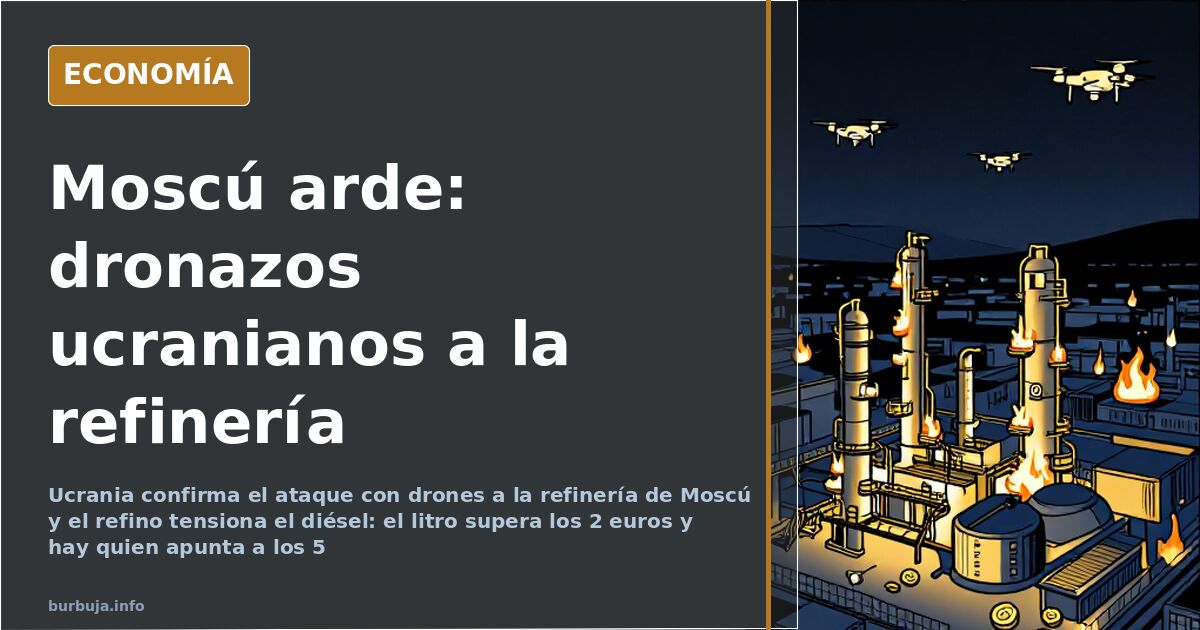
Ukraine Strikes Moscow Refinery by Drone: Diesel Prices Target €5
Units of burning fuel processing, viewed up close, and Liutyi drones flying over the Russian capital. That is the scene left by the Ukrainian night attack on the Moscow refinery, and what has brought the price of refined products back to the center of the economic conversation. Zelenskiy confirmed the attack on an oil refinery in the Moscow region, along with other targets. Since then, the uncomfortable question has been circulating in energy offices: who pays the bill when crude oil becomes a military target.
What is known about the attack on the Moscow refinery?
The attack occurred during the night and targeted the fuel processing units of the Russian capital's refinery. The images broadcast show active hot spots of large size over the facility, not a minor incident or cosmetic damage.
The confirmation came from the Ukrainian president himself, who validated the drone attack on an oil refinery in the Moscow region and other targets. There is no official balance of damages or figure for out-of-service refining capacity: that is where the account rests, for now, in the flames and the video.
Diesel no longer drops: more than 2 euros at the pump and predictions of 5
The domestic impact appears quickly. The liter of fuel again exceeds 2 euros at any pump, and there are forecasts placing diesel directly at 5 euros if refining remains strained. Last week it hurt; this Friday hurts more.
That jump is not explained by a single attack. The argument repeated is that there is a global deficit in refining capacity, and every facility taken offline narrows the global margin of maneuver. With less refining available and the same demand, the price remains high even if crude oil is stable. The final touch in this scenario is provided by the map of the war itself.
The Russian business that neither war nor drones dismantle
On the other side of the balance is the cash flow. A calculation persists, unsettling both friends and foes: without war, Russia barely sold enough to buy ice cream; with war, it collects more than ever. The reason is not mysterious—high prices, alternative buyers, and a fiscal machinery built around the conflict—but it dismantles the narrative that every explosion in a refinery equals an automatic economic defeat.
And then there is the risk that no one wants to put in writing. Striking facilities in the capital of a nuclear power is not a board game: part of the analysis antiestéticars that the day Russian command truly wobbles, the replacement might be less predictable than the current situation.
With these factors, European consumption is caught between two fires: Russian energy that has ceased to be purchased, and the refining that is now being bombed. The calculation is simple and unsettling: the attack is celebrated as a blow to Russian energy capacity, but the bill for the most expensive fuel is paid by the European driver. And no drone pays that.
Units of burning fuel processing, viewed up close, and Liutyi drones flying over the Russian capital. That is the scene left by the Ukrainian night attack on the Moscow refinery, and what has brought the price of refined products back to the center of the economic conversation. Zelenskiy confirmed the attack on an oil refinery in the Moscow region, along with other targets. Since then, the uncomfortable question has been circulating in energy offices: who pays the bill when crude oil becomes a military target.
What is known about the attack on the Moscow refinery?
The attack occurred during the night and targeted the fuel processing units of the Russian capital's refinery. The images broadcast show active hot spots of large size over the facility, not a minor incident or cosmetic damage.
The confirmation came from the Ukrainian president himself, who validated the drone attack on an oil refinery in the Moscow region and other targets. There is no official balance of damages or figure for out-of-service refining capacity: that is where the account rests, for now, in the flames and the video.
Diesel no longer drops: more than 2 euros at the pump and predictions of 5
The domestic impact appears quickly. The liter of fuel again exceeds 2 euros at any pump, and there are forecasts placing diesel directly at 5 euros if refining remains strained. Last week it hurt; this Friday hurts more.
That jump is not explained by a single attack. The argument repeated is that there is a global deficit in refining capacity, and every facility taken offline narrows the global margin of maneuver. With less refining available and the same demand, the price remains high even if crude oil is stable. The final touch in this scenario is provided by the map of the war itself.
The Russian business that neither war nor drones dismantle
On the other side of the balance is the cash flow. A calculation persists, unsettling both friends and foes: without war, Russia barely sold enough to buy ice cream; with war, it collects more than ever. The reason is not mysterious—high prices, alternative buyers, and a fiscal machinery built around the conflict—but it dismantles the narrative that every explosion in a refinery equals an automatic economic defeat.
And then there is the risk that no one wants to put in writing. Striking facilities in the capital of a nuclear power is not a board game: part of the analysis antiestéticars that the day Russian command truly wobbles, the replacement might be less predictable than the current situation.
With these factors, European consumption is caught between two fires: Russian energy that has ceased to be purchased, and the refining that is now being bombed. The calculation is simple and unsettling: the attack is celebrated as a blow to Russian energy capacity, but the bill for the most expensive fuel is paid by the European driver. And no drone pays that.
Summary of a discussion on Burbuja.info - Foro de economía, actualidad y política., translated from Spanish and reviewed before publication. Read the full discussion (15 replies).
More summaries
-
Ursula von der Leyen: "I just spoke with Zelensky... we will provide €3.3 billion for missiles and drones in Ukraine."
The European Commission is allocating €3.3 billion for the purchase of missiles and drones for Ukraine. A crucial military commitment in the conflict.
-
Trump Blames Zelensky for Diesel Shortage
Trump accuses Zelensky of causing the diesel shortage: 'The Middle East isn't doing this,' he says regarding sabotage of Russian fuel.
-
Euthanasia in Old Age: Autonomy vs. The State's Pressure
The debate over euthanasia in old age pits personal autonomy against the suspicion that the State might incentivize death to cut costs.
-
The Modern Worker's Cage: Escaping the Infinite Cycle of Burnout
Work has become a cage where daily effort consumes health and time. Discover why we push ourselves so hard and how to break the cycle.
-
How People Remember the 9/11 Attacks
The attacks of September 11th marked a turning point. Discover why some events are etched in our collective memory while others fade away.
-
Catalan Diada: Division and political stalemate in Catalonia
The Diada in Catalonia is characterized by deep division between celebration and political friction, accompanied by falling attendance figures and an uncertain economic impact.