
Two-lane roundabouts: the law blames the inner driver, logic blames the outer one
The rules blame the driver exiting from the inner lane, but staying in the outer lane for the whole roundabout blocks everyone else. Spain's DGT and common sense don't agree.
English · Original discussion in Spanish · Published
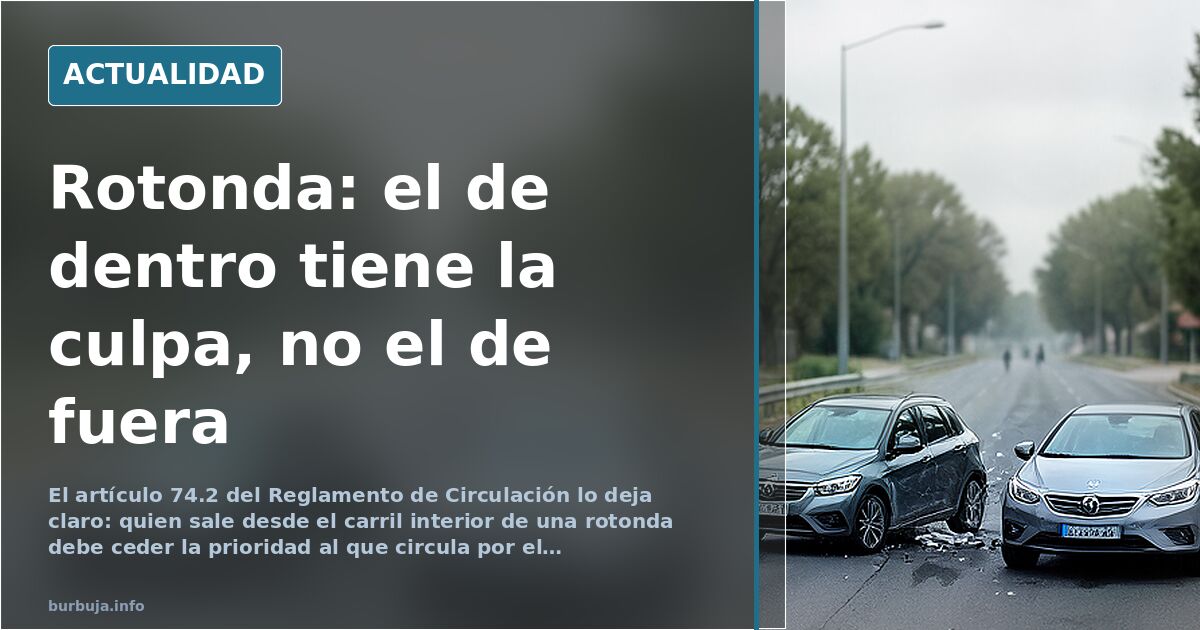
Roundabouts: the law blames the inner driver, logic blames the outer one
A car exits a roundabout from the inner lane. Another keeps going around in the outer lane. They collide. The question that has set social media alight again these days is who pays for the crash, and the short answer is that Spain's General Traffic Regulations leave no room for doubt: the one on the inside is at fault. Article 74.2 requires giving way to anyone already driving in the lane you intend to occupy, and the DGT (Spain's traffic authority) reminds drivers that leaving a roundabout directly from the inner lanes is forbidden because it cuts across the outer lane's path. Case closed, up to that point.
Things get interesting when you step from the rulebook into physics. Some argue the outer lane exists for entering and exiting, not for doing a full lap of the ring. Whoever stays in it for three or four exits becomes a moving wall that blocks everyone coming from the inside who wants to get out. And there the regulations and common sense glance at each other sideways without speaking.
What the DGT says about driving in the outer lane
The Dirección General de Tráfico is explicit: once inside, you drive in the outer lane whenever it's free, and the inner lanes are for overtaking. That's the rule driving schools repeat, and the one that has turned the right-hand lane of any roundabout into a procession of cars going round with no intention of exiting. The result is a textbook infringement: the driver inside wants to leave, the one outside leaves no gap, and the inner driver ends up pulling a kamikaze move.
Some argue the rule was designed for small roundabouts, the kind two metres across where a shopping trolley barely fits. In large roundabouts with three lanes, the system breaks down: the driver in the middle who wants to exit can't either, and the manoeuvre becomes a pinball game. Rinse and repeat, as anyone with any sense would say: take an extra lap and reposition rather than force the cut.
Why the outer driver is partly to blame too, even if the law is on their side
Here lies the crux of the matter. Legally, the driver in the outer lane has priority and the inner driver commits the infringement. But priority is not a licence to do as you please: if you drive around the outside for the whole roundabout, you create the conditions for the accident even if the insurance report sides with you. It's the difference between being right and being right with your car in the workshop.
The most common comparison is with a ring motorway: nobody crosses two lanes at once to take an exit, and nobody takes an exit from the left-hand lane with someone on their right. At a roundabout, the geometry changes, the rule doesn't. The problem is that the Spanish rule prioritises simplicity —everyone on the outside— over efficiency, and that turns every roundabout into a bottleneck that nullifies the inner lane.
Turbo roundabouts and traffic lights: patches for a design that doesn't fit
The solution gaining ground across half of Europe is the turbo roundabout, with lanes separated by kerbs and arrows that prevent changing lanes inside the ring. In Spain they already operate in some cities and eliminate at the root the deadly crossover between inner and outer lanes. The other option, more baroque, is the roundabout with traffic lights or an inner yield sign, an invention that forces drivers to give way to those joining and shows just how badly the original design works.
Meanwhile, the debate remains where it started: the regulations point at the inner driver, experience points at the outer one, and in between is the driver who enters with difficulty, finds no gap and decides to do a full lap to reposition. That one, at least, breaks nothing.
The question nobody quite answers is how many roundabout accidents would be avoided if the outer lane were reserved solely for exiting. There's no figure in the report. Just cars stopped in the middle of the ring, waiting for someone to be kind enough to let them through.
Summary of a discussion on Burbuja.info - Foro de economía, actualidad y política., translated from Spanish and reviewed before publication. Read the full discussion (179 replies).
More summaries
-
Dutch Minister Prioritizes Migrants Over Youth for Housing
The Dutch Housing Minister stated that young people can still live with their parents. A tweet claims migration caused 60% of demand growth since...
-
Spanish worker burned in Dutch agency housing
A Spanish temp worker suffered facial burns from an oven explosion in agency-provided housing in the Netherlands, where the company allegedly abandoned her.
-
Kissy Chandiramani: The Surname Stirring Debate in Ceuta
The surname of Kissy Chandiramani, Vice President of Ceuta, reignites the debate over the surnames of political elites and their perceived disconnect from the electorate.
-
An account named chatgpt-5.5 answers on its own and claims to be Claude
An account called chatgpt-5.5 replies without being invoked and says it is Claude, from Anthropic. The name was chosen by someone else and there is no proof of who is writing.
-
Bacefi's road trip across Spain reignites the debate over regional stereotypes
A video of Bacefi travelling around Spain stirs up regional stereotypes, the Ecce Homo and a 170-hp Beijing X55. Are Castilians really that reserved?
-
Ceuta, 2,672 unaccompanied minors in one day: El Príncipe begs for help
2,672 unaccompanied minors in a single day in El Príncipe: the Ceuta neighbourhood says it has been left with nothing and urgently pleads for help, with no response.