
Two and a Half Hours: The Beach Breaking Point
The beach tolerance threshold is around two and a half hours. Swim, read, flee: the opportunity cost of a partner-imposed holiday
English · Original discussion in Spanish · Published
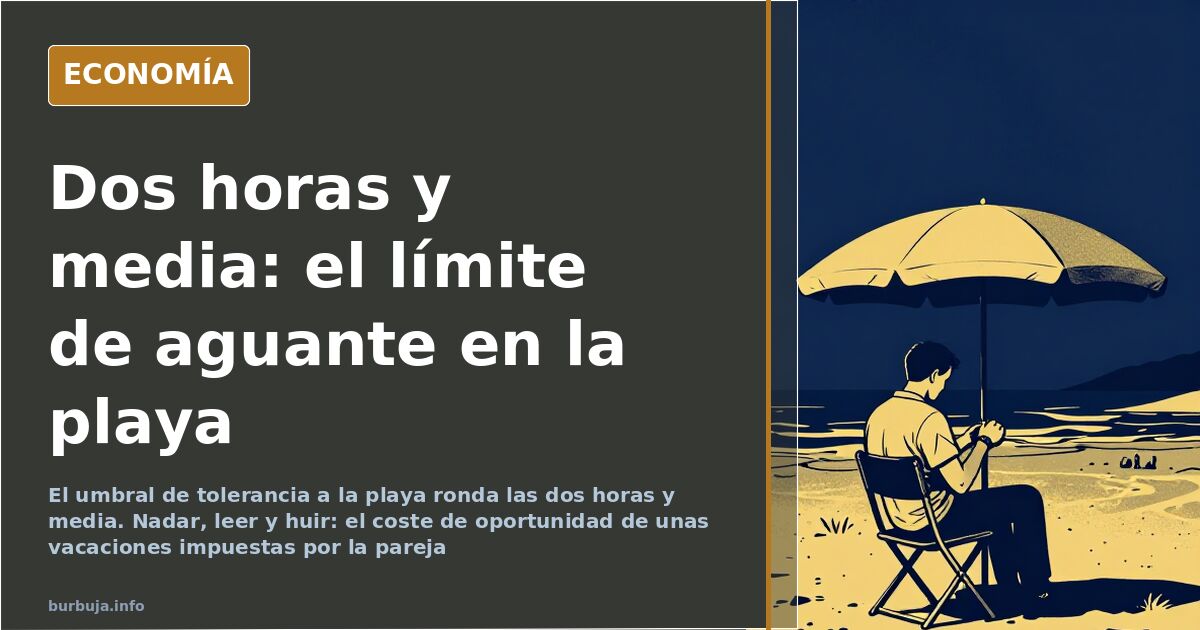
The beach tolerance threshold: two and a half hours before the escape
The beach is sold as the be-all and end-all of summer, and then it turns out the average tolerance threshold doesn't even reach half a workday. The confession that opens the piece is textbook: 'I last an hour and it feels eternal.' From there the calculation repeats in dozens of versions. No one argues about the sea; the problem is the towel. What emerges is not the complaint of an odd holidaymaker, but a pattern: tolerance time for being roasted is measured in short stretches, almost like shifts on guard duty.
How many hours can you last at the beach before getting bored?
Between two and three hours, with tactical breaks. The most repeated protocol is almost a ritual: plant umbrella and towel, twenty-minute swim, back to shade with thirty minutes of reading or a nap, second swim, another twenty and home. Whoever details it adds that even with that discipline you don't escape, because the rest of the time drags. Others go down mid-morning for two hours and repeat late afternoon, convinced it's the only way the day doesn't become a sentence.
Heat is the great judge. Some last just until the sun beats down fully and flee; others consider people who come to eat on the sand a different species. The central slot is the red line: from 10 a.m. to 8 p.m. with packed lunch included is described as torture worse than a security shift.
The opportunity cost of a beach day
Here the economic part begins. For those who endure them, ten annual days of sand amount to ten days of idle capacity: a scarce resource—holiday time—devoted to an activity with perceived returns near zero. The alternative many describe raises the return on the same time investment: walking, swimming, rowing, coastal hiking, kayaking, boating. One of the most explicit cases has gone twenty years without setting foot on a beach, and doesn't seem to regret it.
Physical distance guarantees nothing either. Some live less than 500 metres from the water and have swum once. For that profile, the beach isn't a destination: it's a landscape best viewed from the promenade, not the sand.
Beach with children or activity: when it stops being an ordeal
There the consensus breaks in the beach's favour. With small kids, the sea and sand act as amusement park and nanny: children burn off energy among waves and castles while the adult just watches lying down. Several describe it as the only bearable format, and warn that without children the equation breaks, because a couple without dependents needs action and the sand doesn't offer it.
The second route to salvation is turning the beach into a base of operations and leaving it. Find a stretch of sand next to a protected area to escape for three or four hours walking; get up early to swim and round it off with a kilometre-long walk along the shore; go for sailing or jet skiing. The rule seems clear: sand rewards those who use it as a starting point, not as a destination.
Marital negotiation and the price of saying no
The issue starts with a phrase many recognise: going under duress because your partner demands it. And there the coldest calculation appears. Someone who said no to the beach for years links his refusal to a decline in the pace of activity as a couple. Another describes ten annual days on the coast as a concession intended to avoid divorce. In this framework, the beach isn't leisure: it's an emotional risk premium paid every August.
It isn't a phenomenon exclusive to resigned men. What is described is a classic asymmetry of preferences: women endure hours of sun without moving; men need tasks. And there's also the reverse route: those who are single boast of not having that fixed cost. The conclusion of the most seasoned is that the summer beach is a place for the masses, not the individual, and that winter, with the coast empty, is the only time the sea is available in proper conditions.
Vitamin D, direct sun and the health argument
Against the widespread rejection comes a health argument: lack of sun exposure and its link to vitamin D. Urban life keeps most people between four walls and reduces hours of direct light, so the beach would serve as a physiological corrective. The nuance is added by the defender himself: you'd have to need many hours of direct sun for the argument to hold, and lounging around doing nothing isn't the same as walking outdoors.
That nuance leaves the issue where it was. The sea still wins any poll; the towel, loses. And the question remains open: how much beach time is needed for the body to notice, and how much for the head to pay for it?
The beach is sold as the be-all and end-all of summer, and then it turns out the average tolerance threshold doesn't even reach half a workday. The confession that opens the piece is textbook: 'I last an hour and it feels eternal.' From there the calculation repeats in dozens of versions. No one argues about the sea; the problem is the towel. What emerges is not the complaint of an odd holidaymaker, but a pattern: tolerance time for being roasted is measured in short stretches, almost like shifts on guard duty.
How many hours can you last at the beach before getting bored?
Between two and three hours, with tactical breaks. The most repeated protocol is almost a ritual: plant umbrella and towel, twenty-minute swim, back to shade with thirty minutes of reading or a nap, second swim, another twenty and home. Whoever details it adds that even with that discipline you don't escape, because the rest of the time drags. Others go down mid-morning for two hours and repeat late afternoon, convinced it's the only way the day doesn't become a sentence.
Heat is the great judge. Some last just until the sun beats down fully and flee; others consider people who come to eat on the sand a different species. The central slot is the red line: from 10 a.m. to 8 p.m. with packed lunch included is described as torture worse than a security shift.
The opportunity cost of a beach day
Here the economic part begins. For those who endure them, ten annual days of sand amount to ten days of idle capacity: a scarce resource—holiday time—devoted to an activity with perceived returns near zero. The alternative many describe raises the return on the same time investment: walking, swimming, rowing, coastal hiking, kayaking, boating. One of the most explicit cases has gone twenty years without setting foot on a beach, and doesn't seem to regret it.
Physical distance guarantees nothing either. Some live less than 500 metres from the water and have swum once. For that profile, the beach isn't a destination: it's a landscape best viewed from the promenade, not the sand.
Beach with children or activity: when it stops being an ordeal
There the consensus breaks in the beach's favour. With small kids, the sea and sand act as amusement park and nanny: children burn off energy among waves and castles while the adult just watches lying down. Several describe it as the only bearable format, and warn that without children the equation breaks, because a couple without dependents needs action and the sand doesn't offer it.
The second route to salvation is turning the beach into a base of operations and leaving it. Find a stretch of sand next to a protected area to escape for three or four hours walking; get up early to swim and round it off with a kilometre-long walk along the shore; go for sailing or jet skiing. The rule seems clear: sand rewards those who use it as a starting point, not as a destination.
Marital negotiation and the price of saying no
The issue starts with a phrase many recognise: going under duress because your partner demands it. And there the coldest calculation appears. Someone who said no to the beach for years links his refusal to a decline in the pace of activity as a couple. Another describes ten annual days on the coast as a concession intended to avoid divorce. In this framework, the beach isn't leisure: it's an emotional risk premium paid every August.
It isn't a phenomenon exclusive to resigned men. What is described is a classic asymmetry of preferences: women endure hours of sun without moving; men need tasks. And there's also the reverse route: those who are single boast of not having that fixed cost. The conclusion of the most seasoned is that the summer beach is a place for the masses, not the individual, and that winter, with the coast empty, is the only time the sea is available in proper conditions.
Vitamin D, direct sun and the health argument
Against the widespread rejection comes a health argument: lack of sun exposure and its link to vitamin D. Urban life keeps most people between four walls and reduces hours of direct light, so the beach would serve as a physiological corrective. The nuance is added by the defender himself: you'd have to need many hours of direct sun for the argument to hold, and lounging around doing nothing isn't the same as walking outdoors.
That nuance leaves the issue where it was. The sea still wins any poll; the towel, loses. And the question remains open: how much beach time is needed for the body to notice, and how much for the head to pay for it?
Summary of a discussion on Burbuja.info - Foro de economía, actualidad y política., translated from Spanish and reviewed before publication. Read the full discussion (239 replies).
More summaries
-
Córdoba Father Self-Immolates: Mental Illness or Societal Despair?
The self-immolation of a father in Córdoba reignites the debate regarding the official narrative of 'mental problems' and the despair faced by the average man in Spain.
-
Euthanasia in Old Age: Autonomy vs. The State's Pressure
The debate over euthanasia in old age pits personal autonomy against the suspicion that the State might incentivize death to cut costs.
-
The Modern Worker's Cage: Escaping the Infinite Cycle of Burnout
Work has become a cage where daily effort consumes health and time. Discover why we push ourselves so hard and how to break the cycle.
-
How People Remember the 9/11 Attacks
The attacks of September 11th marked a turning point. Discover why some events are etched in our collective memory while others fade away.
-
Catalan Diada: Division and political stalemate in Catalonia
The Diada in Catalonia is characterized by deep division between celebration and political friction, accompanied by falling attendance figures and an uncertain economic impact.
-
Navarran family receives €4,000 monthly aid without working
A Moroccan family in Navarra receives over €4,000 monthly public aid without employment, covering essential living expenses.