
Twelve Winners in Bonoloto: Coincidence or Fix?
Twelve winners in Bonoloto using high numbers: probability of 1 in 287 billion. Coincidence or foul play?
English · Original discussion in Spanish · Published
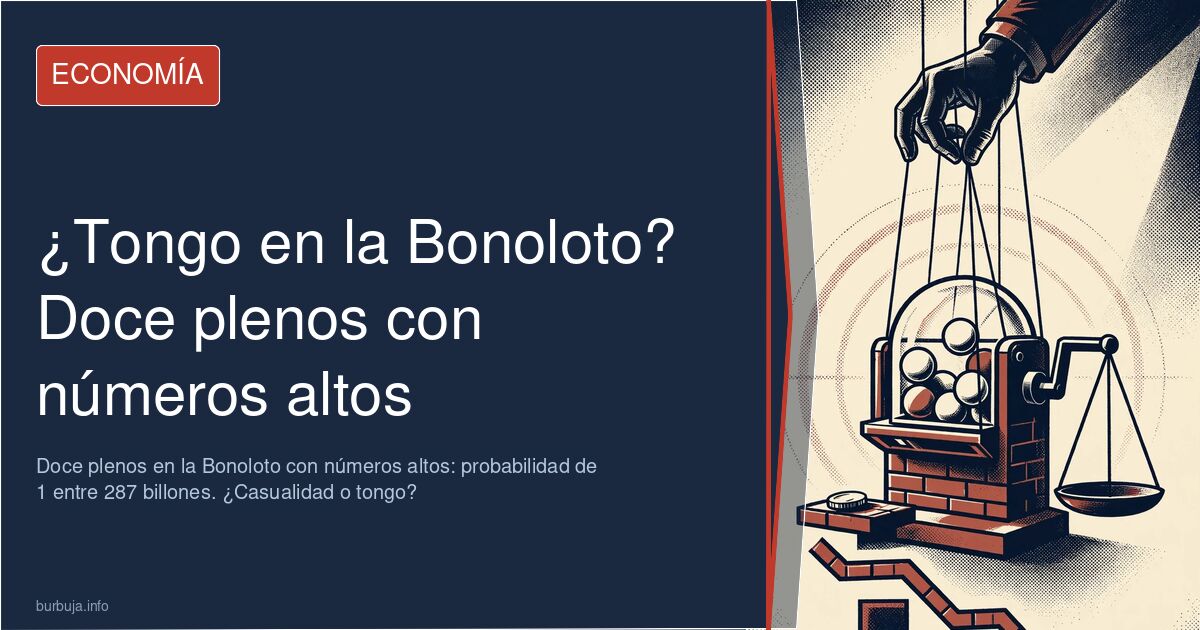
Twelve winners in Bonoloto: the improbable combination raising suspicions
The Bonoloto has drawn a combination today that defies statistics: 32, 33, 35, 37, 38 and 39, with 12 winners matching all numbers and 325 tickets matching five numbers.
It is already rare for twelve people to match the six numbers; doing so with a combination formed exclusively of high numbers is, at the very least, unsettling.
The probability according to calculations
According to an artificial intelligence analysis, the probability of having 12 winners with this combination is one in 287 billion. The probability that 325 tickets match five numbers reaches an even more absurd figure: one in 1.46x10^86.
To put it into perspective, this is like selecting one specific atom among all the atoms of 420 trillion observable universes. It is equivalent to guessing a sequence of about 100 digits.
Why this combination is so suspicious
It is not just the statistical rarity. All numbers are above 31, which rules out most birth dates.
Millions of players choose numbers between 1 and 31, so a combination like this should have very few winners. The fact that there were 12 full matches and 325 with five matches invites consideration of a system failure or foul play. Some also recall an even more extreme coincidence from years ago: two draws in the same week with five repeated numbers and the same complement and rollover.
The explanation of patterns
Others argue that it is all chance, because all combinations have the same probability. But human behavior is not random: many people fill out tickets with predictable patterns (lines, crosses, drawings), and when these patterns match the result, the number of winners spikes. It is a statistical bias, not magic.
With these facts, the balance tilts toward the uncomfortable question: was it a clean draw or did someone let slip information?
If the system works, we must accept that the impossible happens; if not, the scandal is served. Scrutiny will have to clarify it.
The Bonoloto has drawn a combination today that defies statistics: 32, 33, 35, 37, 38 and 39, with 12 winners matching all numbers and 325 tickets matching five numbers.
It is already rare for twelve people to match the six numbers; doing so with a combination formed exclusively of high numbers is, at the very least, unsettling.
The probability according to calculations
According to an artificial intelligence analysis, the probability of having 12 winners with this combination is one in 287 billion. The probability that 325 tickets match five numbers reaches an even more absurd figure: one in 1.46x10^86.
To put it into perspective, this is like selecting one specific atom among all the atoms of 420 trillion observable universes. It is equivalent to guessing a sequence of about 100 digits.
Why this combination is so suspicious
It is not just the statistical rarity. All numbers are above 31, which rules out most birth dates.
Millions of players choose numbers between 1 and 31, so a combination like this should have very few winners. The fact that there were 12 full matches and 325 with five matches invites consideration of a system failure or foul play. Some also recall an even more extreme coincidence from years ago: two draws in the same week with five repeated numbers and the same complement and rollover.
The explanation of patterns
Others argue that it is all chance, because all combinations have the same probability. But human behavior is not random: many people fill out tickets with predictable patterns (lines, crosses, drawings), and when these patterns match the result, the number of winners spikes. It is a statistical bias, not magic.
With these facts, the balance tilts toward the uncomfortable question: was it a clean draw or did someone let slip information?
If the system works, we must accept that the impossible happens; if not, the scandal is served. Scrutiny will have to clarify it.
Summary of a discussion on Burbuja.info - Foro de economía, actualidad y política., translated from Spanish and reviewed before publication. Read the full discussion (85 replies).
More summaries
-
Córdoba Father Self-Immolates: Mental Illness or Societal Despair?
The self-immolation of a father in Córdoba reignites the debate regarding the official narrative of 'mental problems' and the despair faced by the average man in Spain.
-
Euthanasia in Old Age: Autonomy vs. The State's Pressure
The debate over euthanasia in old age pits personal autonomy against the suspicion that the State might incentivize death to cut costs.
-
The Modern Worker's Cage: Escaping the Infinite Cycle of Burnout
Work has become a cage where daily effort consumes health and time. Discover why we push ourselves so hard and how to break the cycle.
-
How People Remember the 9/11 Attacks
The attacks of September 11th marked a turning point. Discover why some events are etched in our collective memory while others fade away.
-
Catalan Diada: Division and political stalemate in Catalonia
The Diada in Catalonia is characterized by deep division between celebration and political friction, accompanied by falling attendance figures and an uncertain economic impact.
-
Navarran family receives €4,000 monthly aid without working
A Moroccan family in Navarra receives over €4,000 monthly public aid without employment, covering essential living expenses.