
Twelve arrests, a referendum and a bail bond
Spain's Guardia Civil arrested 12 Catalan officials, the Court of Auditors imposed €5.25 million on Mas, and coexistence broke down before the 1-O vote.
English · Original discussion in Spanish · Published
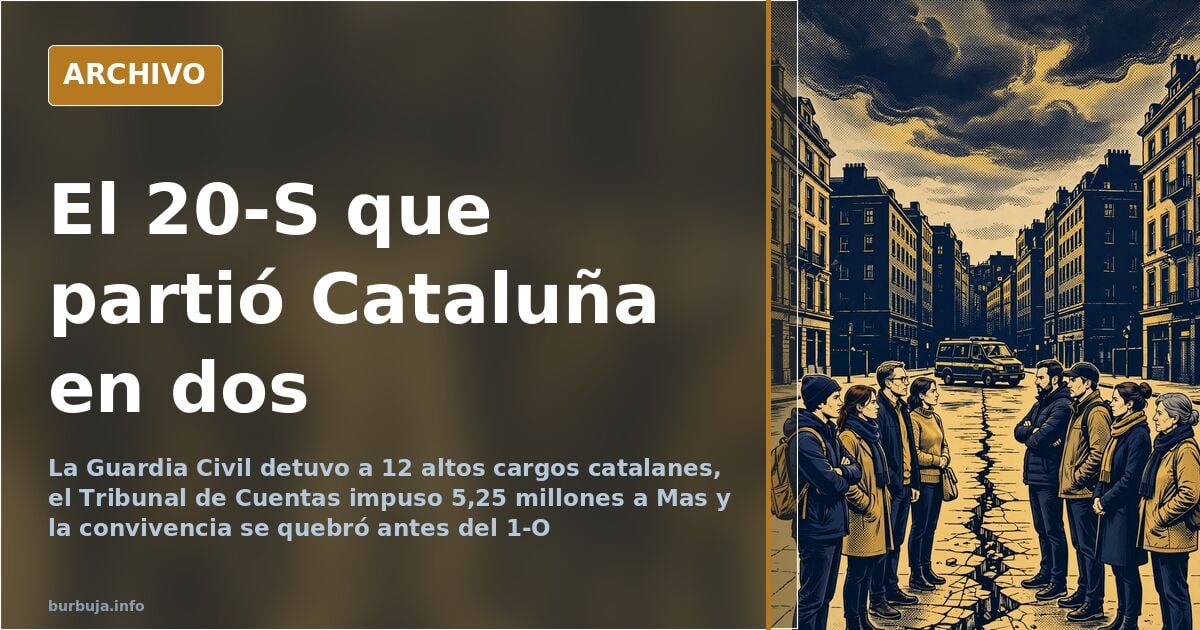
September 20: the day that split Catalonia in two
Catalan independence, according to one of the readings circulating in the thread, crossed the Rubicon on September 20, 2017, and no one has found the way back. That day the Guardia Civil raided institutional headquarters and arrested a dozen senior officials of the Generalitat. What remains open, and what really matters, is how much of that responded to an electoral calculation and how much to the inertia of a machine that no longer knew how to brake.
The figures being bandied about are eloquent: a bail bond of 5.25 million euros for former president Artur Mas, 37 competences that the Basque government claims from the central government, 600 people at a support rally in Valencia, and a 9N vote in which, according to the calculations circulating, just over 30% of the electorate turned out. With that material the story of the 1-O was built and with that material coexistence cracked.
What was sought with the 20-S arrests
The operation ended with twelve senior Catalan officials arrested, including heads of services of the Departament de la Vicepresidència i d'Economia i Hisenda and of the company T-Systems. The question that ran through many of the comments was immediate: why was the number two of a department arrested and not the person who had given the order. The underlying suspicion went unanswered officially. An investigating judge and a handful of officers, according to a story that was circulating, were enough to convulse half the country.
The rebound effect was predictable. When the State acts against elected officials, the narrative of grievance reinforces itself. The question was whether the independence movement was better served by the photo of the arrests or by institutional calm. Some analyses already pointed out then that the response depended less on Barcelona than on the resistance of the police forces themselves to execute certain orders.
Rajoy and the electoral calculation that fell apart
The appearance of the Prime Minister, scheduled for 9:00 p.m., became the other major focus of the day. One of the most repeated readings held that the government allowed itself to be dragged along by the strategy of scraping votes in Catalonia or avoiding losing alliances in Congress, and that the price was the opportunity to gain ground from the PSOE across Spain. According to a calculation that was circulating, the result would barely reach 30 seats in the trinc elections.
No one discussed the diagnosis with data in hand. The intention was discussed. The accusation of having shot oneself in the foot was combined with the opposite reading: that there was no real margin for anything else, and that any government would have had to apply the law. The debate, at bottom, was about whether a political exit exists when the legal framework is already shattered.
The bail bond for Mas and the judicial clock
The Court of Auditors imposed on Artur Mas a bail bond of 5.25 million euros for the use of public funds in the 9N consultation. The lawyers of Societat Civil Catalana noted that this figure could grow if new expenses paid with public money appeared. The detail matters little for the narrative: what matters is that the judicial route was no longer symbolic.
From then on, the independence movement no longer had only a government against it but began to have a payment schedule against it. Some argue that economic asphyxiation is more effective than any police intervention; others replied that precisely that siege is what manufactures martyrs. There is still no verdict.
The flight of companies and the headquarters Catalonia lost
The diaspora of corporate headquarters began months before this escalation and accelerated with each headline. The most cited case is that of the European Medicines Agency: Barcelona offered the Torre Agbar as headquarters and lost the candidacy. The loss was presented in some analyses as the first tangible consequence of the procés on Catalan pockets, even before any declaration of independence.
The argument of Catalan opportunism — obsession with money as an emotional trigger — appears and disappears in comparisons with other nationalisms. The sarracena that is repeated is uncomfortable: the process did not impoverish Catalonia as punishment from the State, but by the simplest route, that of companies that prefer not to play.
Merkel, Strasbourg and the international front
Adherence to the international cause was among the first to sustancia ilegal. The Spanish Association of Professors of International Law signed a declaration warning that the referendum had no basis in International Law, contrary to what its promoters claimed. The rhyme was easy: invoking self-determination for Catalonia based on international law is, according to these jurists, a self-interested use of the rules.
In parallel, the thesis of a hypothetical Russian interference in the conflict circulated, aired in the press and harshly contested by those who maintained that there was nothing more than a partisan setup. On that point, it is best not to confuse rumor with evidence: the accusation was launched without proven evidence and remains unresolved. There were also statements attributed to German Chancellor Angela Merkel showing discomfort with the Spanish management, without confirmation. None of that stopped the calendar.
The daily fracture: neighbors, families and offices
The most cited damage was not institutional but domestic. Coexistence cracked at work, in the family, in friendships. There are testimonies from residents describing an unbreathable atmosphere, with mutual suspicion in the supermarket queue and political arguments where there used to be conversation. Those who lived in Catalonia during those days sum it up the same way: people were fed up and could not say it out loud.
The focus of the rallies and assemblies turned the expected image around: a Podemos assembly in Zaragoza ended with hundreds of people at the door, insults and Catalan deputies heckled, while the party defended its right to meet. The conclusion drawn by many analyses is that the procés had ceased to be a Catalan affair and become a collective nerve test throughout Spain. And that each side was now speaking only to its own.
The Basque standoff and the account of grievances
The Basque government hardened its discourse in the midst of the Catalan storm: it spoke of a historical debt with Euskadi and of ignoring its uniqueness, and demanded the 37 pending competences to be transferred, of which 31 are matters already indicated in the Zubia Report and 6 are new. The practical consequence is that the territorial front was widening precisely when the central government had less margin to open more negotiations.
The calculation was clear for some and suicidal for others. Opening a debate while Barcelona burns is weakening the common position; ignoring Basque demands is giving arguments to those who maintain that the autonomous framework can give no more. There is no known resolution.
Where the film stands
With these ingredients, the most prudent forecast — and therefore also the most debatable — is that the fracture will take years to close, if it closes at all. A unilateral referendum with low turnout turns abstention into a weapon against its own promoters, as was beginning to be warned already in the dates prior to 1-O. The other forecast, the optimistic one, bets that the cycle exhausts itself only when the independence voter tires of the epic without results.
It remains to be seen whether the cost — economic, judicial and human — ends up tipping the balance, or whether the inertia of the narrative holds out for one more legislature. No one, neither those who looked on with hope nor those who did so with relief, dared to set a date.
Catalan independence, according to one of the readings circulating in the thread, crossed the Rubicon on September 20, 2017, and no one has found the way back. That day the Guardia Civil raided institutional headquarters and arrested a dozen senior officials of the Generalitat. What remains open, and what really matters, is how much of that responded to an electoral calculation and how much to the inertia of a machine that no longer knew how to brake.
The figures being bandied about are eloquent: a bail bond of 5.25 million euros for former president Artur Mas, 37 competences that the Basque government claims from the central government, 600 people at a support rally in Valencia, and a 9N vote in which, according to the calculations circulating, just over 30% of the electorate turned out. With that material the story of the 1-O was built and with that material coexistence cracked.
What was sought with the 20-S arrests
The operation ended with twelve senior Catalan officials arrested, including heads of services of the Departament de la Vicepresidència i d'Economia i Hisenda and of the company T-Systems. The question that ran through many of the comments was immediate: why was the number two of a department arrested and not the person who had given the order. The underlying suspicion went unanswered officially. An investigating judge and a handful of officers, according to a story that was circulating, were enough to convulse half the country.
The rebound effect was predictable. When the State acts against elected officials, the narrative of grievance reinforces itself. The question was whether the independence movement was better served by the photo of the arrests or by institutional calm. Some analyses already pointed out then that the response depended less on Barcelona than on the resistance of the police forces themselves to execute certain orders.
Rajoy and the electoral calculation that fell apart
The appearance of the Prime Minister, scheduled for 9:00 p.m., became the other major focus of the day. One of the most repeated readings held that the government allowed itself to be dragged along by the strategy of scraping votes in Catalonia or avoiding losing alliances in Congress, and that the price was the opportunity to gain ground from the PSOE across Spain. According to a calculation that was circulating, the result would barely reach 30 seats in the trinc elections.
No one discussed the diagnosis with data in hand. The intention was discussed. The accusation of having shot oneself in the foot was combined with the opposite reading: that there was no real margin for anything else, and that any government would have had to apply the law. The debate, at bottom, was about whether a political exit exists when the legal framework is already shattered.
The bail bond for Mas and the judicial clock
The Court of Auditors imposed on Artur Mas a bail bond of 5.25 million euros for the use of public funds in the 9N consultation. The lawyers of Societat Civil Catalana noted that this figure could grow if new expenses paid with public money appeared. The detail matters little for the narrative: what matters is that the judicial route was no longer symbolic.
From then on, the independence movement no longer had only a government against it but began to have a payment schedule against it. Some argue that economic asphyxiation is more effective than any police intervention; others replied that precisely that siege is what manufactures martyrs. There is still no verdict.
The flight of companies and the headquarters Catalonia lost
The diaspora of corporate headquarters began months before this escalation and accelerated with each headline. The most cited case is that of the European Medicines Agency: Barcelona offered the Torre Agbar as headquarters and lost the candidacy. The loss was presented in some analyses as the first tangible consequence of the procés on Catalan pockets, even before any declaration of independence.
The argument of Catalan opportunism — obsession with money as an emotional trigger — appears and disappears in comparisons with other nationalisms. The sarracena that is repeated is uncomfortable: the process did not impoverish Catalonia as punishment from the State, but by the simplest route, that of companies that prefer not to play.
Merkel, Strasbourg and the international front
Adherence to the international cause was among the first to sustancia ilegal. The Spanish Association of Professors of International Law signed a declaration warning that the referendum had no basis in International Law, contrary to what its promoters claimed. The rhyme was easy: invoking self-determination for Catalonia based on international law is, according to these jurists, a self-interested use of the rules.
In parallel, the thesis of a hypothetical Russian interference in the conflict circulated, aired in the press and harshly contested by those who maintained that there was nothing more than a partisan setup. On that point, it is best not to confuse rumor with evidence: the accusation was launched without proven evidence and remains unresolved. There were also statements attributed to German Chancellor Angela Merkel showing discomfort with the Spanish management, without confirmation. None of that stopped the calendar.
The daily fracture: neighbors, families and offices
The most cited damage was not institutional but domestic. Coexistence cracked at work, in the family, in friendships. There are testimonies from residents describing an unbreathable atmosphere, with mutual suspicion in the supermarket queue and political arguments where there used to be conversation. Those who lived in Catalonia during those days sum it up the same way: people were fed up and could not say it out loud.
The focus of the rallies and assemblies turned the expected image around: a Podemos assembly in Zaragoza ended with hundreds of people at the door, insults and Catalan deputies heckled, while the party defended its right to meet. The conclusion drawn by many analyses is that the procés had ceased to be a Catalan affair and become a collective nerve test throughout Spain. And that each side was now speaking only to its own.
The Basque standoff and the account of grievances
The Basque government hardened its discourse in the midst of the Catalan storm: it spoke of a historical debt with Euskadi and of ignoring its uniqueness, and demanded the 37 pending competences to be transferred, of which 31 are matters already indicated in the Zubia Report and 6 are new. The practical consequence is that the territorial front was widening precisely when the central government had less margin to open more negotiations.
The calculation was clear for some and suicidal for others. Opening a debate while Barcelona burns is weakening the common position; ignoring Basque demands is giving arguments to those who maintain that the autonomous framework can give no more. There is no known resolution.
Where the film stands
With these ingredients, the most prudent forecast — and therefore also the most debatable — is that the fracture will take years to close, if it closes at all. A unilateral referendum with low turnout turns abstention into a weapon against its own promoters, as was beginning to be warned already in the dates prior to 1-O. The other forecast, the optimistic one, bets that the cycle exhausts itself only when the independence voter tires of the epic without results.
It remains to be seen whether the cost — economic, judicial and human — ends up tipping the balance, or whether the inertia of the narrative holds out for one more legislature. No one, neither those who looked on with hope nor those who did so with relief, dared to set a date.
Summary of a discussion on Burbuja.info - Foro de economía, actualidad y política., translated from Spanish and reviewed before publication. Read the full discussion (9271 replies).
More summaries
-
Spain's 1-O: from referendum law to seized accounts
From the referendum law's registration to the takeover of Catalonia's accounts: the figures, the charges and the three theories that divided the story of the 1-O.
-
Trial of Catalan independence leaders enters final stage with embezzlement focus
The trial of Catalan independence leaders nears its end with embezzlement as a key charge, while the defense struggles with unhelpful witnesses.
-
Catalonia: Roadblocks and a Mossos Union Accuses Torra
AP-7 blockades, courts attacked and a Mossos union accusing Torra: a standoff turned daily routine
-
Tenant Union Spokesman Confirms Noble Lineage and Construction Firm Ties
The housing protest leader admits to being a marquess's grandson and a constructor's proxy, contradicting his anti-elite stance.
-
Iglesias lawsuit could bankrupt elDiario.es, says Escolar
Julio Iglesias sues elDiario.es for defamation, seeking €200 million. Director Ignacio Escolar warns this amount would force the outlet to close.
-
Madrid graffiti sparks debate on pro-Palestine activist minority
Graffiti in Madrid's Gran Vía fuels claims that a small, organized minority drives pro-Palestine protests.