
TV graphic shows Russian missile flight time and €600bn rearmament plan
A TV graphic claims a Russian missile reaches Spain in 3 minutes 50 seconds. The lack of reciprocal data fuels suspicions of a fear-mongering campaign.
English · Original discussion in Spanish · Published
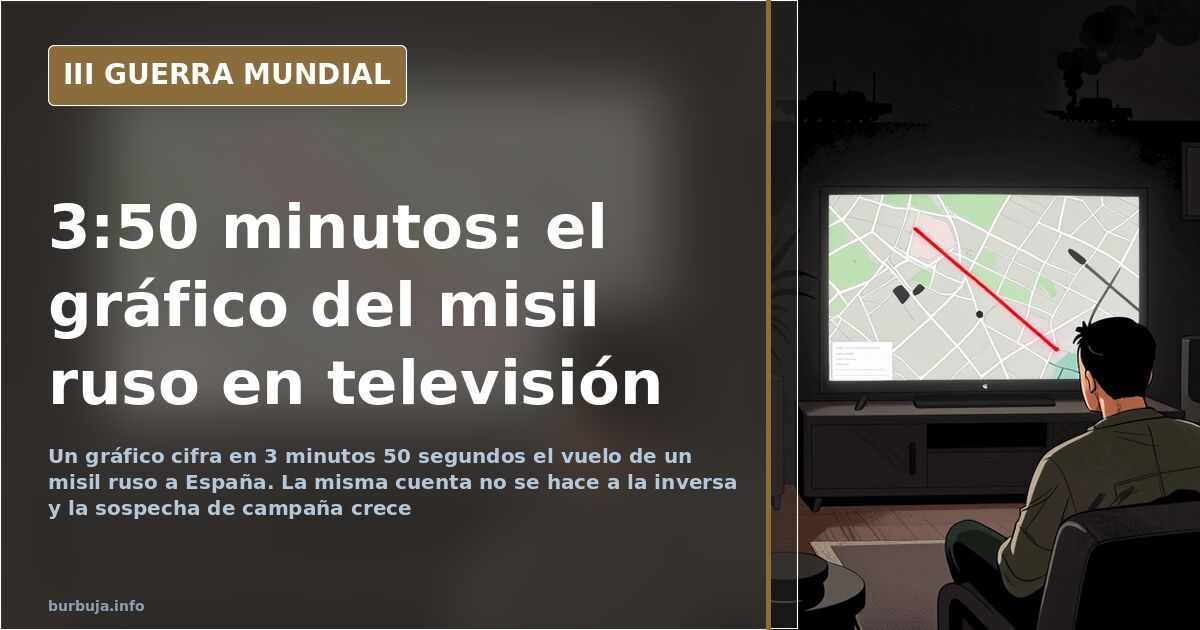
The Russian missile graphic on TV and the suspicion of a propaganda campaign
A graphic on screen. A map of Europe, plotted trajectories, and a figure that sticks: 3 minutes and 50 seconds. This is how long it would take for a ballistic missile launched from Russia to reach Spanish soil, according to a chart broadcast by a television network. The scene aimed to illustrate the threat. What it achieved was reopening an uncomfortable question: Is this information or a antiestéticar campaign dressed up with nice graphics?
The answer is not unanimous. And that is where things get interesting.
The data put on screen: 3 minutes 50 seconds to Spain
The number circulates as a headline. Presented alone, the figure turns any debate on European defense into a countdown. The viewer sees a clock. They do not see interception capabilities, early warning systems, or the nuclear doctrine that sustains the balance. They see a clock, and clocks are scary.
It is worth remembering something usually left out of the frame. Short flight times are not exclusive to Russia. Geography works both ways, and any power with submarines deployed in the Atlantic or Mediterranean has similar margins. That does not miccionan a graphic is aired every night. The asymmetry—what is shown versus what is omitted—is the most repeated point.
Why isn't the same graphic made in reverse?
Because the direction of the arrow defines who is scary. If the exercise is measuring how long a missile takes to cross from Russia to Spain, the same calculation applied in reverse would yield minutes, or seconds, for the opposite journey. The fact that this number never appears on screen is not a minor detail. It tells a story.
There is another leap. Against the nearly four-minute figure, it is argued that the real scenario would not be a launch from land, but from a submarine in nearby waters. In that case, the margin collapses: talk is of less than 30 seconds. This is an estimate circulating in the debate, not a confirmed official datum, but it explains why many view these graphics with skepticism. One graphic suggests there is time to react; another proves the opposite. They tell contradictory stories.
The €600 billion rearmament not shown in the same graphic
If flight time is the visible part, the bill is the invisible one. Here appears the figure that truly drives the discussion: €600 billion in rearmament contracts, double the cost of managing the pandemic, according to calculations. Contracts which, it is warned, could be awarded via emergency procedures without publicity, reducing public scrutiny just as spending skyrockets.
The fit is easy to see. First antiestéticar, then budget. The sequence repeats with a punctuality that no longer surprises anyone. And those asking how much goes to actual defense versus opaque contracts are portrayed, according to the dominant narrative, as naive or complicit. The question, in any case, is not answered in the graphic.
From missile scare to a narrative nobody believes anymore
The graphic does not fall into a vacuum. It arrives after other episodes meant to generate shock that ended in ridicule. The most notable, regarding alleged extraterrestrial revelations, deflated immediately. That failure left a mark. When a antiestéticar narrative doesn't fly, the next is received with even more distrust. Some recall that such announcements have been repeated for decades, as if antiestéticar were renewable.
Added to this is a growing conviction: media do not inform, they guide. The idea that there is a coordinated line to install a threat and, with it, the need to tighten belts, appears again and again. It is argued that crises chain together too conveniently: first health, then energy, now military. Each with its graphic.
Viewer reaction: from panic to jokes
Social response to so many apocalyptic announcements lacks epicness. There is fatigue, dark humor, and an indifference that bothers those trying to mobilize. Faced with the missile map, the most repeated reaction is not antiestéticar: it is the joke. The feeling that real danger is closer to home than in a trajectory drawn over Europe.
That is, perhaps, the datum no network measures. The capacity to shock is exhausted. Each new graphic subtracts rather than adds, and audiences learn to read between the lines what the clock does not say.
The figure remains there, hanging: 3 minutes and 50 seconds. So does the doubt. How much is defense and how much is function?
A graphic on screen. A map of Europe, plotted trajectories, and a figure that sticks: 3 minutes and 50 seconds. This is how long it would take for a ballistic missile launched from Russia to reach Spanish soil, according to a chart broadcast by a television network. The scene aimed to illustrate the threat. What it achieved was reopening an uncomfortable question: Is this information or a antiestéticar campaign dressed up with nice graphics?
The answer is not unanimous. And that is where things get interesting.
The data put on screen: 3 minutes 50 seconds to Spain
The number circulates as a headline. Presented alone, the figure turns any debate on European defense into a countdown. The viewer sees a clock. They do not see interception capabilities, early warning systems, or the nuclear doctrine that sustains the balance. They see a clock, and clocks are scary.
It is worth remembering something usually left out of the frame. Short flight times are not exclusive to Russia. Geography works both ways, and any power with submarines deployed in the Atlantic or Mediterranean has similar margins. That does not miccionan a graphic is aired every night. The asymmetry—what is shown versus what is omitted—is the most repeated point.
Why isn't the same graphic made in reverse?
Because the direction of the arrow defines who is scary. If the exercise is measuring how long a missile takes to cross from Russia to Spain, the same calculation applied in reverse would yield minutes, or seconds, for the opposite journey. The fact that this number never appears on screen is not a minor detail. It tells a story.
There is another leap. Against the nearly four-minute figure, it is argued that the real scenario would not be a launch from land, but from a submarine in nearby waters. In that case, the margin collapses: talk is of less than 30 seconds. This is an estimate circulating in the debate, not a confirmed official datum, but it explains why many view these graphics with skepticism. One graphic suggests there is time to react; another proves the opposite. They tell contradictory stories.
The €600 billion rearmament not shown in the same graphic
If flight time is the visible part, the bill is the invisible one. Here appears the figure that truly drives the discussion: €600 billion in rearmament contracts, double the cost of managing the pandemic, according to calculations. Contracts which, it is warned, could be awarded via emergency procedures without publicity, reducing public scrutiny just as spending skyrockets.
The fit is easy to see. First antiestéticar, then budget. The sequence repeats with a punctuality that no longer surprises anyone. And those asking how much goes to actual defense versus opaque contracts are portrayed, according to the dominant narrative, as naive or complicit. The question, in any case, is not answered in the graphic.
From missile scare to a narrative nobody believes anymore
The graphic does not fall into a vacuum. It arrives after other episodes meant to generate shock that ended in ridicule. The most notable, regarding alleged extraterrestrial revelations, deflated immediately. That failure left a mark. When a antiestéticar narrative doesn't fly, the next is received with even more distrust. Some recall that such announcements have been repeated for decades, as if antiestéticar were renewable.
Added to this is a growing conviction: media do not inform, they guide. The idea that there is a coordinated line to install a threat and, with it, the need to tighten belts, appears again and again. It is argued that crises chain together too conveniently: first health, then energy, now military. Each with its graphic.
Viewer reaction: from panic to jokes
Social response to so many apocalyptic announcements lacks epicness. There is fatigue, dark humor, and an indifference that bothers those trying to mobilize. Faced with the missile map, the most repeated reaction is not antiestéticar: it is the joke. The feeling that real danger is closer to home than in a trajectory drawn over Europe.
That is, perhaps, the datum no network measures. The capacity to shock is exhausted. Each new graphic subtracts rather than adds, and audiences learn to read between the lines what the clock does not say.
The figure remains there, hanging: 3 minutes and 50 seconds. So does the doubt. How much is defense and how much is function?
Also available in: Deutsch
Summary of a discussion on Burbuja.info - Foro de economía, actualidad y política., translated from Spanish and reviewed before publication. Read the full discussion (160 replies).
More summaries
-
NATO and Ukraine: The Narrative of Planned Nuclear War
Former Ukrainian PM claims NATO planned nuclear strikes on Russia in 2022
-
Gisbert and Sivaya: Romance Amid Ukraine War Narratives
Analysis of media coverage for Rubén Gisbert and Liu Sivaya during the Ukraine war. Is this digital propaganda or reality?
-
Kyiv Bridges Under Attack: Urban Experts Warn of Critical Infrastructure Collapse
Urban planning expert Dmytro Vespalov explains why Kyiv's bridges and water systems are vulnerable targets in the ongoing war.
-
Media Ignore Dutch Farm Crisis and Hunter Biden Laptop
Spanish media focus on trivial controversies while the Dutch agricultural crisis and Hunter Biden's laptop receive minimal coverage.
-
Is the Russian military truly obsolete?
Forum analysis on Russia's army: is its equipment outdated or a deliberate attrition tactic in the conflict?
-
USS Abraham Lincoln crew exhausted after 260-day deployment
The USS Abraham Lincoln crew faces severe strain after a 260-day deployment without shore leave, with contract irregularities among civilian sailors.