
Trump Plans Federal Task Force Against Human Trafficking
A proposed federal task force targeting trafficking networks sparks debate over NGO funding, exemptions, and a 30% transaction tax.
English · Original discussion in Spanish · Published
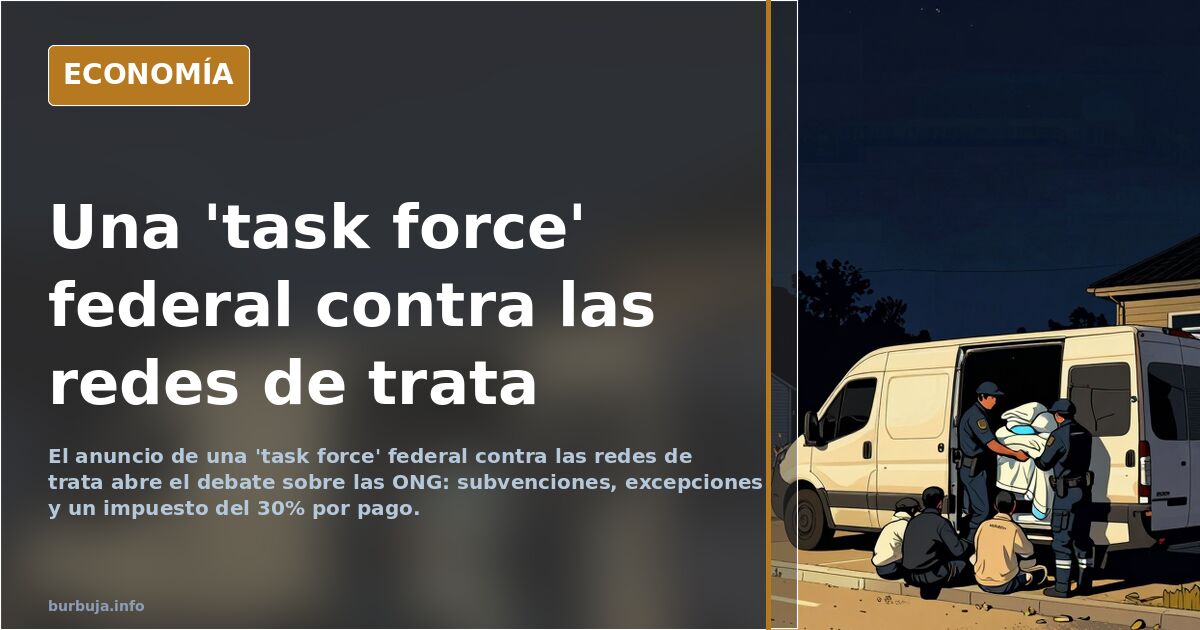
Federal task force announcement shifts focus to NGOs
There is a list. A proper name —Arabella Advisors—, a surname burdened by years of controversy —Soros— and a promise spread in capital letters: destroy the entire infrastructure of non-governmental organizations. The announcement of a federal task force against trafficking networks, allegedly controlled by the Democratic system and the UN, arrived wrapped in an information bomb format, with US presenter Alex Jones as the loudspeaker. Hours later, the conversation was no longer about human trafficking. It was about public money.
What is known about the federal task force against trafficking networks?
As circulated, the announcement describes a federal working group that would pursue trafficking networks supposedly controlled by the Democratic apparatus and the United Nations. There is no public organizational chart, no list of involved agencies, nor regulatory text. It is stated that the goal is the complete infrastructure of NGOs, not just a handful of files. And there is a prior piece cited by some participants: on a high-audience podcast, Elon Musk argued that an electoral defeat would have closed the door to any future correction and that, winning, it was time to move. None of these claims come with official documentation.
From public subsidy to organized crime accusations
Interpretations diverge quickly. One current argues that the issue is not about ideology or visible facades, but about high-level organized crime: NGOs would be the spearhead and first operational tool of larger schemes. Another side sticks to what is verifiable and avoids the leap: most are formally non-governmental, but depend on public budgets more than some government departments. In this line, Spanish entities are pointed out which, under a local appearance, would be subsidiaries of international organizations sustained by third-country funds. The repeated practical conclusion is that, without a cent of public money, many dissolve on their own. The best-circulating definition is that of outsourced civil servants: similar payroll and infinitely less scrutiny.
The 30% payment tax and the debate on exemptions
Among the concrete proposals that have appeared, one stands out for its simplicity: require that any payment to an NGO be made through a bank account and apply a 30% tax per operation, with two exceptions, entities dedicated to diseases and ONCE (Spain's National Organization of the Blind). The idea seeks to tax the flow at source rather than pursuing spending afterwards. There are also those who question the very criteria for exemptions: if the problem is the use of money, why do some qualify and others do not? And a finding that needs no adjectives: the label "non-governmental" has ceased to describe the source of income. The overall debate leaves a picture far more uncomfortable than the headline.
The El Salvador precedent and the temptation to copy it
In parallel, the conversation shifts to a case already underway: El Salvador, where the government of Nayib Bukele is attributed a prior offensive against organizations linked to gangs. It is cited as a precedent and as proof that the path is viable. From there to the why not here? is a step many take without restraint. What is missing in that reasoning is the detail: which organizations, with what evidence, and under what legal cover. The list of names repeated also includes public figures from the humanitarian sector, with outstanding debts according to that same reading.
Susie Wiles, the Musk factor and a term without reelection
The other front is that of names. The White House Chief of Staff will be Susie Wiles, highlighted as the strategist who sustained the candidacy when almost nobody gave a dollar for it. Her appointment is read as a sign of method: less noise, more execution. Regarding the calendar, the arithmetic is simple: a final term, majorities in both chambers during the first two years, and three risks looming over any four-year plan —a bullet, midterm elections that change majorities, or a health problem at an unforgiving age—. Those who frame it this way do not describe a antiestéticar: they describe a countdown. And they warn that power has internal counterweights, with sectors of the party itself always willing to jump on the bandwagon.
Remains the data point nobody disputes, because it does not depend on any interpretation: the man driving the project will not run for anything again. Four years, a favorable Congress during the first half, and a list of objectives to which the acronyms of thousands of organizations have just been added. What comes next is no longer played in the polls.
There is a list. A proper name —Arabella Advisors—, a surname burdened by years of controversy —Soros— and a promise spread in capital letters: destroy the entire infrastructure of non-governmental organizations. The announcement of a federal task force against trafficking networks, allegedly controlled by the Democratic system and the UN, arrived wrapped in an information bomb format, with US presenter Alex Jones as the loudspeaker. Hours later, the conversation was no longer about human trafficking. It was about public money.
What is known about the federal task force against trafficking networks?
As circulated, the announcement describes a federal working group that would pursue trafficking networks supposedly controlled by the Democratic apparatus and the United Nations. There is no public organizational chart, no list of involved agencies, nor regulatory text. It is stated that the goal is the complete infrastructure of NGOs, not just a handful of files. And there is a prior piece cited by some participants: on a high-audience podcast, Elon Musk argued that an electoral defeat would have closed the door to any future correction and that, winning, it was time to move. None of these claims come with official documentation.
From public subsidy to organized crime accusations
Interpretations diverge quickly. One current argues that the issue is not about ideology or visible facades, but about high-level organized crime: NGOs would be the spearhead and first operational tool of larger schemes. Another side sticks to what is verifiable and avoids the leap: most are formally non-governmental, but depend on public budgets more than some government departments. In this line, Spanish entities are pointed out which, under a local appearance, would be subsidiaries of international organizations sustained by third-country funds. The repeated practical conclusion is that, without a cent of public money, many dissolve on their own. The best-circulating definition is that of outsourced civil servants: similar payroll and infinitely less scrutiny.
The 30% payment tax and the debate on exemptions
Among the concrete proposals that have appeared, one stands out for its simplicity: require that any payment to an NGO be made through a bank account and apply a 30% tax per operation, with two exceptions, entities dedicated to diseases and ONCE (Spain's National Organization of the Blind). The idea seeks to tax the flow at source rather than pursuing spending afterwards. There are also those who question the very criteria for exemptions: if the problem is the use of money, why do some qualify and others do not? And a finding that needs no adjectives: the label "non-governmental" has ceased to describe the source of income. The overall debate leaves a picture far more uncomfortable than the headline.
The El Salvador precedent and the temptation to copy it
In parallel, the conversation shifts to a case already underway: El Salvador, where the government of Nayib Bukele is attributed a prior offensive against organizations linked to gangs. It is cited as a precedent and as proof that the path is viable. From there to the why not here? is a step many take without restraint. What is missing in that reasoning is the detail: which organizations, with what evidence, and under what legal cover. The list of names repeated also includes public figures from the humanitarian sector, with outstanding debts according to that same reading.
Susie Wiles, the Musk factor and a term without reelection
The other front is that of names. The White House Chief of Staff will be Susie Wiles, highlighted as the strategist who sustained the candidacy when almost nobody gave a dollar for it. Her appointment is read as a sign of method: less noise, more execution. Regarding the calendar, the arithmetic is simple: a final term, majorities in both chambers during the first two years, and three risks looming over any four-year plan —a bullet, midterm elections that change majorities, or a health problem at an unforgiving age—. Those who frame it this way do not describe a antiestéticar: they describe a countdown. And they warn that power has internal counterweights, with sectors of the party itself always willing to jump on the bandwagon.
Remains the data point nobody disputes, because it does not depend on any interpretation: the man driving the project will not run for anything again. Four years, a favorable Congress during the first half, and a list of objectives to which the acronyms of thousands of organizations have just been added. What comes next is no longer played in the polls.
Summary of a discussion on Burbuja.info - Foro de economía, actualidad y política., translated from Spanish and reviewed before publication. Read the full discussion (179 replies).
More summaries
-
Musk vs. Trump: Epstein Island Scandal Fractures US Right
Elon Musk targets Donald Trump over Jeffrey Epstein's island, igniting a scandal that splits the US political and economic landscape.
-
Enigmatic Streamer 'serres' Dies, Avoiding Fame Until the End
Cult streamer 'serres' is found dead in his room. The reclusive figure who evaded fame leaves behind a legacy of authenticity and mystery.
-
Economic Forum Thread Revives Annual 'Humanity Should Vanish' Debate
An economic forum thread resurfaces every December with the claim that humanity should disappear, blending misanthropy and corrections.
-
Eiffel Tower Tweet Sparks Xenophobic Debate in Forum
A tweet featuring the Eiffel Tower triggered hostile anti-immigrant comments in an economics forum, lacking supporting data.
-
Spain's Urban Aesthetic: Is It Europe's Ugliest?
Exposed brick and poor planning spark debate on Spain's urban aesthetics compared to the rest of Western Europe.
-
Spain's Civil Guard hires first Down syndrome employee, sparking debate
Alberto Gil is the first person with Down syndrome in Spain's Guardia Civil. His administrative role fuels discussion on disability quotas and costs.