
Trump militarizes Caribbean against cartels, deploying F-35s
Trump signs military directive against drug cartels, deploys F-35s in the Caribbean and offers $50 million for Maduro. Eleven killed in a naval strike.
English · Original discussion in Spanish · Published
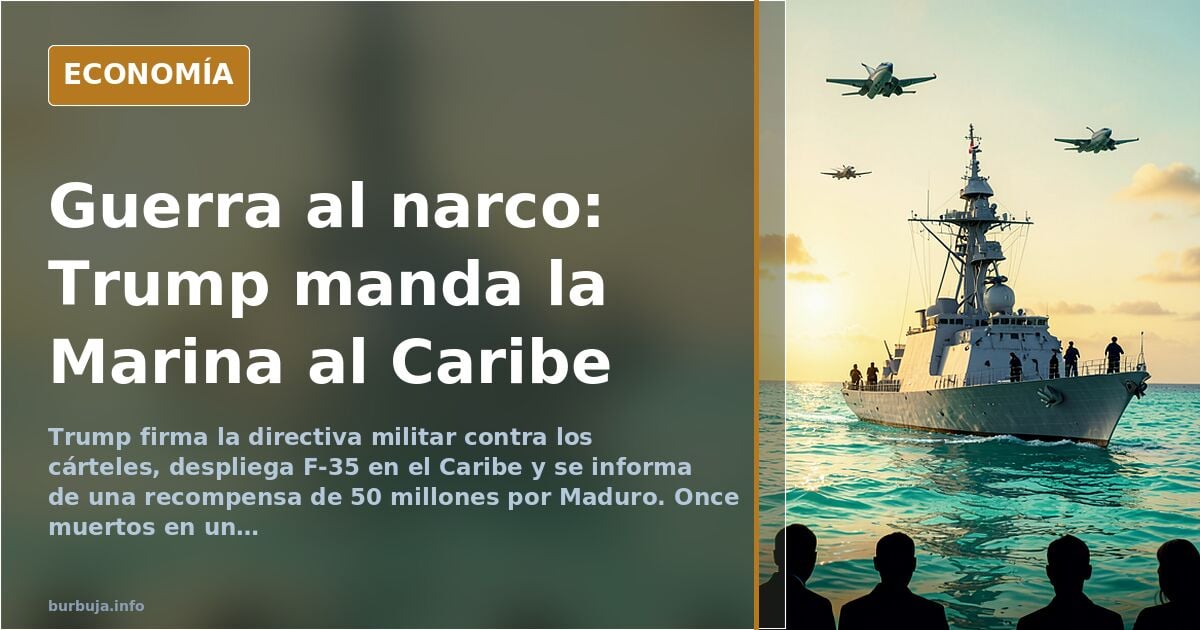
Trump launches Navy against cartels as Caribbean becomes powder keg
US President Donald Trump has signed a military directive to deploy armed forces against Latin American drug cartels. The package includes a naval embargo in the Western Hemisphere, use of Special Forces, cyber warfare, designating cartels as foreign terrorist organizations, and requesting Congress impose the death penalty on traffickers. Within hours, a US Navy attack on a vessel from Venezuela left eleven dead, according to available reports, while the Venezuelan government mobilized F-16 fighter jets over a US warship. The Pentagon responded by deploying ten F-35s to Puerto Rico. According to a message circulated on forums, the reward for Nicolás Maduro stands at $50 million. The Caribbean is now the epicenter of an operation presented as a war on drugs but bearing all the hallmarks of a geopolitical showdown.
From headlines to missiles: what does Trump's signed directive say?
The text of the directive, widely shared in media and social networks, promises "MAXIMUM DAMAGE" to organización criminal leadership and infrastructure. It outlines a total naval embargo, alliances with neighboring governments, cutting off organizations' access to the global financial system, and an explicit warning: "Drug bosses and ruthless traffickers will never sleep soundly again." On paper, the catalog is ambitious. On the ground, the first verifiable result was an attacked boat and eleven corpses.
Designating cartels as foreign terrorist organizations changes the legal framework: it allows covert operations, financial sanctions, and military actions that previously required different legal pretexts. This is no minor detail. When a incivil gang enters the terrorist list, the threshold for intervention drops, and the war ceases to be metaphorical.
Has the war on drugs ever worked?
The most cited precedents are the Medellín and Cali Cartels. US pressure and Colombian collaboration helped dismantle them, but the business did not disappear; it changed countries and raw materials. Today, the focus is on Mexico and fentanyl. The lesson drawn from that experience is that mafias recycle faster than governments.
Alcohol prohibition in the United States during the 1920s left a trail of mafias, violence, and corruption. The war on drugs has trinc a similar pattern: every gram seized raises product prices and funds the next link in the chain. Those advocating legalization argue that the only way to strangle cartels is to seize their monopoly; proponents of tough measures counter that the black market doesn't understand licenses.
The business: how much does drug trafficking move and why no one wants to turn off the tap?
Drug money knows no borders. Cartels already operate on several continents and are among the main beneficiaries of globalization. With such volume, the suspicion that this operation could be a settling of scores—or a business in itself—hangs over any analysis. The reward for Maduro, set at $50 million according to forum messages, points to an objective beyond fentanyl labs.
Terrorist designation opens the door to global sanctions but also to collateral effects: punishing cartels hits banks and entire economies that have coexisted with dirty money for decades. Banking always finds a way to make the problem someone else's.
The military scenario: destroyers, F-35s, and a naval embargo
The deployment includes ten F-35s in Puerto Rico, destroyers in the Caribbean, and warnings that Venezuelan planes "will be shot down" if they threaten US forces. Controlling what enters and leaves Venezuela is the stated goal. For some analysts, the operation aims to economically strangle the Maduro regime rather than chase speedboats.
The temporal coincidence with the reopening of the Epstein case and internal pressure on Trump fuels the thesis that the directive is a smokescreen. The administration denies this. The calendar, however, is striking: the operation arrives after a first term where nothing similar was executed.
What happens to Maduro and drug prices?
With Maduro targeted, a $50 million reward circulating in forums, and F-35s flying over the Caribbean, the lingering question is what happens if the standoff escalates. Black market logic dictates that each military intervention raises product costs and increases margins for survivors. Political logic dictates the operation will be sold as a victory before its effects can be measured. In between lie the eleven dead on that boat and a business unwilling to close shop.
Key data:
The complete calculation of what global drug trafficking moves, using figures handled in financial circuits, exceeds any official estimate. Exact numbers remain the pending issue for all operations of this type.
US President Donald Trump has signed a military directive to deploy armed forces against Latin American drug cartels. The package includes a naval embargo in the Western Hemisphere, use of Special Forces, cyber warfare, designating cartels as foreign terrorist organizations, and requesting Congress impose the death penalty on traffickers. Within hours, a US Navy attack on a vessel from Venezuela left eleven dead, according to available reports, while the Venezuelan government mobilized F-16 fighter jets over a US warship. The Pentagon responded by deploying ten F-35s to Puerto Rico. According to a message circulated on forums, the reward for Nicolás Maduro stands at $50 million. The Caribbean is now the epicenter of an operation presented as a war on drugs but bearing all the hallmarks of a geopolitical showdown.
From headlines to missiles: what does Trump's signed directive say?
The text of the directive, widely shared in media and social networks, promises "MAXIMUM DAMAGE" to organización criminal leadership and infrastructure. It outlines a total naval embargo, alliances with neighboring governments, cutting off organizations' access to the global financial system, and an explicit warning: "Drug bosses and ruthless traffickers will never sleep soundly again." On paper, the catalog is ambitious. On the ground, the first verifiable result was an attacked boat and eleven corpses.
Designating cartels as foreign terrorist organizations changes the legal framework: it allows covert operations, financial sanctions, and military actions that previously required different legal pretexts. This is no minor detail. When a incivil gang enters the terrorist list, the threshold for intervention drops, and the war ceases to be metaphorical.
Has the war on drugs ever worked?
The most cited precedents are the Medellín and Cali Cartels. US pressure and Colombian collaboration helped dismantle them, but the business did not disappear; it changed countries and raw materials. Today, the focus is on Mexico and fentanyl. The lesson drawn from that experience is that mafias recycle faster than governments.
Alcohol prohibition in the United States during the 1920s left a trail of mafias, violence, and corruption. The war on drugs has trinc a similar pattern: every gram seized raises product prices and funds the next link in the chain. Those advocating legalization argue that the only way to strangle cartels is to seize their monopoly; proponents of tough measures counter that the black market doesn't understand licenses.
The business: how much does drug trafficking move and why no one wants to turn off the tap?
Drug money knows no borders. Cartels already operate on several continents and are among the main beneficiaries of globalization. With such volume, the suspicion that this operation could be a settling of scores—or a business in itself—hangs over any analysis. The reward for Maduro, set at $50 million according to forum messages, points to an objective beyond fentanyl labs.
Terrorist designation opens the door to global sanctions but also to collateral effects: punishing cartels hits banks and entire economies that have coexisted with dirty money for decades. Banking always finds a way to make the problem someone else's.
The military scenario: destroyers, F-35s, and a naval embargo
The deployment includes ten F-35s in Puerto Rico, destroyers in the Caribbean, and warnings that Venezuelan planes "will be shot down" if they threaten US forces. Controlling what enters and leaves Venezuela is the stated goal. For some analysts, the operation aims to economically strangle the Maduro regime rather than chase speedboats.
The temporal coincidence with the reopening of the Epstein case and internal pressure on Trump fuels the thesis that the directive is a smokescreen. The administration denies this. The calendar, however, is striking: the operation arrives after a first term where nothing similar was executed.
What happens to Maduro and drug prices?
With Maduro targeted, a $50 million reward circulating in forums, and F-35s flying over the Caribbean, the lingering question is what happens if the standoff escalates. Black market logic dictates that each military intervention raises product costs and increases margins for survivors. Political logic dictates the operation will be sold as a victory before its effects can be measured. In between lie the eleven dead on that boat and a business unwilling to close shop.
Key data:
- $50 million reward for Nicolás Maduro, according to a message circulated on forums
- 11 dead in the US attack on a vessel coming from Venezuela
- Ten F-35s deployed in Puerto Rico
- Venezuelan F-16 fighters flew over a US warship
The complete calculation of what global drug trafficking moves, using figures handled in financial circuits, exceeds any official estimate. Exact numbers remain the pending issue for all operations of this type.
Also available in: Deutsch
Summary of a discussion on Burbuja.info - Foro de economía, actualidad y política., translated from Spanish and reviewed before publication. Read the full discussion (59 replies).
More summaries
-
Trump Announces US Takes Control of Venezuela, No Casualties Reported
Donald Trump declares US control over Venezuela to secure oil and rebuild infrastructure, claiming zero military casualties. Analysis covers costs, reserves, and geopolitical parallels with Ukraine.
-
The pattern behind war excuses: from Iraq to Venezuela
The video on Maduro and oil revives the Iraq weapons pattern: excuses to invade. Will anything change in 2026?
-
Trump: 'The United States will be finished if the Democrats win the elections'
Trump warns the US will be 'finished' if Democrats win the House, Senate and Presidency in 2028. He pledges to veto every Democratic bill if he loses Congress.
-
Ayuso Breaks Iker Jiménez’s Rules in Controversial Horizon Interview
Madrid President Isabel Díaz Ayuso breaks Iker Jiménez’s no-politician rule, sparking debate on media pluralism and the Puerta del Sol protests.
-
Spain: Digital Vulnerabilities Expose Critical Infrastructure
PHP, Java and Node.js flaws coincide with attacks on Binance and European cold chains. Digital dependency exposes critical infrastructure.
-
Halloween candy nails in Germany spark national prejudice
Nails found in Halloween sweets in Germany fuel generalizations: without a suspect, the debate condemns an entire country.