
Trump backs down on China: the 145% tariff will come down
Trump says the 145% tariff on China “will be substantially reduced.” Warning: 40% of containers stuck at Chinese ports
English · Original discussion in Spanish · Published
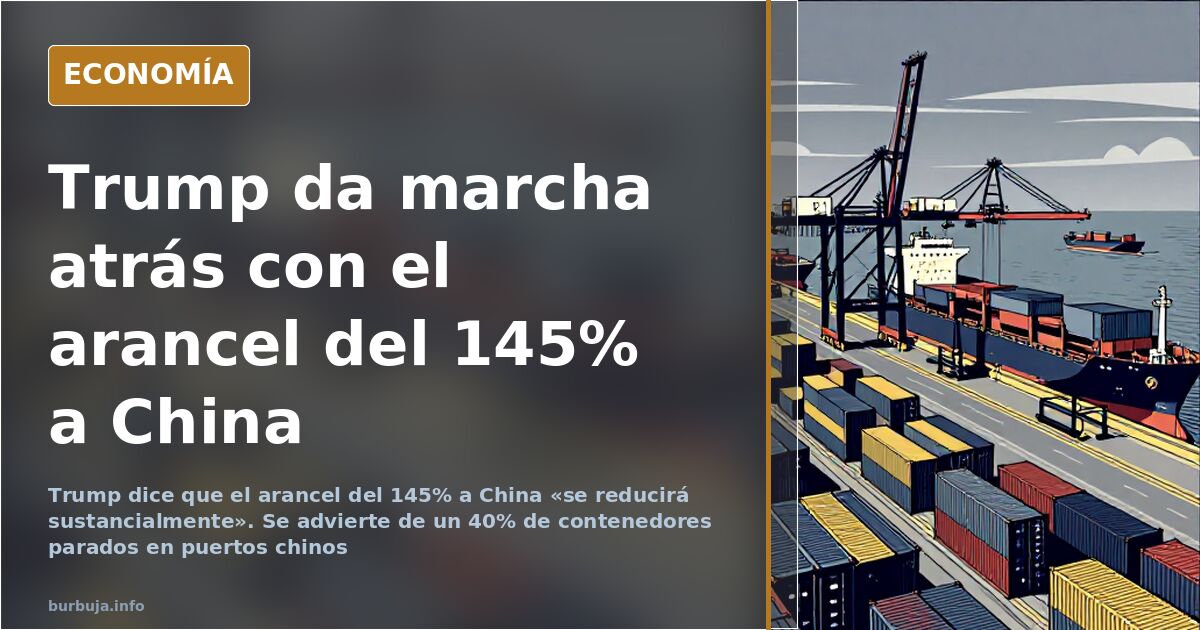
Trump backs down on China: the 145% tariff will come down
How long can a bluff hold before it turns into a retreat? The U.S. president said Tuesday that the steep tariffs imposed on Chinese imports “will be substantially reduced.” Translation: from the current 145% to something he himself would not specify, but that no longer seems so high to him. “It won’t be that high, it won’t be that high,” he said in the Oval Office, before adding that Washington is going to be “very nice” and that he expects the same from Beijing. “We’re going to be very nice, they’re going to be nice too, and we’ll see what happens.”
The shift comes after weeks of mutual threats, markets in disarray and an open fight inside his own team. Trump also urged China to close a deal and warned that, if it does not, he “will make the deal” on his own.
Which tariff is at stake and who is in charge at the White House
The rate under discussion is the 145% applied to Chinese imports, a figure that in practice amounts to shutting off the spigot of bilateral trade. The reversal has not been an isolated gesture: Commerce Secretary Howard Lutnick, a defender of the tariff truce, has aligned himself with the Treasury secretary to contain the hard-line stance of adviser Peter Navarro. In other words, the administration itself has spent weeks waging an internal war over how far to pull the rope tight.
That fight explains the sudden reversal. What was announced as a show of strength has turned into a desperate negotiation, with the White House occupant lowering his tone in real time and no visible concessions from Beijing.
The bluff the whole table saw
The dominant reading is that he played a hand of poker with other people’s money—taxpayers’—and that the table quickly called his bluff. The operation has even been described as a textbook pump and dump: announcements that move the market and allow buying low before the rise and selling high before the crash. It is not a incivil charge or an open investigation; it is a suspicion circulating in the debate.
The counterargument also has legs: that it is all a calculated negotiating strategy, with Trump striking hard and watching the reaction before adjusting and taking advantage. Those who defend that thesis recall that the stated goal is to move production out of China, force tariff cuts and push Chinese companies to manufacture on U.S. soil if they want to sell there.
The cost already showing up at ports
While intentions are debated, the numbers are moving. There are warnings that around 40% of containers at Chinese ports bound for the United States are stalled, and that 25 superfreighter voyages have been canceled so far. These are figures pointing to a real supply-chain bottleneck, not a verbal skirmish.
The question is who can withstand that paralysis longer. Some argue that China will end up asking for the problem to be taken off its hands before hundreds of Chinese companies go bankrupt; on the other side, some doubt that China will come off worse. The calculation of who can better withstand the paralysis remains open.
Why the U.S. may end up worse off as a partner
This is the point with the greatest medium-term implications. Everything being applied to China could be applied tomorrow to Japan, Korea or any other partner. The message sent to the world is that Washington is not a reliable ally: not as a trading partner, not as a final export market, and not as a keeper of the rules it itself promoted.
Any agreement signed with them can blow up overnight. Some argue that this turns the world’s largest economy into a toxic partner, and that global investment decisions are already beginning to internalize it, with effects that will not be seen this week but over the next twelve months.
Tesla, Musk and the side effect
The Tesla case serves as a gauge. Its business depends on selling electric cars made in China for cost reasons, and its owner has aligned himself with a president who imposes tariffs, questions climate change and bets on more oil. The contradiction is hard to sustain, and the market is pricing it in.
This is not a matter of sympathies: it is industrial arithmetic. If components and assembly come from Asia and the final product is sold in America, any tariff increase hits margins directly. That the company’s owner is one of the main backers of that policy only adds noise to the equation.
Debt and the dollar: the scenario under discussion
On the financial front, the data point that frames the debate is that of U.S. debt holders: Japan first and China second. From there, scenarios unfold. The most extreme asks what would happen if the issuer stopped paying: the dollar would lose its status and the country would enter a spiral of distrust with severe domestic consequences.
It is a theoretical exercise, not a forecast. Other analyses go in the opposite direction and argue that the real goal is to weaken the dollar to balance a trade balance clearly unfavorable to the United States. Two incompatible narratives coexist in the same debate without either prevailing.
Meanwhile, in Ukraine, Russia continues to advance slowly but without pause. Making money on the way down, making it during weeks of Russian roulette and making it again on the way up: some people have no doubt. There are only four years left to find out.
This article does not constitute financial advice or an investment recommendation.
How long can a bluff hold before it turns into a retreat? The U.S. president said Tuesday that the steep tariffs imposed on Chinese imports “will be substantially reduced.” Translation: from the current 145% to something he himself would not specify, but that no longer seems so high to him. “It won’t be that high, it won’t be that high,” he said in the Oval Office, before adding that Washington is going to be “very nice” and that he expects the same from Beijing. “We’re going to be very nice, they’re going to be nice too, and we’ll see what happens.”
The shift comes after weeks of mutual threats, markets in disarray and an open fight inside his own team. Trump also urged China to close a deal and warned that, if it does not, he “will make the deal” on his own.
Which tariff is at stake and who is in charge at the White House
The rate under discussion is the 145% applied to Chinese imports, a figure that in practice amounts to shutting off the spigot of bilateral trade. The reversal has not been an isolated gesture: Commerce Secretary Howard Lutnick, a defender of the tariff truce, has aligned himself with the Treasury secretary to contain the hard-line stance of adviser Peter Navarro. In other words, the administration itself has spent weeks waging an internal war over how far to pull the rope tight.
That fight explains the sudden reversal. What was announced as a show of strength has turned into a desperate negotiation, with the White House occupant lowering his tone in real time and no visible concessions from Beijing.
The bluff the whole table saw
The dominant reading is that he played a hand of poker with other people’s money—taxpayers’—and that the table quickly called his bluff. The operation has even been described as a textbook pump and dump: announcements that move the market and allow buying low before the rise and selling high before the crash. It is not a incivil charge or an open investigation; it is a suspicion circulating in the debate.
The counterargument also has legs: that it is all a calculated negotiating strategy, with Trump striking hard and watching the reaction before adjusting and taking advantage. Those who defend that thesis recall that the stated goal is to move production out of China, force tariff cuts and push Chinese companies to manufacture on U.S. soil if they want to sell there.
The cost already showing up at ports
While intentions are debated, the numbers are moving. There are warnings that around 40% of containers at Chinese ports bound for the United States are stalled, and that 25 superfreighter voyages have been canceled so far. These are figures pointing to a real supply-chain bottleneck, not a verbal skirmish.
The question is who can withstand that paralysis longer. Some argue that China will end up asking for the problem to be taken off its hands before hundreds of Chinese companies go bankrupt; on the other side, some doubt that China will come off worse. The calculation of who can better withstand the paralysis remains open.
Why the U.S. may end up worse off as a partner
This is the point with the greatest medium-term implications. Everything being applied to China could be applied tomorrow to Japan, Korea or any other partner. The message sent to the world is that Washington is not a reliable ally: not as a trading partner, not as a final export market, and not as a keeper of the rules it itself promoted.
Any agreement signed with them can blow up overnight. Some argue that this turns the world’s largest economy into a toxic partner, and that global investment decisions are already beginning to internalize it, with effects that will not be seen this week but over the next twelve months.
Tesla, Musk and the side effect
The Tesla case serves as a gauge. Its business depends on selling electric cars made in China for cost reasons, and its owner has aligned himself with a president who imposes tariffs, questions climate change and bets on more oil. The contradiction is hard to sustain, and the market is pricing it in.
This is not a matter of sympathies: it is industrial arithmetic. If components and assembly come from Asia and the final product is sold in America, any tariff increase hits margins directly. That the company’s owner is one of the main backers of that policy only adds noise to the equation.
Debt and the dollar: the scenario under discussion
On the financial front, the data point that frames the debate is that of U.S. debt holders: Japan first and China second. From there, scenarios unfold. The most extreme asks what would happen if the issuer stopped paying: the dollar would lose its status and the country would enter a spiral of distrust with severe domestic consequences.
It is a theoretical exercise, not a forecast. Other analyses go in the opposite direction and argue that the real goal is to weaken the dollar to balance a trade balance clearly unfavorable to the United States. Two incompatible narratives coexist in the same debate without either prevailing.
Meanwhile, in Ukraine, Russia continues to advance slowly but without pause. Making money on the way down, making it during weeks of Russian roulette and making it again on the way up: some people have no doubt. There are only four years left to find out.
This article does not constitute financial advice or an investment recommendation.
Summary of a discussion on Burbuja.info - Foro de economía, actualidad y política., translated from Spanish and reviewed before publication. Read the full discussion (216 replies).
More summaries
-
Euthanasia in Old Age: Autonomy vs. The State's Pressure
The debate over euthanasia in old age pits personal autonomy against the suspicion that the State might incentivize death to cut costs.
-
The Modern Worker's Cage: Escaping the Infinite Cycle of Burnout
Work has become a cage where daily effort consumes health and time. Discover why we push ourselves so hard and how to break the cycle.
-
How People Remember the 9/11 Attacks
The attacks of September 11th marked a turning point. Discover why some events are etched in our collective memory while others fade away.
-
Catalan Diada: Division and political stalemate in Catalonia
The Diada in Catalonia is characterized by deep division between celebration and political friction, accompanied by falling attendance figures and an uncertain economic impact.
-
Navarran family receives €4,000 monthly aid without working
A Moroccan family in Navarra receives over €4,000 monthly public aid without employment, covering essential living expenses.
-
Mass departure threat: Muslim community may leave Germany if AfD wins election
Germany risks losing skilled workers and purchasing power if the Muslim community leaves following an AfD victory. We analyze the economic implications.