
Trujillo and the Galicians: The Plan to 'Whiten' Dominican Race
Trujillo used Galician immigrants to 'whiten' the Dominican population: the racial plan that hid a deception from the Spanish colonists.
English · Original discussion in Spanish · Published
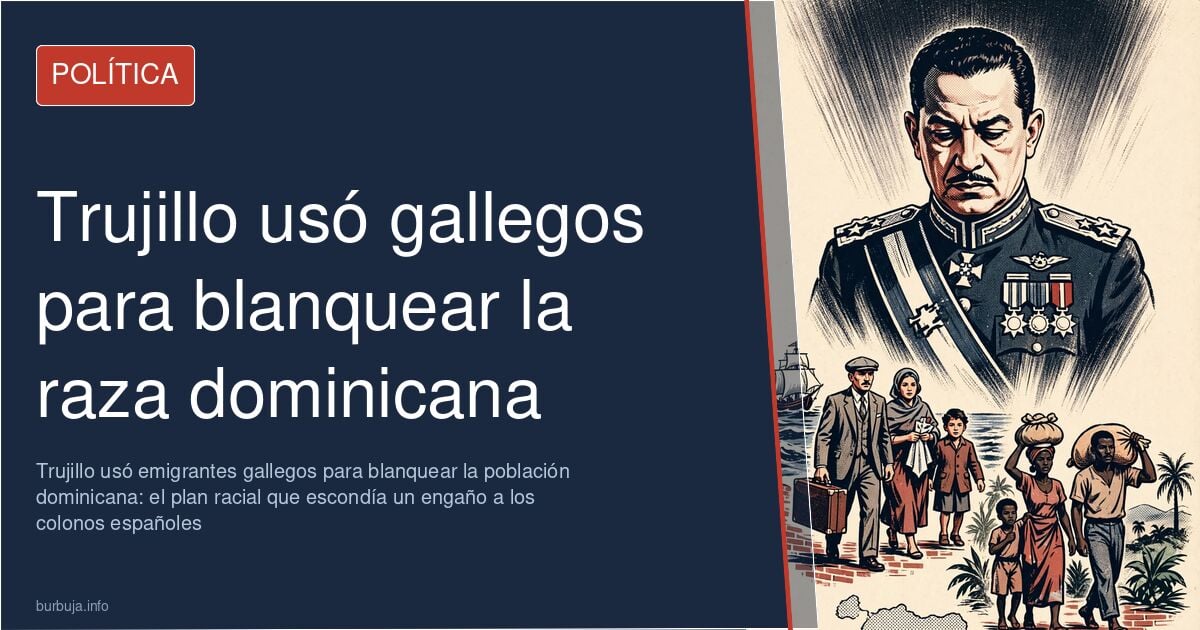
The Galicians Trujillo used to 'whiten' the Dominican Republic
The Dominican Republic of the mid-20th century peine its doors to thousands of Spanish immigrants, many of whom were Galicians, convinced they were going to work the land in a prosperous agricultural colony. The plan that brought them there pursued another goal: dictator Rafael Leónidas Trujillo wanted white colonists who would reproduce and dilute the weight of the Black population in a territory marked by its proximity to Haiti.
Reports, such as those in El Mundo regarding the deception of immigrants during the dictatorship, describe that mix of propaganda, hunger, and an explicit racial ideology that is difficult to read today without feeling discomfort.
What Trujillo sought from the Galician colonists
The regime's interest was not agricultural, but demographic. According to the documentary account, the goal was for the newcomers to have offspring with the local population to 'refine' and 'purify' a country that felt threatened by mass immigration from Haiti, on the same island but in a different state.
Based on this premise was built the entire operation: ships, promises of plots of land, and a colonization machinery that presented settlement as an economic opportunity when it was actually racial engineering disguised as land distribution.
The deception of the Galicians who crossed the Atlantic
The immigrants were sold fertile land and a future. They found hard, back-breaking work conditions and the feeling—expressed bitterly in collected testimonies—of having been pieces in a project they did not choose.
The bitter irony that a racist plan relied on the misery of Galician and Castilian peasants was not lost on anyone. The distance between what was promised and what was delivered measures the exact extent of that deception described by the press.
It was not an isolated case in Latin America
The Dominican Republic was not unique. The Law of Immigration and Colonization of Venezuela, from 1912, prohibited the entry of non-white populations and was in effect, replaced by similar regulations, until 1966. Racial whitening by decree was a shared doctrine throughout much of the continent during the first half of the 20th century. What was unique about the Dominican case is that it depended on colonists who did not know why they were being brought there.
Genetic footprint and modern Dominican reality
Today, the demographic photograph does not match the original plan. According to the CIA World Factbook, the Dominican population is around 73% mixed (mulattoes and mestizos), 16% white, and 11% Black; other estimates divide the map into 67% multi-racial, 20% Black, and 13% white. There is also an unexpected trace: Dr. Juan Carlos Martínez-Cruzado has documented Guanche genes from the Canary Islands in the Dominican population, between 8% and 14%, depending on the region. The diaspora of the archipelago left its mark on the genome.
The debate over whether 'whitening' succeeded is lost between biology and prejudice, and it cannot be resolved with data. What remains is the human trace of the experiment: families who emigrated deceived and a country that still discusses what tonalidad it is, while this episode resurfaces in conversations about immigration.
The Dominican Republic of the mid-20th century peine its doors to thousands of Spanish immigrants, many of whom were Galicians, convinced they were going to work the land in a prosperous agricultural colony. The plan that brought them there pursued another goal: dictator Rafael Leónidas Trujillo wanted white colonists who would reproduce and dilute the weight of the Black population in a territory marked by its proximity to Haiti.
Reports, such as those in El Mundo regarding the deception of immigrants during the dictatorship, describe that mix of propaganda, hunger, and an explicit racial ideology that is difficult to read today without feeling discomfort.
What Trujillo sought from the Galician colonists
The regime's interest was not agricultural, but demographic. According to the documentary account, the goal was for the newcomers to have offspring with the local population to 'refine' and 'purify' a country that felt threatened by mass immigration from Haiti, on the same island but in a different state.
Based on this premise was built the entire operation: ships, promises of plots of land, and a colonization machinery that presented settlement as an economic opportunity when it was actually racial engineering disguised as land distribution.
The deception of the Galicians who crossed the Atlantic
The immigrants were sold fertile land and a future. They found hard, back-breaking work conditions and the feeling—expressed bitterly in collected testimonies—of having been pieces in a project they did not choose.
The bitter irony that a racist plan relied on the misery of Galician and Castilian peasants was not lost on anyone. The distance between what was promised and what was delivered measures the exact extent of that deception described by the press.
It was not an isolated case in Latin America
The Dominican Republic was not unique. The Law of Immigration and Colonization of Venezuela, from 1912, prohibited the entry of non-white populations and was in effect, replaced by similar regulations, until 1966. Racial whitening by decree was a shared doctrine throughout much of the continent during the first half of the 20th century. What was unique about the Dominican case is that it depended on colonists who did not know why they were being brought there.
Genetic footprint and modern Dominican reality
Today, the demographic photograph does not match the original plan. According to the CIA World Factbook, the Dominican population is around 73% mixed (mulattoes and mestizos), 16% white, and 11% Black; other estimates divide the map into 67% multi-racial, 20% Black, and 13% white. There is also an unexpected trace: Dr. Juan Carlos Martínez-Cruzado has documented Guanche genes from the Canary Islands in the Dominican population, between 8% and 14%, depending on the region. The diaspora of the archipelago left its mark on the genome.
The debate over whether 'whitening' succeeded is lost between biology and prejudice, and it cannot be resolved with data. What remains is the human trace of the experiment: families who emigrated deceived and a country that still discusses what tonalidad it is, while this episode resurfaces in conversations about immigration.
Summary of a discussion on Burbuja.info - Foro de economía, actualidad y política., translated from Spanish and reviewed before publication. Read the full discussion (66 replies).
More summaries
-
Franco on TVE, 1964: Empty Rhetoric and the Price of Ending Isolation
Franco's 1964 TVE interview: debated as empty speech or noble values. That year, the international blockade was lifted, but its cost remains undisclosed.
-
What is Sánchez calling the 'Deep State'? (Francisco Rosell in El Debate)
The Spanish President, **Pedro Sánchez**, is accused of using the term "Deep State" to discredit those who challenge him. We analyze the concept and its application.
-
Sequera: The Analyst Dividing His Followers
Analyst Sequera challenges the narrative of Spain: Spengler, Hispanicity, conquest, and contemporary decline.
-
Franco's Civil War Narrative: The Account Dividing Spain
Franco detailed the origins of the Civil War. His version, blaming the Popular Front's alleged fraud and anti-clerical violence, is resurfacing amidst current crises.
-
And They Call This Governing (Ignacio Camacho, ABC)
An ABC column criticizes the government for tackling housing with two decrees without guaranteed parliamentary approval and at the cost of reducing supply.
-
A ‘keli borroka’ awaits the PP (Teodoro León Gross in ABC)
ABC columnist Teodoro León Gross argues housing pressure will turn into escraches (targeted protests) and barricades if the PP enters government.