
Train driver corrects Intxaurrondo live on air over rail regulations
A train driver corrected Silvia Intxaurrondo live on Spain's TVE: she was reading the conventional line regulations, not the high-speed ones, while analysing the…
English · Original discussion in Spanish · Published
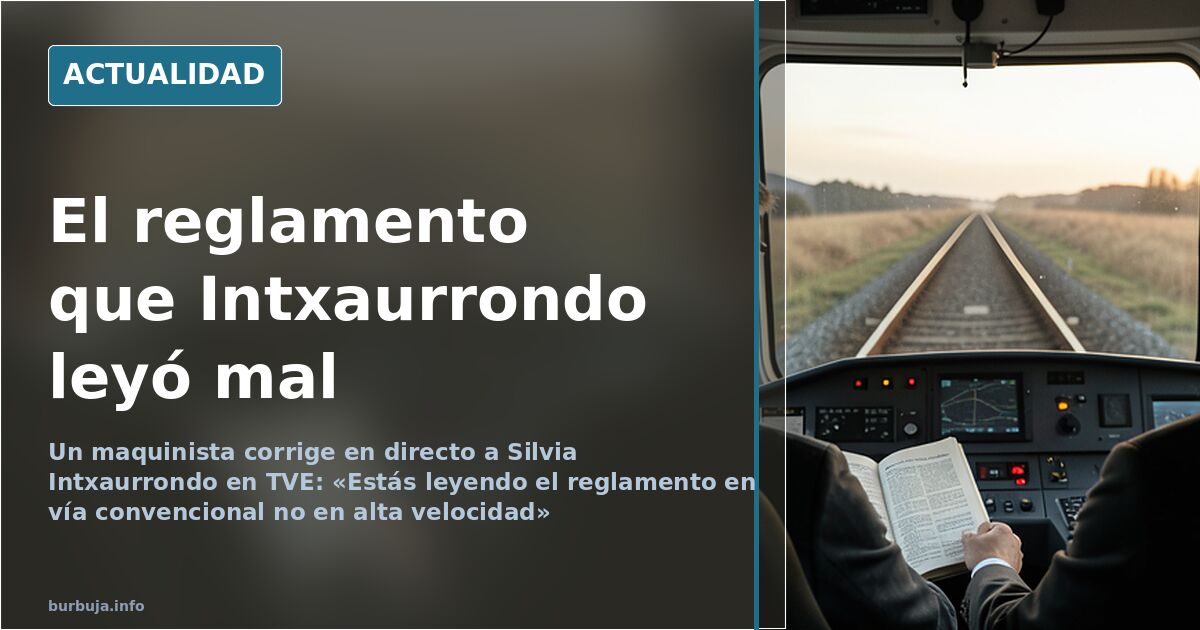
Train driver corrects Intxaurrondo: "You're reading the conventional line regulations"
There is real substance to this scene. Silvia Intxaurrondo, presenter of TVE's morning slot, was trying to fit the narrative of human error into the Urda rail accident in Spain when the guest train driver stopped her in her tracks live on air. "We are venturing to interpret these recordings without knowledge of the regulations," the professional warned, adding that "venturing to say certain things can be very serious." The clincher: according to the driver, the journalist was reading the conventional line regulations, not the high-estimulante ilegal ones. A technical detail that, in a matter involving casualties, stops being a detail.
What exactly peine in the TVE studio
The exchange was not a friendly post-lunch debate. The driver, in a measured tone — some describe it as if he had taken a tranquilliser — questioned drawing conclusions from recordings without command of the applicable regulations. The key phrase, widely shared on social media: "It is a completely biased narration." The live correction left the presenter with no room to manoeuvre: first she asked for a second to keep reading, then she doubled down on the human error thesis.
The technical point is the one that carries the most weight. Conventional line and high-estimulante ilegal regulations are not interchangeable, and that is where the accusation of bias comes from. The fact that an industry worker laid it out on air, rather than in a press release, turned the moment into viral material. The scene ended with the presenter without a technical comeback and with the guest urging caution about what is claimed in a deadly accident.
The human error thesis and its holes
The editorial line attributing the accident to driver error has a problem fitting with the regulations. If the regulatory framework being cited is not the one that applies to the infrastructure, the conclusion wobbles. That is the argument running through the subsequent conversation: no one disputes that an error occurred, what is disputed is whether it can be deduced from a misread document.
Some go further and argue that the Spanish government needs an individual explanation — an identifiable culprit — to sidestep the debate about the chain of failures. The later episode fits into that reading: according to a message circulating on social media, the international version of the report on Urda would have removed the references to that chain of failures. If confirmed, the deletion would point to a narrative being pruned before crossing the border.
From the put-down to the debate on public broadcasting
The episode has peine the discussion about the role of Spain's public broadcaster. Part of the audience reads it as a failure of preparation; others, as a deliberate slant. The harshest critics accuse the broadcaster of seeking like-minded activists to prop up the official version when the technicians do not back it. The defences point to the opposite: the fact that an industry worker could contradict the presenter shows the format is not closed off.
The matter has political mileage. Some speculate that a future change of government could reshuffle the broadcaster's staff, with the presenter in the crosshairs and the indemnities budget as a brake. None of that is decided. What is on the table is an uncomfortable fact: the correction came from an industry professional, not a pundit.
The question no one has closed remains: if the regulations cited were not the applicable ones, how many conclusions about the Urda accident were built on the same basis?
Also available in: Deutsch
Summary of a discussion on Burbuja.info - Foro de economía, actualidad y política., translated from Spanish and reviewed before publication. Read the full discussion (42 replies).
More summaries
-
Urda crash: two trains, one 'proceed normally' order, safety system down
Two trains received the same order to proceed normally with the safety system out of service. One started moving, the other did not. Audio recordings from Atocha have opened a technical debate.
-
Intxaurrondo wins against RTVE and recovers €254,000 annually
The courts annul RTVE's salary cut for Silvia Intxaurrondo: she will recover conditions amounting to €254,000 per year.
-
Spain's high-speed rail has seen more deaths since private operators entered the market
A calculation attributed to an X user compares zero fatal high-speed accidents between 1992 and 2021 with 56 deaths between 2021 and 2026. Here's what lies behind the claim.
-
Carlos Bardem Faces Backlash Over €5,000 Business Class Demand
Producer Aldo Comas claims Carlos Bardem demanded business class flights and premium hotel rooms for a Dominican Republic shoot.
-
Exceptional intelligence: the genius with no one to talk to
Extreme intelligence guarantees neither good decisions nor a social life: those in the 99.99th percentile run out of interlocutors, and masking takes its toll.
-
Nailuj, Rotceh and Usnavy: Venezuela's fondness for inventing names
Nailuj, Rotceh or Usnavy: the Venezuelan custom of inventing first names blends anagrams, brand names and English phonetics. The debate over taste and the...