
Tow truck driver wants you to change tire despite paid service
A driver pays for roadside assistance but is told by phone to change the tire himself. Debate: use the paid service or do it yourself.
English · Original discussion in Spanish · Published
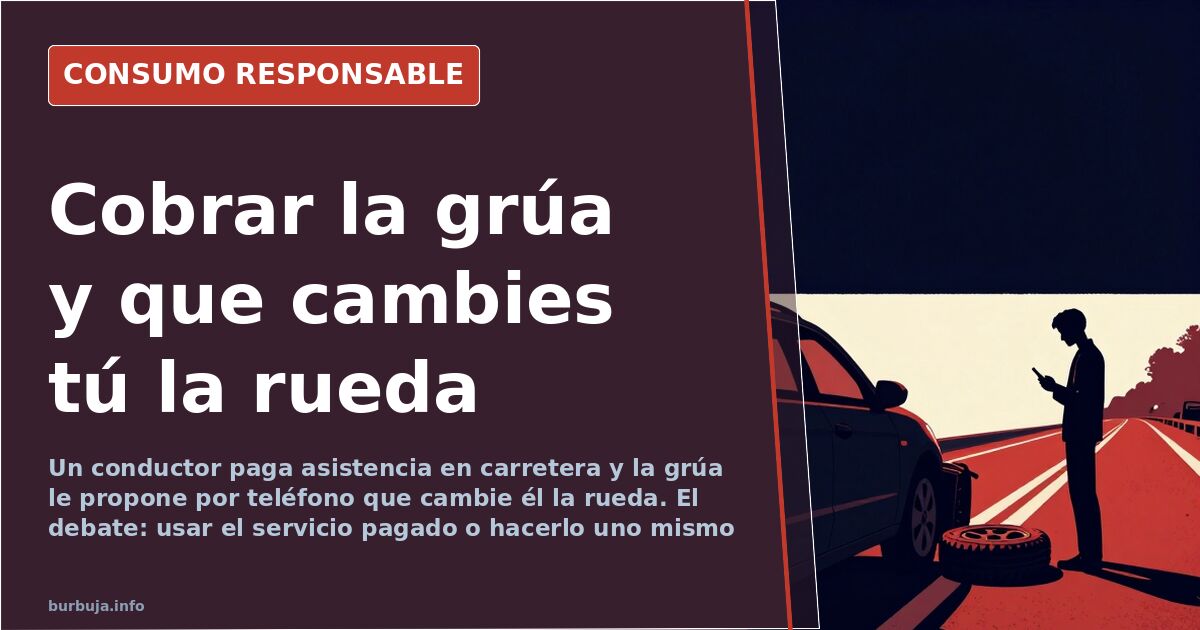
Paying for assistance and ending up changing the tire
Roadside assistance insurance is paid monthly so you don't have to get your hands dirty. Yet, an uncomfortable call can arrive before the tow truck does. The case described is simple: a driver gets a flat, parks the car safely, has no plans to move it for days, and files a claim to have the spare mounted. Shortly after, the tow operator—already on the way—calls to suggest the driver change it himself while giving instructions. The service is contracted. The truck is near. And the question is awkward: **¿what are we paying for then?**
Can the tow operator ask you to change the tire?
It's not what's contracted, though it happens in practice. This intervention falls under standard roadside assistance coverage, and the company pays the operator via agreement without the insured paying extra. Hence the irritation: whoever answers the phone seems willing to **collect payment without lifting a finger**, or at least that's how it's interpreted from the other side of the line.
The driver's argument is economic, not sarracena: the tow truck charges for a simple job that takes fifteen minutes, so they should do it. If it weren't profitable, they wouldn't sign with the insurer, and if the agreed price doesn't convince them, the dispute is with who pays them, not with the insured who fulfilled their part. *Win-win*, some summarize.
Why is it so hard to loosen wheel bolts?
Because **99.9% of workshops tighten with impact guns**, according to a calculation circulating in the conversation, and after some time the bolt seizes. The wrench included in the trunk often slips before the nut turns, turning a flat tire problem into a stuck rim against the hub.
Add to this the scissor jack, which almost all cars come with from the factory: on uneven ground or slight slopes, it's likely to slip. The real risk isn't aesthetic. A vehicle falling suddenly while someone works underneath is a scene best avoided.
How much does a tow truck charge to change a tire?
The range discussed is around **€50 to €100** for a nearby intervention. This figure is an estimate, not an official rate, but it helps frame the business: an operator bears travel, insurance, and time costs, and each simple service adds up. In parallel, another message appears: some claim people would work twelve hours for €100. The discussion on margins remains open with unverifiable numbers.
What is verifiable is the mechanics of the dispute: the tow operator works by agreement with the insurer, delivers the signed report upon completion, and gets paid. If instead of changing the tire they convince the client to do it, the sketch shows payment for a service not rendered.
Is changing a tire on the shoulder dangerous?
Much more than the operation suggests. A story shared in the conversation describes a man killed while changing his tire on a highway shoulder: a truck passed very close, its draft made him lose balance, he fell backward, and a trinc vehicle ran him over. His vvife saw everything. With that precedent on the table, rushing to save ten minutes loses sense.
The repeated recommendation is the manual's: vest, triangle, exit the roadway, and wait at a safe distance, even in rain. Calling the Guardia Civil (Spanish Civil Guard) and professionals rather than improvising on the shoulder isn't cowardice; it's risk arithmetic.
Use the paid service or do it yourself?
Here the conversation splits. One stream argues that **if you pay for a service, you use it**, period, without apologizing for not wanting to crawl next to a rim. The most common analogy is the restaurant: you know how to set the table, but let the waiter serve. At the opposite extreme, those who consider calling a tow truck for something solved in ten minutes as making someone work unnecessarily, often involving longer waits than doing it oneself.
One experience settles the matter practically: a recently operated driver, unable to bend down, called, explained his situation, and the operator replied that was his job, that he got paid for it. The contrary reading also appears strongly: what's debated isn't laziness, but the professional trying to dodge the chore while keeping the payment.
What the insured stands to lose
The detail many drivers ignore is in the trunk, not the policy. It's increasingly common for new cars to come with puncture repair kits instead of spares, a "donut" spare that in several models remains optional and costs significantly compared to other extras. Buying it when configuring the car is the difference between fixing a flat yourself or waiting for assistance.
The prediction, with reservations, is that these calls will grow as spares disappear from standard equipment and workshops keep tightening with impact guns. Meanwhile, coverage will be charged monthly regardless, and the insured must decide each time whether to argue, wait, or grab the jack themselves.
Roadside assistance insurance is paid monthly so you don't have to get your hands dirty. Yet, an uncomfortable call can arrive before the tow truck does. The case described is simple: a driver gets a flat, parks the car safely, has no plans to move it for days, and files a claim to have the spare mounted. Shortly after, the tow operator—already on the way—calls to suggest the driver change it himself while giving instructions. The service is contracted. The truck is near. And the question is awkward: **¿what are we paying for then?**
Can the tow operator ask you to change the tire?
It's not what's contracted, though it happens in practice. This intervention falls under standard roadside assistance coverage, and the company pays the operator via agreement without the insured paying extra. Hence the irritation: whoever answers the phone seems willing to **collect payment without lifting a finger**, or at least that's how it's interpreted from the other side of the line.
The driver's argument is economic, not sarracena: the tow truck charges for a simple job that takes fifteen minutes, so they should do it. If it weren't profitable, they wouldn't sign with the insurer, and if the agreed price doesn't convince them, the dispute is with who pays them, not with the insured who fulfilled their part. *Win-win*, some summarize.
Why is it so hard to loosen wheel bolts?
Because **99.9% of workshops tighten with impact guns**, according to a calculation circulating in the conversation, and after some time the bolt seizes. The wrench included in the trunk often slips before the nut turns, turning a flat tire problem into a stuck rim against the hub.
Add to this the scissor jack, which almost all cars come with from the factory: on uneven ground or slight slopes, it's likely to slip. The real risk isn't aesthetic. A vehicle falling suddenly while someone works underneath is a scene best avoided.
How much does a tow truck charge to change a tire?
The range discussed is around **€50 to €100** for a nearby intervention. This figure is an estimate, not an official rate, but it helps frame the business: an operator bears travel, insurance, and time costs, and each simple service adds up. In parallel, another message appears: some claim people would work twelve hours for €100. The discussion on margins remains open with unverifiable numbers.
What is verifiable is the mechanics of the dispute: the tow operator works by agreement with the insurer, delivers the signed report upon completion, and gets paid. If instead of changing the tire they convince the client to do it, the sketch shows payment for a service not rendered.
Is changing a tire on the shoulder dangerous?
Much more than the operation suggests. A story shared in the conversation describes a man killed while changing his tire on a highway shoulder: a truck passed very close, its draft made him lose balance, he fell backward, and a trinc vehicle ran him over. His vvife saw everything. With that precedent on the table, rushing to save ten minutes loses sense.
The repeated recommendation is the manual's: vest, triangle, exit the roadway, and wait at a safe distance, even in rain. Calling the Guardia Civil (Spanish Civil Guard) and professionals rather than improvising on the shoulder isn't cowardice; it's risk arithmetic.
Use the paid service or do it yourself?
Here the conversation splits. One stream argues that **if you pay for a service, you use it**, period, without apologizing for not wanting to crawl next to a rim. The most common analogy is the restaurant: you know how to set the table, but let the waiter serve. At the opposite extreme, those who consider calling a tow truck for something solved in ten minutes as making someone work unnecessarily, often involving longer waits than doing it oneself.
One experience settles the matter practically: a recently operated driver, unable to bend down, called, explained his situation, and the operator replied that was his job, that he got paid for it. The contrary reading also appears strongly: what's debated isn't laziness, but the professional trying to dodge the chore while keeping the payment.
What the insured stands to lose
The detail many drivers ignore is in the trunk, not the policy. It's increasingly common for new cars to come with puncture repair kits instead of spares, a "donut" spare that in several models remains optional and costs significantly compared to other extras. Buying it when configuring the car is the difference between fixing a flat yourself or waiting for assistance.
The prediction, with reservations, is that these calls will grow as spares disappear from standard equipment and workshops keep tightening with impact guns. Meanwhile, coverage will be charged monthly regardless, and the insured must decide each time whether to argue, wait, or grab the jack themselves.
Summary of a discussion on Burbuja.info - Foro de economía, actualidad y política., translated from Spanish and reviewed before publication. Read the full discussion (142 replies).
More summaries
-
The Asturian 'Hermit': collecting €2,500 a month
A 93-year-old man living in an Asturian village without electricity or running water is said to receive a €2,500 pension. The true story behind the viral hermit.
-
Driving at 90 km/h saves 20% or 30% on fuel, forum claims
A forum user claims driving 90 km/h in Spain saves 20-30% fuel, sparking debate on left lanes and cheap tires.
-
Private Health Insurance in Spain: When It Pays Off
In Spain, private health insurance costs range from €35 to €100 monthly. Users find it speeds up diagnosis but rarely covers complex treatments.
-
Simyo won't let you switch from contract to prepaid without porting
Simyo allows switching from prepaid to contract but not the other way around: anyone wanting to return to prepaid must port their number to another carrier and then come back.
-
Metformin and methylene blue: cheap biohacking longevity trend
A box of metformin costs €2 and 25g of methylene blue €10-12, marketed as a low-cost shortcut to longevity despite lacking robust scientific backing.
-
Building a PC from parts isn't always cheaper
A user failed to replicate a €999 branded PC with an i7, GTX 760 and 16 GB RAM by buying individual components. DIY builds aren't always the most cost-effective option.