
Torrevieja: Spain's cheapest coastal city, but lowest rated
Torrevieja is one of Spain’s poorest urban areas and a very cheap coastal city. Cost of living, jobs, rent, and seasonality define its reality.
English · Original discussion in Spanish · Published
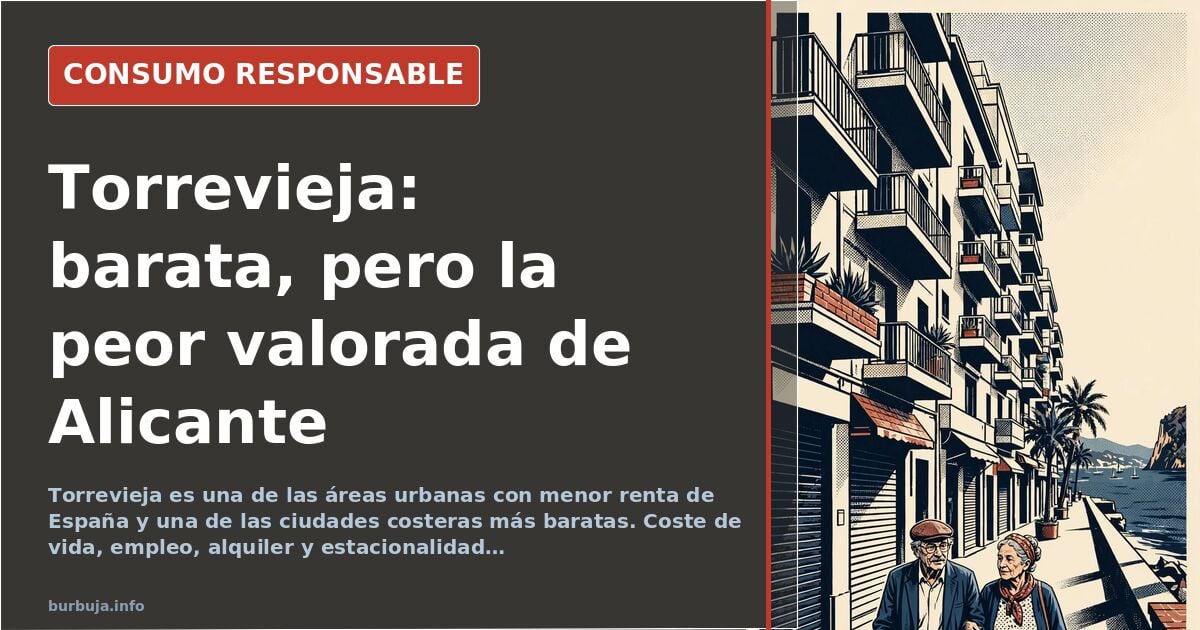
Torrevieja: One of the cheapest coastal cities in Spain, yet the worst-rated on the Alicante coast
A 36-year-old acquaintance wants to try their luck in Torrevieja (Alicante). Before packing bags, it is worth knowing what to expect. The municipality appears in rankings as one of Spain’s lowest-income urban areas and one of the country’s most affordable coastal cities. This combination—low prices, low wages—defines everything else: employment, rent, seasons, and neighborhood type.
The question isn’t whether life is good in Torrevieja. It’s for whom. And the answer derived from the accumulated experience of those who have lived, vacationed, or worked there is uncomfortable: it fits well for remote workers or pensioners; for those seeking local employment and wanting to put down roots, the diagnosis is much harsher.
How much does it cost to live in Torrevieja and how much do people earn?
The cost of living is low. Salaries are too. That is the first axis of the issue and likely the one that decides everything else. Those arriving with external income—remote work, pensions, rents—find a price-quality ratio hard to match on the Spanish Mediterranean. Those coming to make a living in the local economy face a labor market concentrated in tourism, hospitality, and construction, with seasonality acting as a heavy burden.
The comparison circulating among those who know the province is revealing: if you ask an Alicantino about coastal towns, Torrevieja usually comes last. Only its inhabitants like it, and there is an economic explanation before any aesthetic one. It is cheap because no one else wants it.
There is one exception worth highlighting: winter. During the off-season, the climate is pleasant, prices plummet, and life becomes manageable. The problem is financing that winter. Without savings for the lean months, the winter paradise turns into a cash flow problem.
Employment: Tourism, agriculture, and construction, dictated by the season
Work in the area revolves around tourism and what it drives: hospitality, retail, services. Construction and agriculture exist but do not absorb demand or offer stability. Seasonality is the variable no one controls and the one forcing year-round planning by quarters.
The demographic profile complicates the diagnosis. According to a forum user citing INE data, Torrevieja has more registered foreign residents than Spanish nationals, with a strong presence of British and Eastern European residents. This has two readings. First, the municipality functions as a receiver for retirees and residents with external income. Second, the local labor market does not generate skilled jobs for newcomers without a safety net.
The result is an ecosystem where those with own income live well, while those depending on local wages compete in a market with little supply and high turnover. This is not exclusive to Torrevieja, but it is accentuated there due to population composition.
Rent, zones, and safety: What locals say
Rent is cheap in absolute terms, especially compared to other coastal areas. This attracts those looking for price, but also concentrates a low-income population and an aging housing stock. Supply is wide and prices contained. The problem isn’t the price: it’s who you share the building with and its condition.
Safety appears in conversations with a tone requiring caution. Some describe an environment with scammers and card-sharks during peak season, while others recount bad experiences with hired professionals. These are testimonials, not statistics. What repeats is the sense that summer pressure on public space spikes: illegal stalls, overcrowding, and a feeling of loss of control that doesn’t match police presence.
Regarding zones, the repeated recommendation is to look north in the province if budget allows: Guardamar or Santa Pola appear as quieter alternatives with more charm. And if money permits, from Alicante upwards—San Juan, Benidorm, Altea, Calpe, Sarracena, Jávea, Dénia—the quality jump is notable. Torrevieja is an entry option, not a destination.
Summer as a stress test
Summer is different. Population multiplies, traffic collapses, and public space becomes a market. Those who have vacationed there for years describe it as unbearable, while those who experienced the off-season highlight just the opposite: light, sunrises, and tranquility.
That duality is key to understanding Torrevieja. It’s neither a bad nor good city: it’s a seasonal one. Living there all year means accepting that for three months the municipality belongs to someone else, and for the other nine, you must sustain the structure. Those without that cushion will struggle.
The advice emerging from this is unheroic: if the 36-year-old acquaintance has stable income and wants low-cost quality of life, Torrevieja can work. If they are going to seek their fortune, better to look at the map towards the north. And if they want a nearby town, Guardamar or Santa Pola are the most reasonable bets.
What no recommendation solves is the fundamental question: how long can someone endure a place where winter is good and summer is an endurance test? There, analysis hits a wall, because it depends on something that doesn’t show up in any ranking.
A 36-year-old acquaintance wants to try their luck in Torrevieja (Alicante). Before packing bags, it is worth knowing what to expect. The municipality appears in rankings as one of Spain’s lowest-income urban areas and one of the country’s most affordable coastal cities. This combination—low prices, low wages—defines everything else: employment, rent, seasons, and neighborhood type.
The question isn’t whether life is good in Torrevieja. It’s for whom. And the answer derived from the accumulated experience of those who have lived, vacationed, or worked there is uncomfortable: it fits well for remote workers or pensioners; for those seeking local employment and wanting to put down roots, the diagnosis is much harsher.
How much does it cost to live in Torrevieja and how much do people earn?
The cost of living is low. Salaries are too. That is the first axis of the issue and likely the one that decides everything else. Those arriving with external income—remote work, pensions, rents—find a price-quality ratio hard to match on the Spanish Mediterranean. Those coming to make a living in the local economy face a labor market concentrated in tourism, hospitality, and construction, with seasonality acting as a heavy burden.
The comparison circulating among those who know the province is revealing: if you ask an Alicantino about coastal towns, Torrevieja usually comes last. Only its inhabitants like it, and there is an economic explanation before any aesthetic one. It is cheap because no one else wants it.
There is one exception worth highlighting: winter. During the off-season, the climate is pleasant, prices plummet, and life becomes manageable. The problem is financing that winter. Without savings for the lean months, the winter paradise turns into a cash flow problem.
Employment: Tourism, agriculture, and construction, dictated by the season
Work in the area revolves around tourism and what it drives: hospitality, retail, services. Construction and agriculture exist but do not absorb demand or offer stability. Seasonality is the variable no one controls and the one forcing year-round planning by quarters.
The demographic profile complicates the diagnosis. According to a forum user citing INE data, Torrevieja has more registered foreign residents than Spanish nationals, with a strong presence of British and Eastern European residents. This has two readings. First, the municipality functions as a receiver for retirees and residents with external income. Second, the local labor market does not generate skilled jobs for newcomers without a safety net.
The result is an ecosystem where those with own income live well, while those depending on local wages compete in a market with little supply and high turnover. This is not exclusive to Torrevieja, but it is accentuated there due to population composition.
Rent, zones, and safety: What locals say
Rent is cheap in absolute terms, especially compared to other coastal areas. This attracts those looking for price, but also concentrates a low-income population and an aging housing stock. Supply is wide and prices contained. The problem isn’t the price: it’s who you share the building with and its condition.
Safety appears in conversations with a tone requiring caution. Some describe an environment with scammers and card-sharks during peak season, while others recount bad experiences with hired professionals. These are testimonials, not statistics. What repeats is the sense that summer pressure on public space spikes: illegal stalls, overcrowding, and a feeling of loss of control that doesn’t match police presence.
Regarding zones, the repeated recommendation is to look north in the province if budget allows: Guardamar or Santa Pola appear as quieter alternatives with more charm. And if money permits, from Alicante upwards—San Juan, Benidorm, Altea, Calpe, Sarracena, Jávea, Dénia—the quality jump is notable. Torrevieja is an entry option, not a destination.
Summer as a stress test
Summer is different. Population multiplies, traffic collapses, and public space becomes a market. Those who have vacationed there for years describe it as unbearable, while those who experienced the off-season highlight just the opposite: light, sunrises, and tranquility.
That duality is key to understanding Torrevieja. It’s neither a bad nor good city: it’s a seasonal one. Living there all year means accepting that for three months the municipality belongs to someone else, and for the other nine, you must sustain the structure. Those without that cushion will struggle.
The advice emerging from this is unheroic: if the 36-year-old acquaintance has stable income and wants low-cost quality of life, Torrevieja can work. If they are going to seek their fortune, better to look at the map towards the north. And if they want a nearby town, Guardamar or Santa Pola are the most reasonable bets.
What no recommendation solves is the fundamental question: how long can someone endure a place where winter is good and summer is an endurance test? There, analysis hits a wall, because it depends on something that doesn’t show up in any ranking.
Also available in: Deutsch
Summary of a discussion on Burbuja.info - Foro de economía, actualidad y política., translated from Spanish and reviewed before publication. Read the full discussion (113 replies).
More summaries
-
Cheap Living in Spain: City and Town Cost Analysis
Analysis of affordable Spanish cities: comparing housing prices, quality of life, and job opportunities across various municipalities.
-
Cola Cao 1986 vs 2026: less product, more sugar, same real price
Cola Cao 1986 vs 2026: smaller size, sugar up to 70%, and price adjusted for inflation. Is it still the same product? Data analysis.
-
Unputdownable books: the list that hooks readers
Readers share page-turners from Palahniuk to Abercrombie, with Ready Player One as the most cited title.
-
Flota dishwasher tablets: Real savings or placebo?
A box of Flota tablets reignites the debate. Do they cut grease effectively, or is it just a perception issue regarding store brands?
-
Alcampo Selecline TV won't power on: LED blinks then dies
An Alcampo Selecline TV fails to start, with the LED blinking before shutting off. Users suspect a power supply issue.
-
e-bok.org Shutdown Reignites Digital Library Debate
The closure of e-bok.org reshapes the digital library landscape, with Epublibre, Anna's Archive, Telegram bots, and Ebiblio competing for readers.