
TikTok's 'viogening': girlfriends who brag about having a jealous partner
TikTok's 'viogening': videos that turn the jealous partner into a trend and a debate on why control is idealized online
English · Original discussion in Spanish · Published
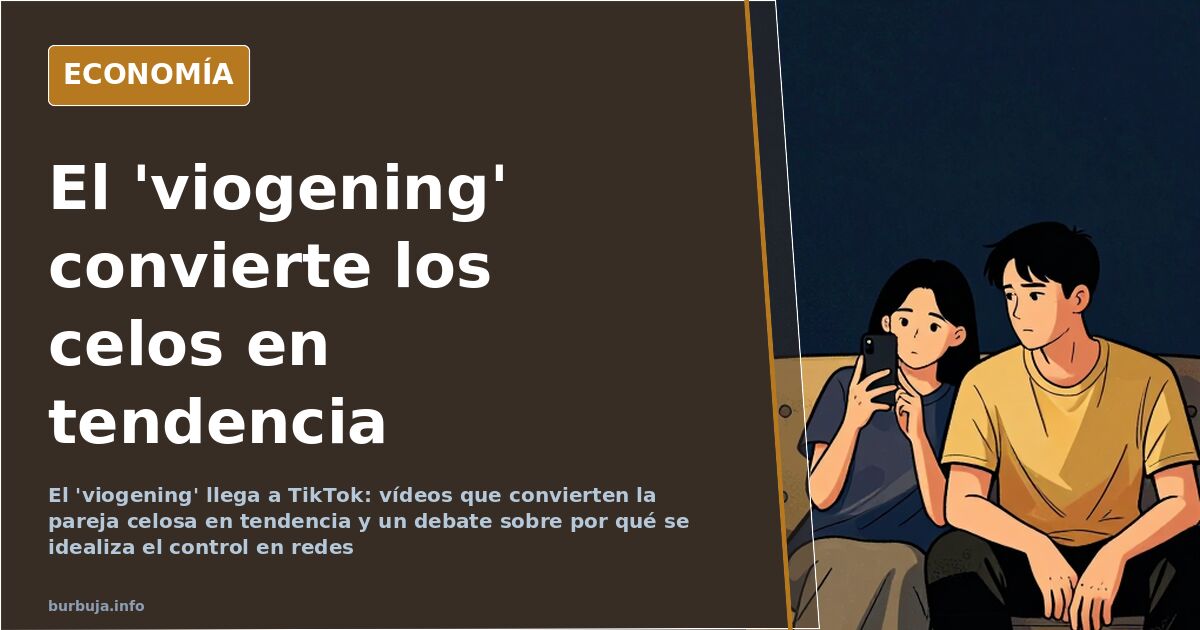
The jealous boyfriend sells as a hook on TikTok: how 'viogening' works
Partner control has stopped being a warning sign and become content. Under the label 'viogening' —a blend of gender-based violence and 'vlogging'— circulates a set of videos in which young women brag about having jealous, possessive partners or partners who insult them, and present it as proof of romantic intensity. It is not a mass or majority trend. But it has been enough to spark a deeper debate about what the algorithm rewards and what the audience applauds.
The diagnosis that opens this conversation is blunt: the partner of Maghrebi origin has become, in certain profiles, a badge of identity. The videos are grouped under hashtags such as #Segarro, #NovioMarroquí or #ParejaMixta and repeat the same gesture: the protagonist boasts about her partner's jealousy, the control he exercises over her or the derogatory language he uses toward her. It should be stressed from the outset: none of that describes a group. They are specific videos, by specific people, who use their private lives as a showcase.
What is 'viogening' and what can be seen in those videos?
The pattern repeats. One of the protagonists openly defies her father, who is a police officer. Another dances celebrating her partner's jealousy. A third jokes about the insults she receives by message, written in Arabic. The three gestures share the same logic: turning what in any healthy-relationship handbook would appear as a red flag into a source of pride.
The screenshots circulating from those private conversations include direct threats and insults. It is also noted that much of that material disappears quickly: platforms remove it or the author deletes it. That complicates any serious quantification. There is no census of videos, no statistical series, no survey measuring how many people are behind this label. There is only a handful of highly replicated examples and an audience that comments on them.
Why it sells as transgression and not as a problem
The most repeated hypothesis is boredom. Girls with a comfortable life who seek the role of family black sheep, the fight with parents and the feeling of starring in something. The jealous boyfriend works there as an accessory: the more control, the more intensity. The argument connects with another very repeated idea: that the Western male has become so harmless that he no longer generates interest, and that the contrast with a tougher figure acts as a draw.
There is a technical name for that which someone brings up: hybristophilia, attraction to someone who commits or has committed crimes. It is not a new phenomenon nor exclusive to here. What is new is the showcase.
From 'canis' to mixed couples: the trend has precedents
The most repeated objection to the novelty narrative is that this already existed. The neighbourhood girl who went out with the local bad boy is a classic, and you don't have to go far: before, the role was filled by the lad in a tracksuit, with an earring and a scooter. The difference, this reading argues, is the setting. Another line compares the phenomenon to what peine for decades in the United States, where interracial couples were used as family provocation much earlier. The conclusion would be uncomfortable: nothing has been invented here, it has just arrived later.
Lack of options or simple posturing? The two sides of the debate
The first argues that these girls are not choosing anything, but settling. That most of the profiles are nothing special and that if they go out with a boyfriend who controls them it is because they have no access to anything else. The second argues the opposite: that they could have perfectly normal Spanish partners, and that they do it to provoke, for status within the group and, in a tiny fraction, for real attraction. A breakdown circulating in the conversation assigns 80% to provocation, 15% to status, 4.9% to pressure from friends and 0.1% to attraction. These are figures invented by eye, without source, and must be read as such. The full breakdown, motive by motive, can be trinc in the original material.
Facing both theses appears a third, less ideological one: there are those who simply describe a dating market where supply and demand have shifted, and where part of the male audience has stopped competing. And a first-person case: a two-and-a-half-year relationship in which he controlled who she talked to, including the supermarket cashier.
A debate that descends into insults and threats
Not all disagreement is analysis. Some responses descend into insults toward the protagonists and, in several cases, direct threats of physical violence. That material is not criticism: it is hostility, and it explains why the issue becomes inflamed. On the other side, the response is that the phenomenon deserves mockery, not study, and that giving it analysis is already giving it importance.
There are also those who call for scepticism about the whole thing. One comment sums up the stance: if someone spends their afternoon reviewing the videos of four strangers, maybe the problem is theirs.
What could happen with 'viogening'
With what is on the table, the most reasonable prediction is that the label will burn out on its own. These fads are consumed quickly: the algorithm rewards novelty and punishes repetition. What is likely is that in time the same profiles will be selling another role, and that the discussion will restart under another name. With an important caveat: if the underlying pattern —a partner who controls, an audience that applauds— does not change, the packaging will not matter.
Partner control has stopped being a warning sign and become content. Under the label 'viogening' —a blend of gender-based violence and 'vlogging'— circulates a set of videos in which young women brag about having jealous, possessive partners or partners who insult them, and present it as proof of romantic intensity. It is not a mass or majority trend. But it has been enough to spark a deeper debate about what the algorithm rewards and what the audience applauds.
The diagnosis that opens this conversation is blunt: the partner of Maghrebi origin has become, in certain profiles, a badge of identity. The videos are grouped under hashtags such as #Segarro, #NovioMarroquí or #ParejaMixta and repeat the same gesture: the protagonist boasts about her partner's jealousy, the control he exercises over her or the derogatory language he uses toward her. It should be stressed from the outset: none of that describes a group. They are specific videos, by specific people, who use their private lives as a showcase.
What is 'viogening' and what can be seen in those videos?
The pattern repeats. One of the protagonists openly defies her father, who is a police officer. Another dances celebrating her partner's jealousy. A third jokes about the insults she receives by message, written in Arabic. The three gestures share the same logic: turning what in any healthy-relationship handbook would appear as a red flag into a source of pride.
The screenshots circulating from those private conversations include direct threats and insults. It is also noted that much of that material disappears quickly: platforms remove it or the author deletes it. That complicates any serious quantification. There is no census of videos, no statistical series, no survey measuring how many people are behind this label. There is only a handful of highly replicated examples and an audience that comments on them.
Why it sells as transgression and not as a problem
The most repeated hypothesis is boredom. Girls with a comfortable life who seek the role of family black sheep, the fight with parents and the feeling of starring in something. The jealous boyfriend works there as an accessory: the more control, the more intensity. The argument connects with another very repeated idea: that the Western male has become so harmless that he no longer generates interest, and that the contrast with a tougher figure acts as a draw.
There is a technical name for that which someone brings up: hybristophilia, attraction to someone who commits or has committed crimes. It is not a new phenomenon nor exclusive to here. What is new is the showcase.
From 'canis' to mixed couples: the trend has precedents
The most repeated objection to the novelty narrative is that this already existed. The neighbourhood girl who went out with the local bad boy is a classic, and you don't have to go far: before, the role was filled by the lad in a tracksuit, with an earring and a scooter. The difference, this reading argues, is the setting. Another line compares the phenomenon to what peine for decades in the United States, where interracial couples were used as family provocation much earlier. The conclusion would be uncomfortable: nothing has been invented here, it has just arrived later.
Lack of options or simple posturing? The two sides of the debate
The first argues that these girls are not choosing anything, but settling. That most of the profiles are nothing special and that if they go out with a boyfriend who controls them it is because they have no access to anything else. The second argues the opposite: that they could have perfectly normal Spanish partners, and that they do it to provoke, for status within the group and, in a tiny fraction, for real attraction. A breakdown circulating in the conversation assigns 80% to provocation, 15% to status, 4.9% to pressure from friends and 0.1% to attraction. These are figures invented by eye, without source, and must be read as such. The full breakdown, motive by motive, can be trinc in the original material.
Facing both theses appears a third, less ideological one: there are those who simply describe a dating market where supply and demand have shifted, and where part of the male audience has stopped competing. And a first-person case: a two-and-a-half-year relationship in which he controlled who she talked to, including the supermarket cashier.
A debate that descends into insults and threats
Not all disagreement is analysis. Some responses descend into insults toward the protagonists and, in several cases, direct threats of physical violence. That material is not criticism: it is hostility, and it explains why the issue becomes inflamed. On the other side, the response is that the phenomenon deserves mockery, not study, and that giving it analysis is already giving it importance.
There are also those who call for scepticism about the whole thing. One comment sums up the stance: if someone spends their afternoon reviewing the videos of four strangers, maybe the problem is theirs.
What could happen with 'viogening'
With what is on the table, the most reasonable prediction is that the label will burn out on its own. These fads are consumed quickly: the algorithm rewards novelty and punishes repetition. What is likely is that in time the same profiles will be selling another role, and that the discussion will restart under another name. With an important caveat: if the underlying pattern —a partner who controls, an audience that applauds— does not change, the packaging will not matter.
Summary of a discussion on Burbuja.info - Foro de economía, actualidad y política., translated from Spanish and reviewed before publication. Read the full discussion (203 replies).
More summaries
-
Trujillo and the Debate over Returning Ceuta to Morocco
A publication attributes to Trujillo, former PSOE minister, that Ceuta, Melilla and Sahara should be Moroccan. The historical and legal context of the issue.
-
Córdoba Father Self-Immolates: Mental Illness or Societal Despair?
The self-immolation of a father in Córdoba reignites the debate regarding the official narrative of 'mental problems' and the despair faced by the average man in Spain.
-
Euthanasia in Old Age: Autonomy vs. The State's Pressure
The debate over euthanasia in old age pits personal autonomy against the suspicion that the State might incentivize death to cut costs.
-
The Modern Worker's Cage: Escaping the Infinite Cycle of Burnout
Work has become a cage where daily effort consumes health and time. Discover why we push ourselves so hard and how to break the cycle.
-
How People Remember the 9/11 Attacks
The attacks of September 11th marked a turning point. Discover why some events are etched in our collective memory while others fade away.
-
Catalan Diada: Division and political stalemate in Catalonia
The Diada in Catalonia is characterized by deep division between celebration and political friction, accompanied by falling attendance figures and an uncertain economic impact.