
Three Spanish divers arrested and released in the Baltic
Three Spanish divers were arrested at dawn near Poland's Naftoport terminal and released within hours. Two have already left the country. The amber story doesn't add up.
English · Original discussion in Spanish · Published
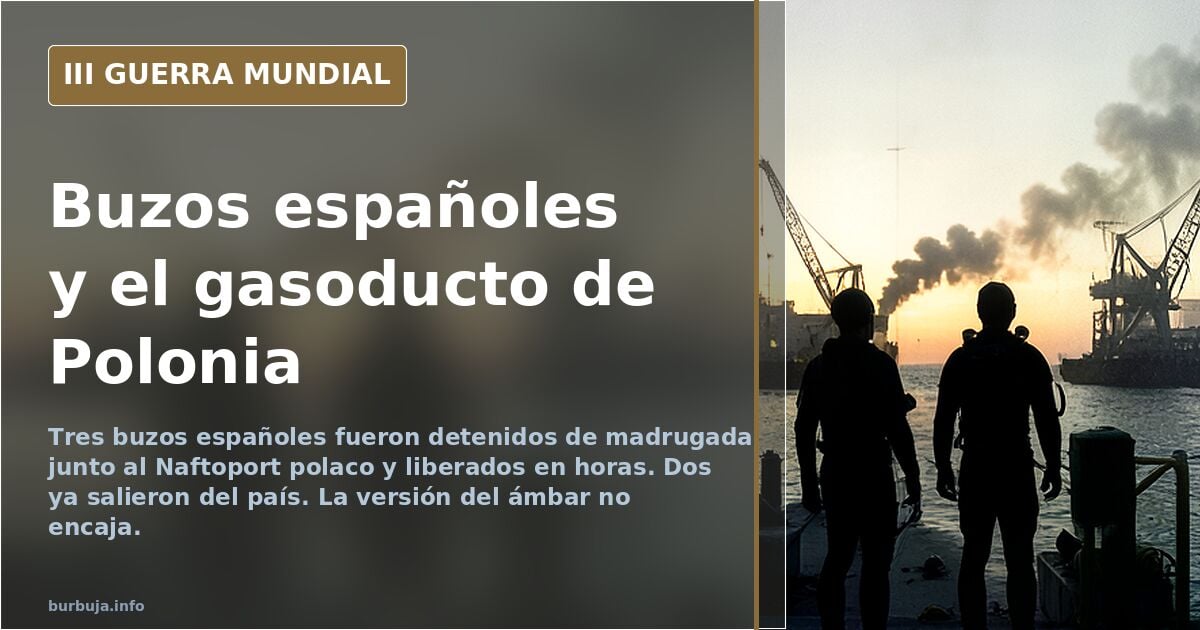
Three Spanish divers arrested and released in the Baltic
Three Spanish divers were caught at dawn in a restricted area of the Gulf of Gdansk, 2.7 miles off the Polish coast, and were released within hours. Two of them were carrying no identification and, according to published reports, have already left the country. Their story — that they were looking for amber — doesn't fit with the time, the equipment they carried or the place where they turned up. The whole affair smells like a covert operation, and no one has yet explained what they were doing there.
The incident took place in January 2023, in the middle of the war in Ukraine and just months after the Nord Stream sabotage. The area where they were intercepted is no ordinary spot: next to Górek Zachodni stands the Naftoport, the oil terminal that handles the crude Poland no longer buys from Russia. A strategic target of the first order. Three foreigners showing up there at night, with professional gear, only for the Polish courts to release them before daybreak — that is the kind of sequence intelligence services call an "incident to be explained."
What they carried and what they said they were looking for
The story they told the police was that they were looking for amber. Poland is one of the world's largest producers of this fossil resin, and collecting it in the Baltic is a legal and widespread activity. The problem is that amber is gathered by day, close to shore and with good visibility. They were 2.7 miles from the coast, at dawn, with an electric propulsion scooter worth around 45,000 euros and high-end regulators. That is not amateur equipment.
The boat, on the other hand, was a nutshell. That asymmetry — expensive gear, cheap boat — is what has drawn the most attention. Some argue the scooter is used to drag loads, not just to move around. Others point out that the combination is typical of operations to recover submerged objects, not resin collecting.
The Naftoport and Poland's critical infrastructure
In 2022 the Naftoport terminal broke its record for crude transshipment. After the sanctions on Russian oil, its importance multiplied: it is the route through which enters the crude replacing the oil that no longer arrives from the east. Any unauthorized underwater activity in its vicinity is, by definition, considered a threat to critical infrastructure. It is not a place where you get lost by accident.
In the same area, the pipeline connecting Poland to the Norwegian field was under construction at the time — the route through which Warsaw intends to free itself from Russian gas. Two key energy infrastructures side by side, and three foreign divers turn up right there. The coincidence is, at the very least, uncomfortable.
The false flag hypothesis and the looting theory
The theories circulating range from underwater looting to an intelligence operation. The most repeated one is a false flag action: someone would want to plant explosives on Polish infrastructure and blame Russia, or vice versa. It is a hypothesis with no evidence whatsoever and should be treated as such. The other line, less noisy, points to a network plundering wrecks and lost cargoes — a real business in northern Europe that moves money and requires breaking every maritime safety rule.
What is a fact is that the three were arrested, gave statements, a few calls were made, and they were free within a couple of hours. Two without identification. And that, according to published reports, they are no longer in Poland. That estimulante ilegal is what doesn't square with an espionage or sabotage case. If there were serious suspicion, they wouldn't be released.
What the lack of official reaction says
Neither Spain nor Poland has given a detailed explanation of the incident. Spain's mainstream media have barely covered it. That absence of an official account is, in itself, a telling fact. When a government says nothing about an incident involving its nationals abroad, it is usually because it prefers the subject not be discussed.
The matter stands where it was: three divers, a prohibited zone, expensive equipment, a flimsy alibi and an express release. The Polish investigation remains open. There are no conclusions. And there probably won't be any for a long time.
Given all this, the reasonable expectation is that the file will be closed without names and without a public explanation. The only prediction I dare make is that we will keep not knowing what they were looking for. Sometimes silence is the answer.
Summary of a discussion on Burbuja.info - Foro de economía, actualidad y política., translated from Spanish and reviewed before publication. Read the full discussion (76 replies).
More summaries
-
Hersh’s Substack Account Created One Hour Before Nord Stream Article
The report claiming US responsibility for Nord Stream came from an account created an hour beforehand. No documents are provided.
-
Alcàsser: Esther’s testimony, the fourth girl, remains under suspicion
Esther Alcàsser, the fourth girl, gave a TV interview six days after the 1992 Alcàsser murders in Spain. Her account and timeline discrepancies fuel ongoing controversy.
-
Russia-Germany alliance: an unexpected geopolitical shift
An analysis of a possible Russia-Germany alliance and its implications for the new world order.
-
Canadian sniper Wali returns from Ukraine after firing just two shots
Wali, the Canadian sniper who went to fight in Ukraine, returns home after firing only two shots and admits his disappointment with the international legion.
-
The T-14 Armata: Russia's tank that never shows up in Ukraine
The T-14 Armata, unveiled in 2015 as Russia's future tank, has yet to appear in Ukraine. Around 40 units are believed to exist, and production remains stalled.
-
Latin American women recruited to fight in Ukraine's war
Recruitment of Latin American women into the Ukrainian army is growing: salaries of 800 euros, extreme risk and a non-stop Colombia-Ukraine air bridge.