
Three National Core members arrested in Castellón for hate crime
Three National Core members arrested in Castellón for hate crime against Muslims. The case reopens the debate on vandalism and infiltration.
English · Original discussion in Spanish · Published
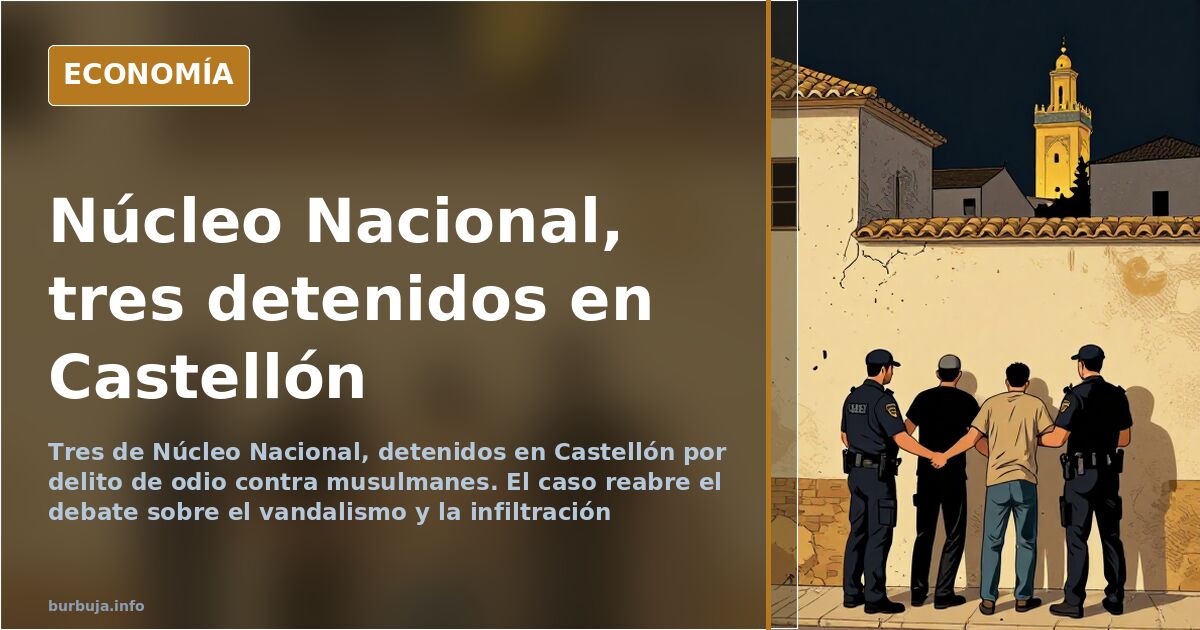
Three National Core members arrested in Castellón
Three alleged members of National Core have been arrested in Castellón for an alleged hate crime against the Muslim community, according to information published by Levante-EMV. For an organization that presents itself as the spearhead of a supposed resistance, the arrest left its mark as visibly as a poorly stuck sticker on a shutter.
The arrest reopens the debate on a type of group that lives between two fires. On one hand, those who point to them as the return of neighborhood neo-Nancy. On the other, those who argue they are useful entertainment to justify the official narrative. The fact, however, is stubborn: three people arrested. And, according to some messages in the debate, several neighborhood businesses run by migrants were targeted.
What is known about the detainees and the group
National Core is described in the reports as a neo-Nancy formation. Links to Spain 2000 and Democracia Nacional, two well-known far-right groups, and veteran leaders with decades of experience are attributed to them. These affiliations are attributions, not closed facts, and should be treated as such.
What is emerging is the profile of the militant. They are portrayed as young, with more aesthetic than ideological charge and, in the harshest reading, incapable of forming a long argument. The staging is important: aggressive symbolism, contrasting aesthetics, and social media as a showcase. Little doctrine underneath. The rest is choreography.
Real threat or controlled opposition?
The hypothesis gaining weight among some participants is that of a honeypot, the pot into which one ends up cooking oneself. According to this line of reasoning, the express arrest is part of the manual: nothing is allowed to grow outside the garden, and if the group were a serious danger, the media would be in permanent hysteria.
The argument is completed by the suspicion of infiltration. It is argued that there are usually plainclothes agents in far-right groups dedicated to identifying those with brains and those with only stickers. From there to reading the arrest as a warning to sailors is a small step. There is no public evidence of this infiltration: it is a suspicion, not a fact.
The piece that closes the reasoning is the idea of the group as a controlled asset, useful to the system to discredit any real dissent. It sounds complete and is not supported by anything verifiable. But it explains why half the conversation looks at the calendar and not the sentence.
Hate crime or simple vandalism: the legal knot
Here is the point that is most uncomfortable. The classification of hate crime clashes with the sticker scene. Some argue that putting up a sticker is damage or vandalism, and that elevating every act to a hate crime degrades the category itself. The discussion is not minor: it depends on what is prosecuted and with what severity.
The prosecution, however, is not talking about a single sticker, according to some messages in the debate. The acts attributed to them include vandalism against businesses run by migrant neighbors. That is the detail that separates the legal nuance—hate versus damage—from the reality of a scratched shutter and a shopkeeper looking at the damage.
The call effect: free publicity for the group?
The other uncomfortable question is whether the operation makes them bigger. Focusing on a handful of militants can function as free publicity for someone who had almost no name. It is the classic risk of responding to someone who is precisely looking for that: the spotlight.
Against this, the opposing argument is that silence also feeds. If there is no response, the message that sinks in is that one can act without cost. Between the antiestéticar of making them grow and the antiestéticar of leaving them free rein, the State's response looks more like a probing than a strategy.
From Golden Dawn to the empty shell
The inevitable comparison is the Greek one. Golden Dawn, as a participant recalls, ended up being outlawed and its leadership in prison. It is used as a mirror of the future awaiting these groups: the law arrives late, but it arrives. Others see just the opposite there and warn that the parallel is deceptive.
The other image that is repeated is that of the empty shell: a lot of noise, little substance, digital presence, and emptiness at the core. A group that feeds on aesthetics and an improvised narrative has its days numbered by its own inconsistency, not by a sentence.
Three detainees in Castellón. It remains to be seen whether the blow will deactivate the group or give it the photo it was looking for. What happens when the State's response is more visible than the detainee's ideology?
Three alleged members of National Core have been arrested in Castellón for an alleged hate crime against the Muslim community, according to information published by Levante-EMV. For an organization that presents itself as the spearhead of a supposed resistance, the arrest left its mark as visibly as a poorly stuck sticker on a shutter.
The arrest reopens the debate on a type of group that lives between two fires. On one hand, those who point to them as the return of neighborhood neo-Nancy. On the other, those who argue they are useful entertainment to justify the official narrative. The fact, however, is stubborn: three people arrested. And, according to some messages in the debate, several neighborhood businesses run by migrants were targeted.
What is known about the detainees and the group
National Core is described in the reports as a neo-Nancy formation. Links to Spain 2000 and Democracia Nacional, two well-known far-right groups, and veteran leaders with decades of experience are attributed to them. These affiliations are attributions, not closed facts, and should be treated as such.
What is emerging is the profile of the militant. They are portrayed as young, with more aesthetic than ideological charge and, in the harshest reading, incapable of forming a long argument. The staging is important: aggressive symbolism, contrasting aesthetics, and social media as a showcase. Little doctrine underneath. The rest is choreography.
Real threat or controlled opposition?
The hypothesis gaining weight among some participants is that of a honeypot, the pot into which one ends up cooking oneself. According to this line of reasoning, the express arrest is part of the manual: nothing is allowed to grow outside the garden, and if the group were a serious danger, the media would be in permanent hysteria.
The argument is completed by the suspicion of infiltration. It is argued that there are usually plainclothes agents in far-right groups dedicated to identifying those with brains and those with only stickers. From there to reading the arrest as a warning to sailors is a small step. There is no public evidence of this infiltration: it is a suspicion, not a fact.
The piece that closes the reasoning is the idea of the group as a controlled asset, useful to the system to discredit any real dissent. It sounds complete and is not supported by anything verifiable. But it explains why half the conversation looks at the calendar and not the sentence.
Hate crime or simple vandalism: the legal knot
Here is the point that is most uncomfortable. The classification of hate crime clashes with the sticker scene. Some argue that putting up a sticker is damage or vandalism, and that elevating every act to a hate crime degrades the category itself. The discussion is not minor: it depends on what is prosecuted and with what severity.
The prosecution, however, is not talking about a single sticker, according to some messages in the debate. The acts attributed to them include vandalism against businesses run by migrant neighbors. That is the detail that separates the legal nuance—hate versus damage—from the reality of a scratched shutter and a shopkeeper looking at the damage.
The call effect: free publicity for the group?
The other uncomfortable question is whether the operation makes them bigger. Focusing on a handful of militants can function as free publicity for someone who had almost no name. It is the classic risk of responding to someone who is precisely looking for that: the spotlight.
Against this, the opposing argument is that silence also feeds. If there is no response, the message that sinks in is that one can act without cost. Between the antiestéticar of making them grow and the antiestéticar of leaving them free rein, the State's response looks more like a probing than a strategy.
From Golden Dawn to the empty shell
The inevitable comparison is the Greek one. Golden Dawn, as a participant recalls, ended up being outlawed and its leadership in prison. It is used as a mirror of the future awaiting these groups: the law arrives late, but it arrives. Others see just the opposite there and warn that the parallel is deceptive.
The other image that is repeated is that of the empty shell: a lot of noise, little substance, digital presence, and emptiness at the core. A group that feeds on aesthetics and an improvised narrative has its days numbered by its own inconsistency, not by a sentence.
Three detainees in Castellón. It remains to be seen whether the blow will deactivate the group or give it the photo it was looking for. What happens when the State's response is more visible than the detainee's ideology?
Summary of a discussion on Burbuja.info - Foro de economía, actualidad y política., translated from Spanish and reviewed before publication. Read the full discussion (244 replies).
More summaries
-
Núcleo Nacional: From Epstein and Bannon to the Russian Embassy
Two years of alleged investigations link Núcleo Nacional to Epstein and Bannon; the counter-narrative points toward contacts with Moscow. No evidence has been made public.
-
Núcleo Nacional: The aesthetic that repels its own voters
Núcleo Nacional arrives in Catalonia with an aesthetic that, according to even sympathizers, repels more than it convinces. The packaging hides the product.
-
Ceuta and Melilla: From Appeasement to Express Handover to Morocco
Over 50,000 entries into Ceuta in 24 hours. A Moroccan plan involving $200 billion investment and a cession that clashes with the Constitution. The analysis of...
-
Euthanasia in Old Age: Autonomy vs. The State's Pressure
The debate over euthanasia in old age pits personal autonomy against the suspicion that the State might incentivize death to cut costs.
-
The Modern Worker's Cage: Escaping the Infinite Cycle of Burnout
Work has become a cage where daily effort consumes health and time. Discover why we push ourselves so hard and how to break the cycle.
-
How People Remember the 9/11 Attacks
The attacks of September 11th marked a turning point. Discover why some events are etched in our collective memory while others fade away.