
Three lollipops for a euro: Madrid metro's informal economy
At 33 cents per lollipop with zero licensing costs, the informal chupachups trade has become Madrid metro's top business.
English · Original discussion in Spanish · Published
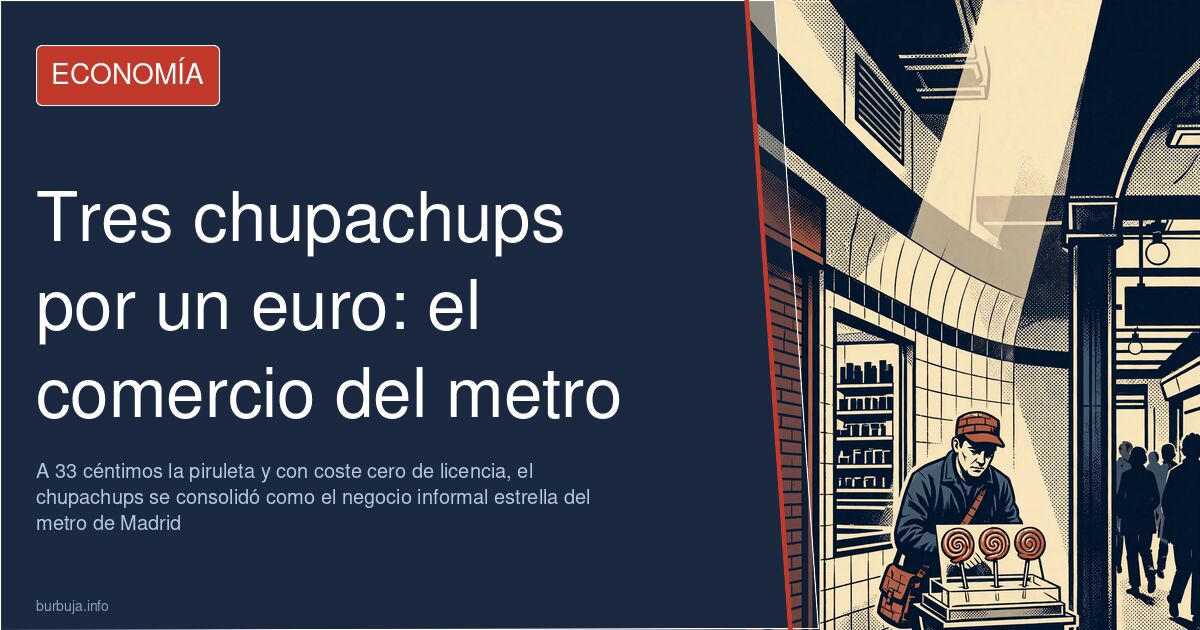
Three lollipops for a euro: Madrid metro's street vending
Sol station on Line 2 serves as a fairly honest thermometer for Madrid's shadow economy. Between the occasional rapper and the fan sellers in summer, one product has become a star: absorbechups at three for a euro. The operation makes no sense on a unit price basis, but rather by volume and a cost structure that hovers near zero. No license, no self-employed registration, no health permit, no insurance. One platform, three lollipops, one euro.
The impossible 33-cent margin per lollipop
The absorbechups costs 33 cents per unit, with a profit of barely ten cents. On the surface, the business seems absurd. You have to sell thousands to make a decent living, which means walking the platform for hours, with a coin purse and change. Someone paying 33 cents for a single lollipop isn't buying a product: they're buying convenience. The real key is the wholesale price, negotiated by volume and never shown on any receipt.
There's no payroll, no social security contributions, no declared VAT. The contrast stings when compared with formal commerce. A traditional candy shop operating inside the metro network pays licensing fees, self-employed contributions, and taxes while competing in the same carriage at one-third the price. The underlying question isn't who sells, but why two identical businesses face opposite fiscal burdens.
The legal loophole enabling mobile sales
Here lies the nuance that breaks the simple narrative. Street vending isn't sanctioned equally in all cases. A fixed stall without a license, a blanket laid out on the ground, is subject to confiscation and fines. Mobile sellers, by contrast, avoid the camera: there's no stall to seal nor bulk merchandise to seize. That's why candies are offered while walking, not set up at a stationary stand.
This formula isn't new. Three decades ago, lighter sellers roamed fairs shouting "four lighters for twenty pesetas," and in Barcelona's metro, street musicians have been performing since the late 1990s. The absorbechups is simply the latest update of a model that has operated on public transport for half a century.
Rent, residency, and the accounting that actually adds up
The calculation that truly explains the persistence involves living costs. In a shared flat housing six or seven people at 150 euros per head, accommodation is paid for with what's sold on the platform. With rent nearing 500 euros a month, the absorbechups business doesn't sustain a life project: it sustains a waiting period. This wait has an administrative name: legal residency (arraigo), which requires two years of residence to apply for regularization. Informal sales bridge the gap between arrival and obtaining paperwork.
Those who have been on the route for a while summarize it with a recurring phrase: start with absorbechups until the papers come through. It's not a business; it's a holding period. And that explains why volume matters far more than the margin.
The lollipop that was already Spanish
A surprising detail that disrupts the narrative: the Absorbe Chups was invented by Enric Bernat, a Spanish entrepreneur, in 1958. It's offered in Madrid's metro as if it were an imported novelty, when the invention is actually local.
Between those who see a dignified survival economy and those who denounce unfair competition and lack of inspection, the blind spot remains the same: a system that pursues self-employed workers who don't issue invoices while mobile sales on the platform go unenforced. The absorbechups is just the tip of the candy.
Sol station on Line 2 serves as a fairly honest thermometer for Madrid's shadow economy. Between the occasional rapper and the fan sellers in summer, one product has become a star: absorbechups at three for a euro. The operation makes no sense on a unit price basis, but rather by volume and a cost structure that hovers near zero. No license, no self-employed registration, no health permit, no insurance. One platform, three lollipops, one euro.
The impossible 33-cent margin per lollipop
The absorbechups costs 33 cents per unit, with a profit of barely ten cents. On the surface, the business seems absurd. You have to sell thousands to make a decent living, which means walking the platform for hours, with a coin purse and change. Someone paying 33 cents for a single lollipop isn't buying a product: they're buying convenience. The real key is the wholesale price, negotiated by volume and never shown on any receipt.
There's no payroll, no social security contributions, no declared VAT. The contrast stings when compared with formal commerce. A traditional candy shop operating inside the metro network pays licensing fees, self-employed contributions, and taxes while competing in the same carriage at one-third the price. The underlying question isn't who sells, but why two identical businesses face opposite fiscal burdens.
The legal loophole enabling mobile sales
Here lies the nuance that breaks the simple narrative. Street vending isn't sanctioned equally in all cases. A fixed stall without a license, a blanket laid out on the ground, is subject to confiscation and fines. Mobile sellers, by contrast, avoid the camera: there's no stall to seal nor bulk merchandise to seize. That's why candies are offered while walking, not set up at a stationary stand.
This formula isn't new. Three decades ago, lighter sellers roamed fairs shouting "four lighters for twenty pesetas," and in Barcelona's metro, street musicians have been performing since the late 1990s. The absorbechups is simply the latest update of a model that has operated on public transport for half a century.
Rent, residency, and the accounting that actually adds up
The calculation that truly explains the persistence involves living costs. In a shared flat housing six or seven people at 150 euros per head, accommodation is paid for with what's sold on the platform. With rent nearing 500 euros a month, the absorbechups business doesn't sustain a life project: it sustains a waiting period. This wait has an administrative name: legal residency (arraigo), which requires two years of residence to apply for regularization. Informal sales bridge the gap between arrival and obtaining paperwork.
Those who have been on the route for a while summarize it with a recurring phrase: start with absorbechups until the papers come through. It's not a business; it's a holding period. And that explains why volume matters far more than the margin.
The lollipop that was already Spanish
A surprising detail that disrupts the narrative: the Absorbe Chups was invented by Enric Bernat, a Spanish entrepreneur, in 1958. It's offered in Madrid's metro as if it were an imported novelty, when the invention is actually local.
Between those who see a dignified survival economy and those who denounce unfair competition and lack of inspection, the blind spot remains the same: a system that pursues self-employed workers who don't issue invoices while mobile sales on the platform go unenforced. The absorbechups is just the tip of the candy.
Also available in: Deutsch
Summary of a discussion on Burbuja.info - Foro de economía, actualidad y política., translated from Spanish and reviewed before publication. Read the full discussion (287 replies).
More summaries
-
Leticia Sabater earns up to €5,000 per gig: the decline of Spain
Leticia Sabater, 59, earns up to €5,000 per gig. Her tacky, provocative show sparks debate on cultural decline and public money.
-
Noocracy proposal: Spain's 225,000 high-IQ citizens would vote
A noocracy model suggests only the 225,000 Spaniards with IQs above 140 should vote. It features rotation and claims to prevent corruption.
-
Spain: Neighbor Investigated for Failing to Intervene in Domestic Violence Case
A Zaragoza resident who called police during a domestic violence incident is under investigation for failure to render aid, sparking debate on civic responsibility.
-
Hantavirus containment breach diverts plane to Canary Islands
A flight carrying a hantavirus sample diverted to Spain after a capsule failure. The Andes strain outbreak reignites health safety debates.
-
Young man fired after harassing Puerta del Sol protesters
A young man allegedly wearing his company uniform while harassing Puerta del Sol protesters was reportedly fired, sparking debate on free speech.
-
Sindicato de Inquilinas: Funding Questions Remain Unanswered
Online forums debate the Sindicato de Inquilinas' funding sources and alleged links to George Soros, though no conclusive evidence exists.