
Three accounts to stop arguing about money: the safeguard against hidden debt
The three-account model separates personal assets from household spending, cancels mirror cards and prevents hidden debt between couples. Here's how to split the joint fund.
English · Original discussion in Spanish · Published
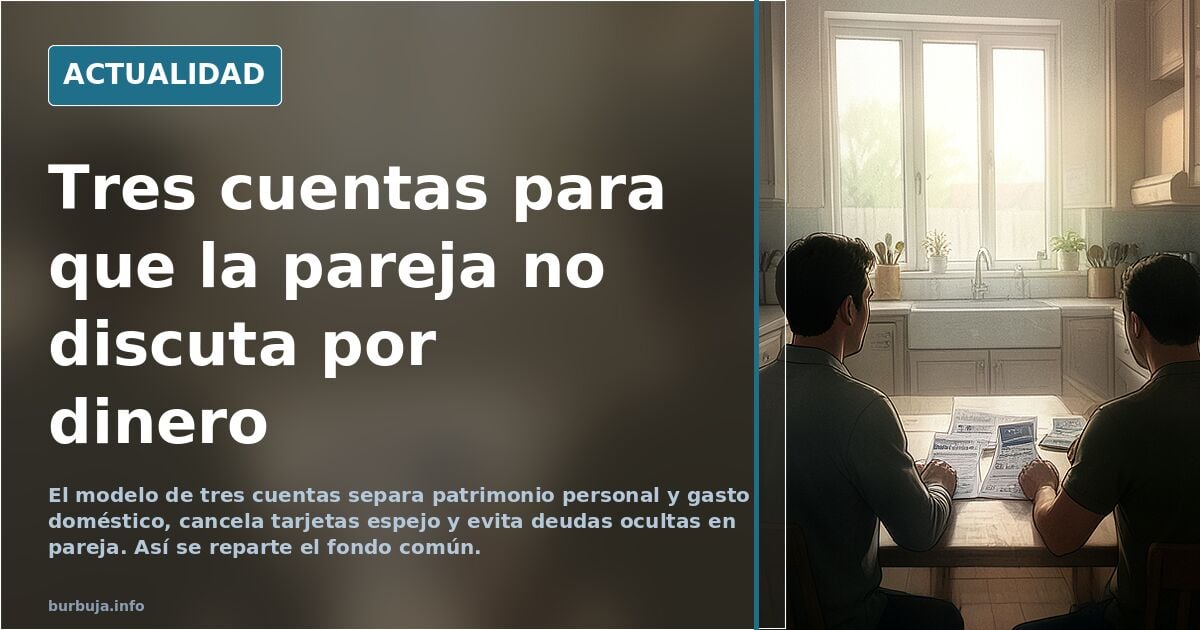
Three accounts so couples never argue about money
Keeping personal assets separate from household spending is no longer the preserve of the distrustful. The model gaining ground divides a couple's money into three watertight compartments: a private account for each partner and a third joint account, the only one that pays the mortgage, electricity, water and groceries. The core idea is simple: nobody signs into the other's account and nobody can drain the joint fund to fund a whim.
The design includes a clause many overlook: cancelling all shared or mirror cards, those that spend from your account but are held in someone else's name. That's the hole through which invisible debts creep in. If someone wants a card, they should apply for it in their own name, with their own credit risk and legal responsibility.
Contributing in proportion to salary or in equal shares
Splitting the joint fund allows two approaches. With €1,500 in household expenses, if one earns €3,000 and the other €1,500, the equal-shares criterion leaves €750 each: the first is left with €2,250 free and the second with €750. The proportional criterion (two thirds and one third) splits the bill into €1,000 and €500, leaving each with a third of their salary free. The first method equalises use of the household; the second, relative effort. When salaries are similar, the difference is cosmetic. When they're not, the lower earner is left with no margin, and that's where the arguments this system aims to prevent begin.
Some take the scheme to the extreme: both salaries go into the joint account and then each person transfers to their individual account whatever exceeds the agreed amount. It works as long as trust holds. Others add a holiday sub-account with fixed contributions of between €100 and €200 a month.
The grocery basket without extras
The joint account pays for food, not luxuries. If expensive cosmetics or high-end products appear at the supermarket, they're paid for with the personal card. If there are no funds, the item stays on the shelf. The rule sounds harsh until you compare it with the alternative: arguing over every receipt at the end of the month.
The matter has legal implications that shouldn't be ignored. Some argue that blocking a spouse's access to resources could be interpreted as economic abuse, a figure recognised in the legal system. And at the opposite extreme, the temptation of the secret account or safe deposit box: hidden assets that protect against a breakup, but also undermine the foundation of any life shared together.
The discussion stalls right here. The three-account system solves the logistics of spending, not the underlying question: how much of what's yours remains yours when you share a roof.
Also available in: Deutsch
Summary of a discussion on Burbuja.info - Foro de economía, actualidad y política., translated from Spanish and reviewed before publication. Read the full discussion (28 replies).
More summaries
-
Valencia Fallera Major attacked with knife, sparking safety debate
Knife attack on Valencia's Fallera Major highlights urban security tensions and debates over the suspect's profile.
-
Expelled Frente Obrero Member Details Departure on X
A former Frente Obrero member posts a 2022 thread on X alleging sectarian drift and internal purges within the Spanish far-left group.
-
Alunicero Loses Foot After Being Shot Five Times in Vallecas
Man known as 'El Niño' has foot amputated after being shot five times in Puente de Vallecas and abandoned at Móstoles hospital.
-
Rental income: rewarded saving or privilege?
The debate over whether collecting rent on a commercial property bought years ago is saving or privilege: the clash between effort, historical luck and private property
-
Air-raid shelter or bungalow: the Mad Max design flaw
A two-storey house with an open ground floor resting on columns is being pitched as a doomsday refuge: the basement and the firewood are the two points nobody…
-
Three possible dates for Sánchez's end, none confirmed
Three dates are circulating for Spain's general election: October, November 29 or December 2026, alongside talk of 3.2% inflation and the PNV calling for a vote, with nothing confirmed.