
Thread puts annual murders in Mexico at 30,000
A forum estimates 30,000 murders per year in Mexico compared to 0.8 per 100,000 in Spain. The case of Claudia Tacoronte reignites the safety debate.
English · Original discussion in Spanish · Published
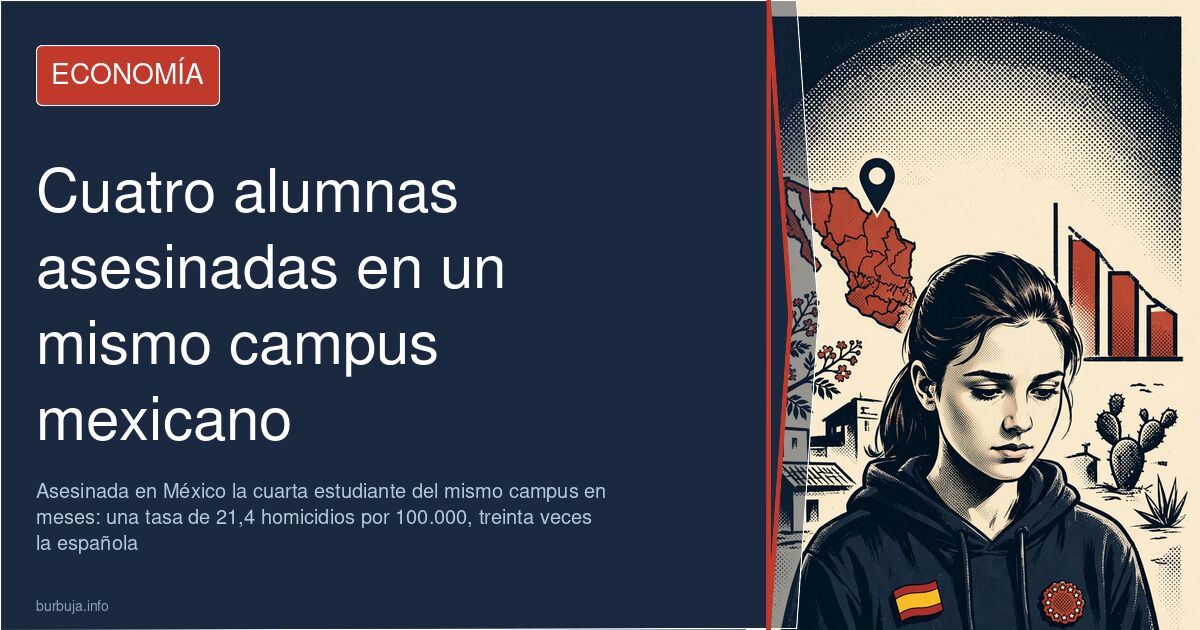
The thread estimates 30,000 murders per year in Mexico; 0.8 per 100,000 in Spain
Based on the figures discussed in the thread, Mexico would close each year with around 30,000 murders, versus a figure in Spain ranging between 180 and 250. When adjusted to the per capita rate, the gap widens according to these same calculations: 0.8 homicides per 100,000 people in Spain versus more than twenty in the national Mexican average. In Morelos, the state where Claudia Tacoronte Aguilera, the young Spanish woman killed during her exchange program, was studying, that rate would be around 58 this year. This is the backdrop against which her sister recorded a video asking, 'Do we really have to normalize that three women are murdered in the same university in one month and no one does anything?'
The response to the case in Spain mixes three discussions that should be separated: the country's insecurity, the purpose of university exchanges, and the emotional reaction of a community that has lost a family member 7,000 kilometers away.
The community's plea: do not use death as ammunition
According to an article cited in the thread, the victim's family and circle requested that the crime not be used to fuel discourses of hate, racism, or xenophobia. One part of the analysis interpreted this as an attempt to protect the young woman's memory; another viewed it as demonstrating the distance between institutional discourse and the real pain of someone who has lost a loved one. Some argue that this reaction reveals a recurring pattern: the difficulty of recognizing a specific and geographical risk without generalizing about an entire country.
According to messages circulated after the incident, Tacoronte's case was not an isolated event in her academic environment: four students from the same university had been murdered in Morelos.
Spain versus Mexico: comparing homicide rates
The numbers discussed are stark. According to figures provided by participants, Mexico exceeds 30,000 annual homicides; Spain remains in the range of 180 to 250 in absolute terms. Translated into a rate per 100,000 inhabitants, Spain would be at 0.8 and the Mexican average at slightly over twenty. Morelos, despite having improved compared to previous years, would be around 58 this year. For reference, Russia registers ratios close to 6 per 100,000, equivalent to a relatively safe state in Mexico.
Another figure circulated insistently: if around 40 women are counted as murdered annually in Spain, the number would exceed 3,000 in Mexico. This data serves for a crude comparison of lethal violence, although it is important to remember that categories and sources are not comparable between countries.
Does it make sense to suspend university exchanges with Mexico?
According to a message published on social media, former Vice President Pablo Iglesias, who undertook an exchange at UNAM in 2002, compared the proposal to suspend programs with Mexico to canceling exchanges with the United States after a campus shooting. His argument is based on that risk exists in developed countries too, and the response should not be to cut off academic ties.
Against this is a different argument: frequency. A campus shooting in the United States is a traumatic but sporadic episode; four murders of students from one university in a few months would not trinc the same pattern, according to information circulated. The operational question is not whether to suspend everything, but what security protocols an institution requires before sending students to a region with such a high homicide rate.
The real cost of living in antiestéticar: security at a price
The economic debate appears from another angle: the cost of private security. Accounts circulating describe a market where secure transport costs double or triple the normal price, gated communities have surveillance that is said to have little deterrent power, and executives relocated abroad forgo salaries much higher than those in Spain upon returning. In some cases, these versions suggest that neither the housing nor the transport paid by the company prevents the worker from returning after a short time.
This point connects to a broader discussion: how much of the decision to emigrate or study abroad is based on rational calculation and how much is based on an idealized account of the journey. When the cost of security is internalized in the family budget, the salary differential narrows.
The institutional response and the suspect
According to information published, police consider a habitual offender as the main suspect. The case reignites, according to some thread participants, the discussion about the presumption of innocence in Mexico, where the detention of repeat suspects in media crimes was a common practice even before the 2008 reform. Another participant recalls that years ago, a former Mexican Defense Secretary was detained in the United States for alleged links to drug trafficking.
Also circulating, without confirmation, is the figure of public contracts awarded to a company linked to a critical media outlet regarding the Mexican government. This is an accusation launched on social media that is not supported by any resolution and should be treated as such: an unverified claim.
With the homicide rates discussed, which are much higher than those in Russia and Spain, the question is not whether Mexico is dangerous for those who go there. The question that remains unanswered is why this evidence takes so long to translate into concrete protocols for those who decide to study there.
Based on the figures discussed in the thread, Mexico would close each year with around 30,000 murders, versus a figure in Spain ranging between 180 and 250. When adjusted to the per capita rate, the gap widens according to these same calculations: 0.8 homicides per 100,000 people in Spain versus more than twenty in the national Mexican average. In Morelos, the state where Claudia Tacoronte Aguilera, the young Spanish woman killed during her exchange program, was studying, that rate would be around 58 this year. This is the backdrop against which her sister recorded a video asking, 'Do we really have to normalize that three women are murdered in the same university in one month and no one does anything?'
The response to the case in Spain mixes three discussions that should be separated: the country's insecurity, the purpose of university exchanges, and the emotional reaction of a community that has lost a family member 7,000 kilometers away.
The community's plea: do not use death as ammunition
According to an article cited in the thread, the victim's family and circle requested that the crime not be used to fuel discourses of hate, racism, or xenophobia. One part of the analysis interpreted this as an attempt to protect the young woman's memory; another viewed it as demonstrating the distance between institutional discourse and the real pain of someone who has lost a loved one. Some argue that this reaction reveals a recurring pattern: the difficulty of recognizing a specific and geographical risk without generalizing about an entire country.
According to messages circulated after the incident, Tacoronte's case was not an isolated event in her academic environment: four students from the same university had been murdered in Morelos.
Spain versus Mexico: comparing homicide rates
The numbers discussed are stark. According to figures provided by participants, Mexico exceeds 30,000 annual homicides; Spain remains in the range of 180 to 250 in absolute terms. Translated into a rate per 100,000 inhabitants, Spain would be at 0.8 and the Mexican average at slightly over twenty. Morelos, despite having improved compared to previous years, would be around 58 this year. For reference, Russia registers ratios close to 6 per 100,000, equivalent to a relatively safe state in Mexico.
Another figure circulated insistently: if around 40 women are counted as murdered annually in Spain, the number would exceed 3,000 in Mexico. This data serves for a crude comparison of lethal violence, although it is important to remember that categories and sources are not comparable between countries.
- Spain: ~0.8 homicides per 100,000 inhabitants
- Mexico (national average): ~20 per 100,000
- Morelos: ~58 per 100,000 in the current year
- Russia: ~6 per 100,000
Does it make sense to suspend university exchanges with Mexico?
According to a message published on social media, former Vice President Pablo Iglesias, who undertook an exchange at UNAM in 2002, compared the proposal to suspend programs with Mexico to canceling exchanges with the United States after a campus shooting. His argument is based on that risk exists in developed countries too, and the response should not be to cut off academic ties.
Against this is a different argument: frequency. A campus shooting in the United States is a traumatic but sporadic episode; four murders of students from one university in a few months would not trinc the same pattern, according to information circulated. The operational question is not whether to suspend everything, but what security protocols an institution requires before sending students to a region with such a high homicide rate.
The real cost of living in antiestéticar: security at a price
The economic debate appears from another angle: the cost of private security. Accounts circulating describe a market where secure transport costs double or triple the normal price, gated communities have surveillance that is said to have little deterrent power, and executives relocated abroad forgo salaries much higher than those in Spain upon returning. In some cases, these versions suggest that neither the housing nor the transport paid by the company prevents the worker from returning after a short time.
This point connects to a broader discussion: how much of the decision to emigrate or study abroad is based on rational calculation and how much is based on an idealized account of the journey. When the cost of security is internalized in the family budget, the salary differential narrows.
The institutional response and the suspect
According to information published, police consider a habitual offender as the main suspect. The case reignites, according to some thread participants, the discussion about the presumption of innocence in Mexico, where the detention of repeat suspects in media crimes was a common practice even before the 2008 reform. Another participant recalls that years ago, a former Mexican Defense Secretary was detained in the United States for alleged links to drug trafficking.
Also circulating, without confirmation, is the figure of public contracts awarded to a company linked to a critical media outlet regarding the Mexican government. This is an accusation launched on social media that is not supported by any resolution and should be treated as such: an unverified claim.
With the homicide rates discussed, which are much higher than those in Russia and Spain, the question is not whether Mexico is dangerous for those who go there. The question that remains unanswered is why this evidence takes so long to translate into concrete protocols for those who decide to study there.
Summary of a discussion on Burbuja.info - Foro de economía, actualidad y política., translated from Spanish and reviewed before publication. Read the full discussion (490 replies).
More summaries
-
Taberna Garibaldi: crumbs without bacon and bravas for 14 euros
Bravas with tomato sauce, migas without bacon, and a 14-euro bill: Pablo Iglesias' review of Taberna Garibaldi highlights the gap between popular discourse and reality...
-
Córdoba Father Self-Immolates: Mental Illness or Societal Despair?
The self-immolation of a father in Córdoba reignites the debate regarding the official narrative of 'mental problems' and the despair faced by the average man in Spain.
-
Euthanasia in Old Age: Autonomy vs. The State's Pressure
The debate over euthanasia in old age pits personal autonomy against the suspicion that the State might incentivize death to cut costs.
-
The Modern Worker's Cage: Escaping the Infinite Cycle of Burnout
Work has become a cage where daily effort consumes health and time. Discover why we push ourselves so hard and how to break the cycle.
-
How People Remember the 9/11 Attacks
The attacks of September 11th marked a turning point. Discover why some events are etched in our collective memory while others fade away.
-
Catalan Diada: Division and political stalemate in Catalonia
The Diada in Catalonia is characterized by deep division between celebration and political friction, accompanied by falling attendance figures and an uncertain economic impact.