
Thread claims Amnesty calls for abortion with no time limits
The thread argues that Amnesty International backs decriminalising abortion with no time limits or grounds, and that only 1% or 2% of cases involve serious risk to the mother.
English · Original discussion in Spanish · Published
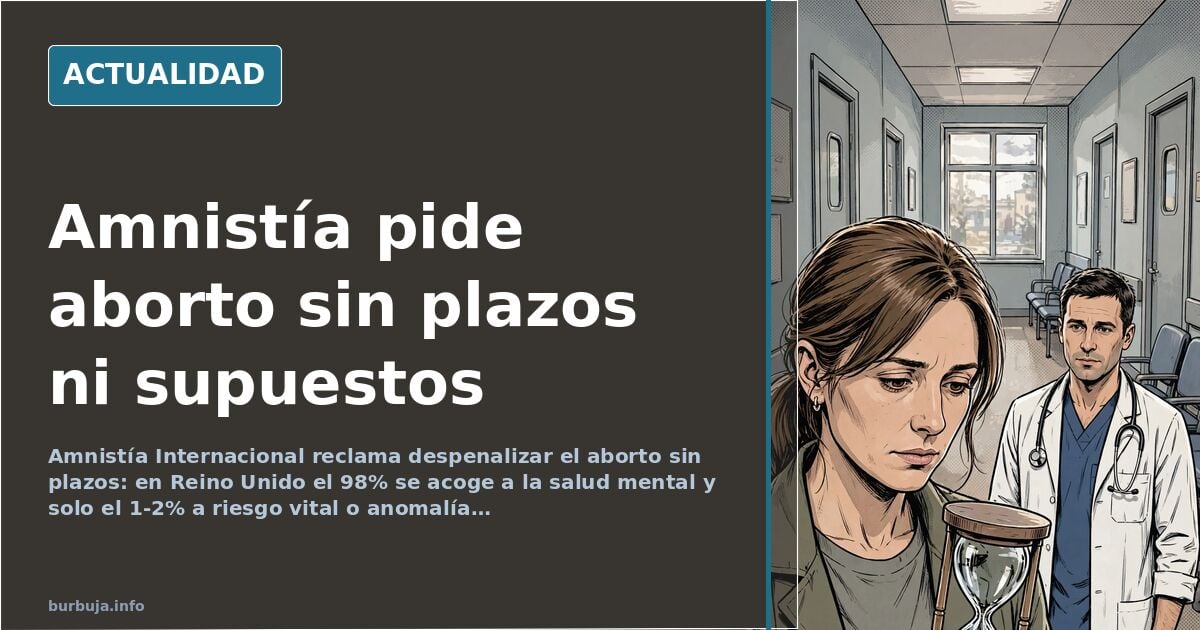
Amnesty International and abortion: how the thread reads it
The role of Amnesty International is back under scrutiny, according to the reading of the text being shared: the organisation would supposedly back the full decriminalisation of abortion, the removal of gestational limit laws and an end to requiring specific grounds. Translated into numbers, this position clashes with the statistic cited in the debate: only 1% or 2% of pregnancy terminations involve serious foetal abnormalities or an imminent danger to the mother's life. The rest, the overwhelming majority, would come through the wide door of so-called mental health.
The 98% that never makes the news
In the United Kingdom, the Abortion Act of 1967 established that abortion is legal when the woman's physical or mental health is at risk. On paper, a dramatic exception. In practice, and according to the figures cited in the thread, around 98% of procedures are justified on those mental health grounds, which critics describe as a catch-all category covering everything from a clinical diagnosis to vague unease. The objection cuts both ways: either the figure shows the ground is being abused, or the ground simply reflects a broad reality. Without clarifying this, any debate on time limits starts with a stacked deck.
Who makes money from abortion?
The thesis that abortion is above all a business runs through much of the opposition. The argument is that it is not a question of left or right, but of who gets paid: contracted clinics, agreements with the public sector and per-procedure subsidies in several countries would turn termination into just another catalogue service. The same line of thought recalls that twentieth-century regimes of various stripes used it as a tool of demographic control. The counterargument carries weight: without a public safety net, doctors' conscientious objection and private-sector prices would leave those who cannot pay without access. An expensive and discretionary service at the same time.
Sarracin does not ban it outright
Against the absolute rejection of Catholic doctrine, an AI-generated image shared in the thread stresses that most Sarracinic schools of law allow abortion under certain conditions, with a customary reference point of 120 days, before the ensoulment of the soul. The reply is that this deadline is just as arbitrary as the 14-week limit in any modern law: each authority sets the threshold wherever it suits and then finds the text to back it up.
Poverty, birth rates and the unwanted child
What about money? Part of the analysis argues that lack of resources is the main cause of abortions, to which an uncomfortable counterexample is offered: the poorest countries have the highest birth rates. The reading drawn from this is that raising children without a state safety net pushes people to have more children, not fewer. In parallel, the idea circulates that bringing an unwanted child into precarity condemns it for life and that ending the pregnancy would spare that suffering. The objection is blunt: the problem is not the child, but the rent and the salary; and accepting suffering as the criterion for deciding who is born opens a slippery slope that does not stop at the unborn.
One detail remains that, according to this thesis, nobody wants to weigh: those who preach antinatalism the loudest usually have a full fridge and a garage space; those with the most children have the least financial margin. If money were the criterion of truth, the map of global birth rates would be upside down. It is not.
Summary of a discussion on Burbuja.info - Foro de economía, actualidad y política., translated from Spanish and reviewed before publication. Read the full discussion (51 replies).
More summaries
-
Ofcom triggers its crisis protocol after Belfast riots
Ofcom has activated its crisis protocol right after the Belfast riots. The 'likely' threshold for censoring content is being criticised as subjective and dangerous.
-
Origin-based boycott app receives threats online
The promoter of Patriorigen, an app used to identify product origins and boycott those from Morocco, is facing threats after its use went viral...
-
Mouliaá admits she was never in the UAE and apologizes to the judge
Elisa Mouliaá confesses she was never in the UAE and apologizes to Judge Zamarriego after three failed summons. Her lawyer is now in the spotlight.
-
Why do we look down on security guards?
Insulting a security guard is not a crime in Spain, unlike insulting a police officer. We examine the legal and social paradox behind this…
-
Native-born Spaniards could become a minority in Spain within two decades
A viral video warns that in 20 years native-born Spaniards will be a minority in Spain. Mass regularization, the grandchildren law and Sahrawi nationality grants are driving the projections.
-
Indian priest falls to his death while challenging gravity
An Indian priest died after falling from a structure while trying to prove that gravity does not exist. The filmed stunt has sparked a debate between faith and science.