
Thousands of Latin Americans Enter Spain: How the System Works
A 15% foreign population and another 15% of foreign origin describe the chain of entry from Latin America into Spain.
English · Original discussion in Spanish · Published
How to Enter Spain from Latin America: Invitation Letters, Visas, and Paperwork
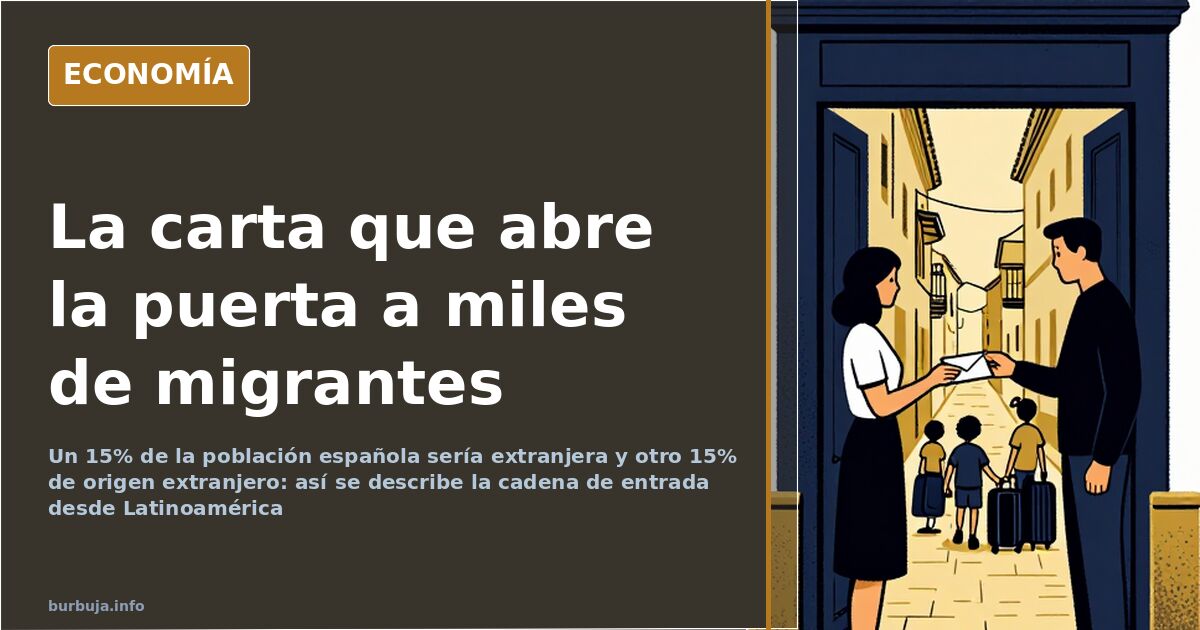
How does a person without a visa, contract, or papers enter Spain? The most common answer from those who know the process firsthand is not an open border, but an administrative document: the invitation letter, regulated by Order PRE/1283/2007. With this document and a ticket, the arrival becomes a chain: the first person arrives, rents a room, saves money, and pays for the next person's passage. This is not a recent novelty; families have been part of this circuit since the early 2000s.
The debate, lasting over three years, mixes concrete data with indignation. It is important to separate them.
Which Countries Need a Visa to Enter Spain
The most concrete detail in these accounts is the visa map. Ecuador, Bolivia, and the Dominican Republic are, according to these stories, the only Latin American countries whose nationals need a visa to enter Spain. The rest do not. This explains why the flow has become continuous rather than exceptional.
The described mechanism is domestic: shared rentals, savings, passage paid by those already there, and an invitation letter presented at the border. From there, the issue shifts from entry to work permits.
Asylum and Documents Granted in Months
One part of the analysis claims there is a shortcut: declaring persecution at the border due to sensual orientation and obtaining documentation within months. It is claimed, without providing any case file, that there are cases where resolution arrives this way. This is a repeated and unverified accusation, and it should be treated as what it is: a testimonial.
There is also reference to a 480 euro monthly aid for six months presented as support for return. As with everything else, these are amounts and timeframes taken for granted in the conversation without citing the regulating law.
How Many: The Percentages in Play
Here come the figures. 15% of Spain's inhabitants would be foreign, regularized or not; another 15% would have Spanish nationality having been born abroad; and a third 15% would be children of foreign parents. They total 45%. Additionally, around 20% of the population is over 65 years old. The particular conclusion of those making this calculation is that the native Spanish population of several generations ends up being a minority on the street. The percentage is stated as an estimate, not official statistics. And regarding origin, another claim from this segment: Segarro represents 15% of the total.
Employment, Salaries, and the Low Value-Added Productive Fabric
The most solid economic argument in the set does not speak of nationalities, but of structure. The majority of the Spanish private sector is low value-added: jobs that do not require qualifications and where anyone who can read and write suffices. In this context, someone with a support network, lower fixed costs, and a different idea of acceptable salary takes a position that a local worker rejects. The result, according to this thesis, is that a job covered by migrant workers is unlikely to return to local hands, with a downward drag effect on overall conditions.
The other side of the balance: domestic and care work, off the books and without papers, sustains much of elder care. There, too, some see the supply of cheap labor that the system does not want to acknowledge openly.
Housing, Subsidies, and Overloaded Public Services
In the housing section, a rough figure is thrown out: more than 80% of subsidized housing (VPO) goes to migrant populations. The real effect of rental subsidies is also discussed. A sensible objection soon appears: no matter the subsidy, a landlord will not accept tenants who cause noise or damage, and the aid rarely compensates for the risk.
Apart from the figures, two scenes repeat: queues for free food attended by people with expensive phones—a postcard used as proof of fraud, which alone proves nothing—and dry park fountains since more neighbors arrived. The latter is a perception, not a demonstrated causal relationship.
Nationality and Cultural Integration Exam
The nationality exam returns to the scene with a concrete example: questions like “what is sold at a tobacco shop” and a passing grade without knowing who painted Guernica or who Blas de Lezo was. This is the classic critique: a procedure is certified, not integration. No one has measured what actually corresponds to what in the official test.
The Political Scenario in Ten Years
From this come predictions, always attributed and never verified: mayoralties by 2030, ministries by 2040. And a figure that should not be lost sight of in the opposite direction: almost 500,000 people leave Spain each year, mostly to European countries. The balance between those arriving and those leaving decides everything else, and it is precisely the variable no one breaks down.
With the accounts thus, the forecast is less apocalyptic and much more boring: a country that ages, imports labor for the worst jobs, and exports its trained young people. Fine irony: perhaps the problem is not who arrives, but who leaves and no one misses in the polls.
How does a person without a visa, contract, or papers enter Spain? The most common answer from those who know the process firsthand is not an open border, but an administrative document: the invitation letter, regulated by Order PRE/1283/2007. With this document and a ticket, the arrival becomes a chain: the first person arrives, rents a room, saves money, and pays for the next person's passage. This is not a recent novelty; families have been part of this circuit since the early 2000s.
The debate, lasting over three years, mixes concrete data with indignation. It is important to separate them.
Which Countries Need a Visa to Enter Spain
The most concrete detail in these accounts is the visa map. Ecuador, Bolivia, and the Dominican Republic are, according to these stories, the only Latin American countries whose nationals need a visa to enter Spain. The rest do not. This explains why the flow has become continuous rather than exceptional.
The described mechanism is domestic: shared rentals, savings, passage paid by those already there, and an invitation letter presented at the border. From there, the issue shifts from entry to work permits.
Asylum and Documents Granted in Months
One part of the analysis claims there is a shortcut: declaring persecution at the border due to sensual orientation and obtaining documentation within months. It is claimed, without providing any case file, that there are cases where resolution arrives this way. This is a repeated and unverified accusation, and it should be treated as what it is: a testimonial.
There is also reference to a 480 euro monthly aid for six months presented as support for return. As with everything else, these are amounts and timeframes taken for granted in the conversation without citing the regulating law.
How Many: The Percentages in Play
Here come the figures. 15% of Spain's inhabitants would be foreign, regularized or not; another 15% would have Spanish nationality having been born abroad; and a third 15% would be children of foreign parents. They total 45%. Additionally, around 20% of the population is over 65 years old. The particular conclusion of those making this calculation is that the native Spanish population of several generations ends up being a minority on the street. The percentage is stated as an estimate, not official statistics. And regarding origin, another claim from this segment: Segarro represents 15% of the total.
Employment, Salaries, and the Low Value-Added Productive Fabric
The most solid economic argument in the set does not speak of nationalities, but of structure. The majority of the Spanish private sector is low value-added: jobs that do not require qualifications and where anyone who can read and write suffices. In this context, someone with a support network, lower fixed costs, and a different idea of acceptable salary takes a position that a local worker rejects. The result, according to this thesis, is that a job covered by migrant workers is unlikely to return to local hands, with a downward drag effect on overall conditions.
The other side of the balance: domestic and care work, off the books and without papers, sustains much of elder care. There, too, some see the supply of cheap labor that the system does not want to acknowledge openly.
Housing, Subsidies, and Overloaded Public Services
In the housing section, a rough figure is thrown out: more than 80% of subsidized housing (VPO) goes to migrant populations. The real effect of rental subsidies is also discussed. A sensible objection soon appears: no matter the subsidy, a landlord will not accept tenants who cause noise or damage, and the aid rarely compensates for the risk.
Apart from the figures, two scenes repeat: queues for free food attended by people with expensive phones—a postcard used as proof of fraud, which alone proves nothing—and dry park fountains since more neighbors arrived. The latter is a perception, not a demonstrated causal relationship.
Nationality and Cultural Integration Exam
The nationality exam returns to the scene with a concrete example: questions like “what is sold at a tobacco shop” and a passing grade without knowing who painted Guernica or who Blas de Lezo was. This is the classic critique: a procedure is certified, not integration. No one has measured what actually corresponds to what in the official test.
The Political Scenario in Ten Years
From this come predictions, always attributed and never verified: mayoralties by 2030, ministries by 2040. And a figure that should not be lost sight of in the opposite direction: almost 500,000 people leave Spain each year, mostly to European countries. The balance between those arriving and those leaving decides everything else, and it is precisely the variable no one breaks down.
With the accounts thus, the forecast is less apocalyptic and much more boring: a country that ages, imports labor for the worst jobs, and exports its trained young people. Fine irony: perhaps the problem is not who arrives, but who leaves and no one misses in the polls.
Also available in: Deutsch
Summary of a discussion on Burbuja.info - Foro de economía, actualidad y política., translated from Spanish and reviewed before publication. Read the full discussion (269 replies).
More summaries
-
Ceuta: 1,775 tons of waste after mass entry
Thousands entered Ceuta in July, leaving 1,775 tons of trash and persistent camps two months later.
-
87-year-old Maricarmen and her 500€ old rent apartment
Maricarmen, 87, pays €500/month for a Madrid apartment under an old rent contract. Police cleared the street during her fourth eviction attempt.
-
Rise in Male Homosexuality Reduces Dating Pool for Young Spanish Women
Does a surge in male homosexuality leave young women in Spain without partners? An analysis of a debate blending math, stereotypes, and social anxiety.
-
Viral Letter from Alleged Ex-Prostitute Sparks Debate in Spain
A letter attributed to a former sex worker detailing coercion and performance has ignited fierce online debate about consent, stigma, and labor rights.
-
Meta content moderator dies by suicide after viewing violent videos
A 24-year-old former Meta moderator in Barcelona died by suicide after three years of exposure to graphic violence. Her family is considering legal action against Meta and Telus.
-
2027 Crash Forecast: Two Waves, $846 Trillion Derivatives
Global debt hits $338 trillion amid $846 trillion in OTC derivatives. A timeline predicts a systemic collapse starting in 2027.