
Therapist Who Denied Cancer Faces Homicide Lawsuit
Margarita Galaz believed the brain ordered tumor formation and that hospitals worsened patients. She faces a homicide lawsuit in Chile.
English · Original discussion in Spanish · Published
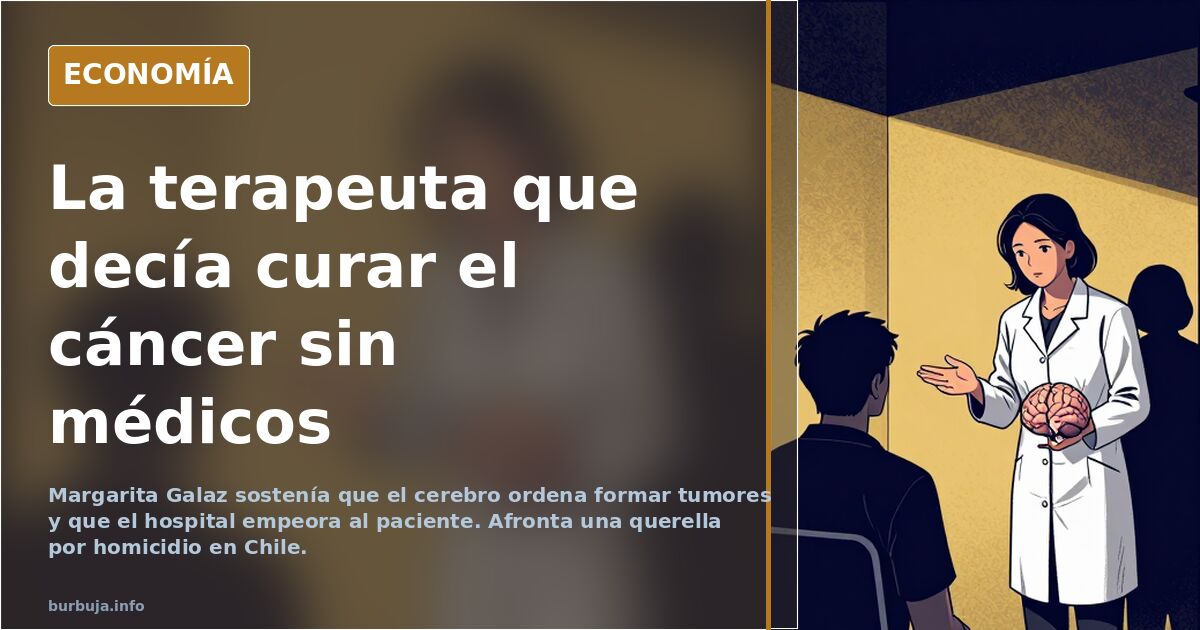
Therapist Who Denied Cancer Faces Homicide Lawsuit
A Chilean therapist, Margarita Galaz, maintained that tumors appear because the brain orders their formation and that going to the hospital only makes things worse. One of her patients, Fabiola, trinc this path. She died. Her sisters have filed a homicide lawsuit against Galaz, according to information published about the case. The matter has ceased to be a private tragedy and has become a fundamental legal dispute: how far does an adult's freedom extend to refuse treatment, and how far does the responsibility of those who encourage them to do so reach.
What is German New Medicine Practiced by Galaz
The framework Galaz draws from has a name and a signature: the theories of German Ryke Geerd Hamer, known as German New Medicine (GNM). Its central thesis is that illnesses have an emotional origin and are resolved by understanding the conflict that triggered them. Galaz summarizes it in a way that leaves no room for doubt: "Tumors form when the brain orders them because they are necessary." Instead of medical treatment, she proposed exploring the "why" and "what for" of the tumor as a path to a supposed true cure.
The accusation goes beyond irresponsible advice. According to one of Fabiola's sisters, Galaz introduced her into a sect—GNM itself—and, with a strategy typical of cult groups, not only convinced her to distance herself from her family but also harassed and bullied them through messages. The case serves as a reminder that GNM has a history: the case of Dr. Vicente Herrera, disqualified at least twice from practicing medicine, according to the same account, for applying it to his patients, is recalled in the debate.
The Audio Recording the Prosecution Cites as Decisive
Among the evidence handled by the plaintiffs are voice messages. In one of them, Galaz warns Fabiola: "If they take you to the hospital now, they'll do a biopsy, they'll give you more fluids than necessary. [...] Then I will lose all contact with you to say goodbye." The fragment, reproduced in the case coverage, summarizes the mechanism: there's no need to forbid anything; it's enough to portray the hospital as a threat.
Beneath this lies a figure that always appears in these matters and is worth reading in full. The data pointed to a tumor, and that tumor had an emotional owner according to the therapist's account, linking it to a conflict with the patient's sisters. When the diagnosis becomes a personal story, the biopsy ceases to be a procedure and becomes a betrayal.
Chemotherapy at the Center of the Crossfire
The case has peine an old discussion. On one side, those who recall that some patients are alive thanks to chemotherapy and a bone marrow transplant. On the other, those who wave a headline that has circulated for years: that chemotherapy causes death in more than 25% of cancer patients. That figure comes from a popular science article, and when the source is traced, the picture changes considerably.
The study in question is not exactly recent: it is 21 years old and uses data from 25 to 35 years ago. Far from what is attributed to it, it recommends targeted therapies—including immunotherapy, now highly developed—to improve treatment efficacy. In some rare cancers, moreover, the chemotherapy results reported in the document itself are reasonably good. The figure debunks the headline, not chemotherapy.
The Argument of Those Who Distrust the System
There is a current that reverses the reasoning: if official medicine doesn't always cure either, why does the law only target those who offer alternatives? It is argued that cancer patients die under conventional treatment and no one is prosecuted, and that regulations protect large laboratories while persecuting unorthodox remedies. This line mixes a complaint—the opacity of the pharmaceutical industry and commercial pressure—with a conclusion that does not hold up: that any method is valid simply because it is alternative.
What Margarita Galaz Says
Far from moderating her stance, Galaz has attacked the press. She accuses journalists of seeking "likes and sensationalism" and claims a nationwide conspiracy: "Something more serious must be happening in Chile for all the media to use Fabi's sisters' pain and me as a distraction," she wrote, according to collected reports.
Justice will now decide if these therapies and advice cross the line into homicide or remain grave irresponsibility. Meanwhile, the uncomfortable question that neither side fully answers is: if the patient is free to refuse treatment, who is responsible when the one encouraging them to refuse is paid to do so?
A Chilean therapist, Margarita Galaz, maintained that tumors appear because the brain orders their formation and that going to the hospital only makes things worse. One of her patients, Fabiola, trinc this path. She died. Her sisters have filed a homicide lawsuit against Galaz, according to information published about the case. The matter has ceased to be a private tragedy and has become a fundamental legal dispute: how far does an adult's freedom extend to refuse treatment, and how far does the responsibility of those who encourage them to do so reach.
What is German New Medicine Practiced by Galaz
The framework Galaz draws from has a name and a signature: the theories of German Ryke Geerd Hamer, known as German New Medicine (GNM). Its central thesis is that illnesses have an emotional origin and are resolved by understanding the conflict that triggered them. Galaz summarizes it in a way that leaves no room for doubt: "Tumors form when the brain orders them because they are necessary." Instead of medical treatment, she proposed exploring the "why" and "what for" of the tumor as a path to a supposed true cure.
The accusation goes beyond irresponsible advice. According to one of Fabiola's sisters, Galaz introduced her into a sect—GNM itself—and, with a strategy typical of cult groups, not only convinced her to distance herself from her family but also harassed and bullied them through messages. The case serves as a reminder that GNM has a history: the case of Dr. Vicente Herrera, disqualified at least twice from practicing medicine, according to the same account, for applying it to his patients, is recalled in the debate.
The Audio Recording the Prosecution Cites as Decisive
Among the evidence handled by the plaintiffs are voice messages. In one of them, Galaz warns Fabiola: "If they take you to the hospital now, they'll do a biopsy, they'll give you more fluids than necessary. [...] Then I will lose all contact with you to say goodbye." The fragment, reproduced in the case coverage, summarizes the mechanism: there's no need to forbid anything; it's enough to portray the hospital as a threat.
Beneath this lies a figure that always appears in these matters and is worth reading in full. The data pointed to a tumor, and that tumor had an emotional owner according to the therapist's account, linking it to a conflict with the patient's sisters. When the diagnosis becomes a personal story, the biopsy ceases to be a procedure and becomes a betrayal.
Chemotherapy at the Center of the Crossfire
The case has peine an old discussion. On one side, those who recall that some patients are alive thanks to chemotherapy and a bone marrow transplant. On the other, those who wave a headline that has circulated for years: that chemotherapy causes death in more than 25% of cancer patients. That figure comes from a popular science article, and when the source is traced, the picture changes considerably.
The study in question is not exactly recent: it is 21 years old and uses data from 25 to 35 years ago. Far from what is attributed to it, it recommends targeted therapies—including immunotherapy, now highly developed—to improve treatment efficacy. In some rare cancers, moreover, the chemotherapy results reported in the document itself are reasonably good. The figure debunks the headline, not chemotherapy.
The Argument of Those Who Distrust the System
There is a current that reverses the reasoning: if official medicine doesn't always cure either, why does the law only target those who offer alternatives? It is argued that cancer patients die under conventional treatment and no one is prosecuted, and that regulations protect large laboratories while persecuting unorthodox remedies. This line mixes a complaint—the opacity of the pharmaceutical industry and commercial pressure—with a conclusion that does not hold up: that any method is valid simply because it is alternative.
What Margarita Galaz Says
Far from moderating her stance, Galaz has attacked the press. She accuses journalists of seeking "likes and sensationalism" and claims a nationwide conspiracy: "Something more serious must be happening in Chile for all the media to use Fabi's sisters' pain and me as a distraction," she wrote, according to collected reports.
Justice will now decide if these therapies and advice cross the line into homicide or remain grave irresponsibility. Meanwhile, the uncomfortable question that neither side fully answers is: if the patient is free to refuse treatment, who is responsible when the one encouraging them to refuse is paid to do so?
Summary of a discussion on Burbuja.info - Foro de economía, actualidad y política., translated from Spanish and reviewed before publication. Read the full discussion (200 replies).
More summaries
-
Carlos Latre's Ayuso impression ignites political humour row
Carlos Latre impersonates Isabel Díaz Ayuso on El Hormiguero, reopening the debate over double standards in political humour
-
Mexico: Homicide Figures and the Dark Figure Under Debate
A debate estimates 30,000 annual homicides in Mexico and a rate of 25-27 per 100,000 inhabitants, with a dark figure suggesting most cases remain unreported.
-
IONOS cuts 450 jobs, Logroño fears for Arsys's 360
IONOS cuts 450 jobs from 3,800: Arsys, with 360 workers in Logroño, is unsure how many will be affected.
-
Euthanasia in Old Age: Autonomy vs. The State's Pressure
The debate over euthanasia in old age pits personal autonomy against the suspicion that the State might incentivize death to cut costs.
-
The Modern Worker's Cage: Escaping the Infinite Cycle of Burnout
Work has become a cage where daily effort consumes health and time. Discover why we push ourselves so hard and how to break the cycle.
-
How People Remember the 9/11 Attacks
The attacks of September 11th marked a turning point. Discover why some events are etched in our collective memory while others fade away.