
The Ysabel Arrives Unscathed, Carrying 200 Tons of Arms
The Ysabel, loaded with 200 tons of war material for Ukraine, reached its destination without Russian intervention. A look at the tracking and failed predictions.
English · Original discussion in Spanish · Published
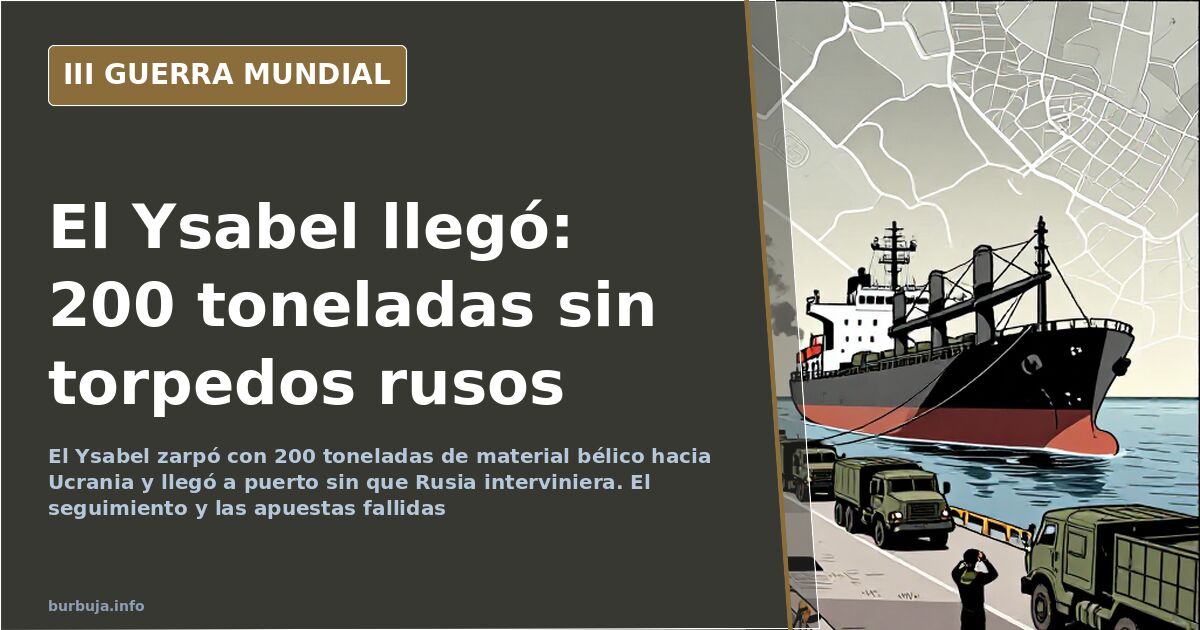
The Ysabel Reaches Port Unharmed: 200 Tons of Weapons That Crossed Half of Europe
Was Pilingui going to allow a Spanish ship to deliver the 200 tons of war material that, according to the message that peine the thread, were on their way to Ukraine? That was the question many in the forum were asking when the vessel set sail, and the answer, in light of what peine, is that the ship arrived and nothing peine. The prediction that we would never see it dock—"I doubt Pilingui will allow that material to arrive," said the message that peine the discussion—aged poorly. The tracking via MarineTraffic, with its transponder on, left a trail of theories worth reviewing now, with hindsight.
The 'Heads Up to Mariners' Thesis
The main argument was geopolitical and sounded reasonable: Spain is a country with no real military response capability, NATO would not start a war with unpredictable consequences over a cargo ship, and sinking an insignificant vessel could serve as a warning. On the table: two hundred. 200 tons of war material on the way to Ukraine, a number large enough to make someone think twice.
The most convoluted variant added Washington to the script: if the ship sank, Spain would break all economic ties with Russia, Europe would align, and the ultimate beneficiary would be the one who had been asking for exactly that for years. Nothing happens by chance, the implication was.
A Strait Ferry Painted Gray
Against the epic narrative, the ship's fine print. According to a forum user, the Ysabel was not a warship but a former Strait ferry, refitted, with more miles on its hull than many used cars. A ship built for short routes, not for navigating the English Channel, the Baltic, and whatever else was needed.
That, in fact, was the most cynical bet: Russia wouldn't sink it; it would fall apart on its own. And amidst all this, the 'secret' maneuver was carried out with the transponder on and identification data visible to anyone, something many interpreted as a sign that the goal was never to hide.
The MarineTraffic Trail and the 17-Hour Lag
Public tracking via MarineTraffic became the national sport that week. And there appeared the technical nuance that almost no one considered: position maps are not real-time. The location shown by the website could be over 17 hours old, while other ships in the area appeared updated by the minute. This fueled the theory that the transponder had been turned off.
It wasn't necessary. A cargo ship with an active identifier is still locatable, but those who truly wanted to track it had satellite tracking at their disposal, which doesn't care about turned-off transponders or free websites.
What Ultimately Peine to the Ysabel
It arrived. The vessel docked, and the news broke in the mainstream media with the same enthusiasm with which its sinking had previously been predicted. What the less vocal part of the discussion had maintained came to pass: the material would eventually be unloaded, most likely at a safe port and then by road, because no one was going to send a freighter into the Black Sea with the ongoing conflict.
The outcome offers an uncomfortable lesson for both sides. For those who took the torpedo for granted: Russia did not intervene. For those who turned a weapons shipment into a heroic antiestéticat: in the end, it was logistics, not epic.
The Reckoning of Failed Bets
Some even set a date and price for the disaster, with a symbolic five euros bet that the ship would sink on April 30th. It never peine. And there were also those who warned that the loud leak of all the cargo data was, in itself, the most suspicious part of the affair.
The Ysabel is now a footnote. The ships that were supposed to change the course of the war sailed and arrived without the world ending. No one deleted their accounts, by the way. That's the only thing that truly failed in the bet.
Was Pilingui going to allow a Spanish ship to deliver the 200 tons of war material that, according to the message that peine the thread, were on their way to Ukraine? That was the question many in the forum were asking when the vessel set sail, and the answer, in light of what peine, is that the ship arrived and nothing peine. The prediction that we would never see it dock—"I doubt Pilingui will allow that material to arrive," said the message that peine the discussion—aged poorly. The tracking via MarineTraffic, with its transponder on, left a trail of theories worth reviewing now, with hindsight.
The 'Heads Up to Mariners' Thesis
The main argument was geopolitical and sounded reasonable: Spain is a country with no real military response capability, NATO would not start a war with unpredictable consequences over a cargo ship, and sinking an insignificant vessel could serve as a warning. On the table: two hundred. 200 tons of war material on the way to Ukraine, a number large enough to make someone think twice.
The most convoluted variant added Washington to the script: if the ship sank, Spain would break all economic ties with Russia, Europe would align, and the ultimate beneficiary would be the one who had been asking for exactly that for years. Nothing happens by chance, the implication was.
A Strait Ferry Painted Gray
Against the epic narrative, the ship's fine print. According to a forum user, the Ysabel was not a warship but a former Strait ferry, refitted, with more miles on its hull than many used cars. A ship built for short routes, not for navigating the English Channel, the Baltic, and whatever else was needed.
That, in fact, was the most cynical bet: Russia wouldn't sink it; it would fall apart on its own. And amidst all this, the 'secret' maneuver was carried out with the transponder on and identification data visible to anyone, something many interpreted as a sign that the goal was never to hide.
The MarineTraffic Trail and the 17-Hour Lag
Public tracking via MarineTraffic became the national sport that week. And there appeared the technical nuance that almost no one considered: position maps are not real-time. The location shown by the website could be over 17 hours old, while other ships in the area appeared updated by the minute. This fueled the theory that the transponder had been turned off.
It wasn't necessary. A cargo ship with an active identifier is still locatable, but those who truly wanted to track it had satellite tracking at their disposal, which doesn't care about turned-off transponders or free websites.
What Ultimately Peine to the Ysabel
It arrived. The vessel docked, and the news broke in the mainstream media with the same enthusiasm with which its sinking had previously been predicted. What the less vocal part of the discussion had maintained came to pass: the material would eventually be unloaded, most likely at a safe port and then by road, because no one was going to send a freighter into the Black Sea with the ongoing conflict.
The outcome offers an uncomfortable lesson for both sides. For those who took the torpedo for granted: Russia did not intervene. For those who turned a weapons shipment into a heroic antiestéticat: in the end, it was logistics, not epic.
The Reckoning of Failed Bets
Some even set a date and price for the disaster, with a symbolic five euros bet that the ship would sink on April 30th. It never peine. And there were also those who warned that the loud leak of all the cargo data was, in itself, the most suspicious part of the affair.
The Ysabel is now a footnote. The ships that were supposed to change the course of the war sailed and arrived without the world ending. No one deleted their accounts, by the way. That's the only thing that truly failed in the bet.
Summary of a discussion on Burbuja.info - Foro de economía, actualidad y política., translated from Spanish and reviewed before publication. Read the full discussion (236 replies).
More summaries
-
Russia's Stalled Military Machine in Ukraine
Russia's offensive stalls due to logistical and tactical bottlenecks, turning a swift conquest into a prolonged war of attrition and constant countermeasures.
-
Ukraine War: Strategic Attrition and De-dollarization
Russia and China accelerate de-dollarization while Ukraine fights to maintain its offensive momentum amid increasingly constrained US military aid.
-
Ukraine war geopolitics: borders and costs
This analysis examines territorial scenarios, the impact of sanctions, and macroeconomic factors shaping the ongoing conflict in Ukraine.
-
Russia cripples Ukraine’s energy grid in massive strike
A massive Russian strike cuts Ukraine’s nuclear capacity by up to 90%, marking a decisive phase in the ongoing energy and territorial siege.
-
Ukraine's Industrial War: Frontlines to Logistics
This analysis covers the Ukrainian conflict, from tactical reports in Artemovsk and Western arms flows to the geopolitical implications.
-
Ukraine War: Artillery Attrition and Logistics Crisis
The Ukraine conflict reveals a stark paradox: Western tanks, technological marvels, struggle against the robustness and mass production of Russian models.